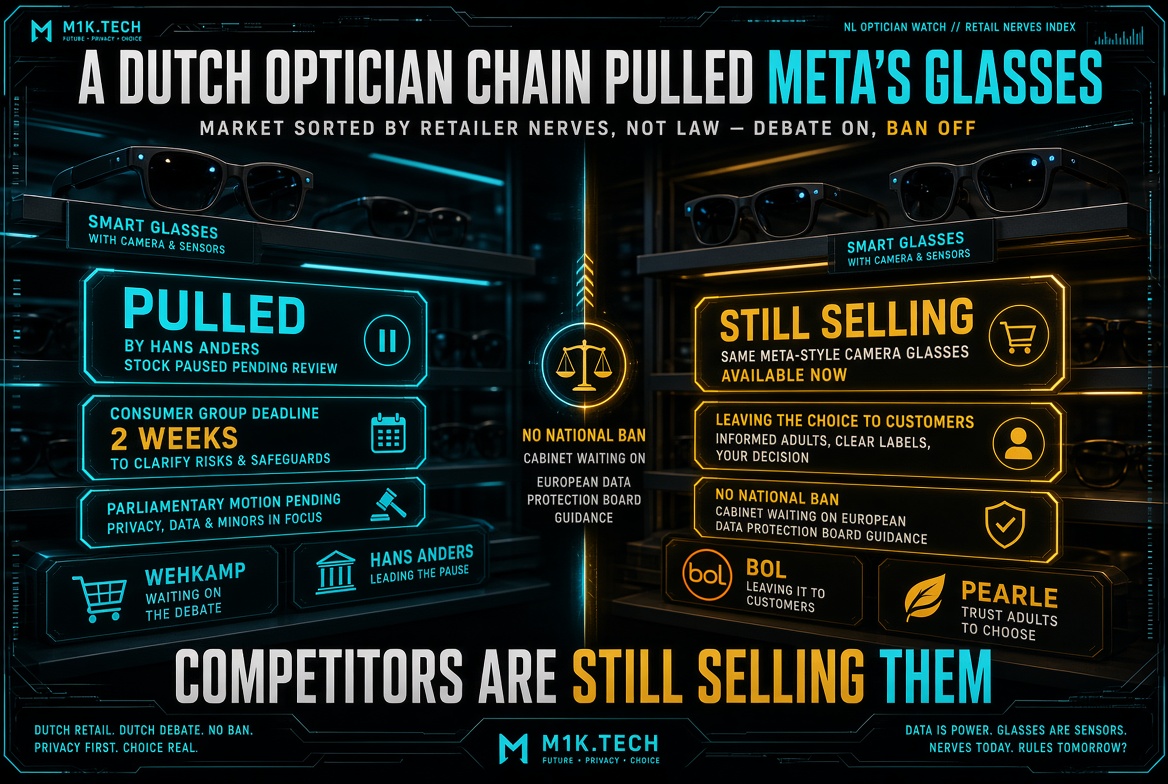
Hans Anders sells glasses for a living, and this week the Dutch optician chain stopped selling Meta’s, which makes the Meta smart glasses Netherlands story more interesting than another privacy op-ed. The chain also paused sales in Belgium, and online retailer Wehkamp followed it in the Netherlands, both saying they will wait for the public and political debate before deciding anything permanent.
The glasses have been on sale there since autumn 2025 at roughly 419 euros, so this is not a launch-week panic. What changed is the stack of institutions leaning on them at once. The Consumentenbond, which has wanted a European ban for a while, sent Meta a formal demand on September 29 to modify the glasses within two weeks or face legal action; by my arithmetic, that runs out around October 13. Last week, the Tweede Kamer passed a motion calling for a clearer ban on wearing camera glasses; the Dutch data protection authority warned that footage recorded with them cannot simply be published; the association of Dutch hospitals advised its members to ban them; and the defense ministry has raised objections of its own.
Here is the detail I keep returning to: Bol and Pearle are still selling the same product, arguing that customers can decide for themselves as long as it remains legal. It does remain legal. There is no national ban; Dutch privacy law already restricts secretly filming people, and the cabinet says it is waiting for guidance from the European Data Protection Board on camera and AI glasses, expected later this autumn. So the market is being sorted by individual retailers’ nerves, which is a strange way to find out where the privacy line sits.
I have argued before that the little recording LED was never the real issue. When Meta fixed its LED loophole twice, regulators in Brussels were not arguing about the light, and the Dutch fight is the same argument in a sharper form. The Dutch commentary I read makes the point that Meta’s glasses are one product in a growing field, so campaigners and politicians want technology-neutral rules rather than a Meta-only ban. That matters more than any single store’s decision, because a rule written around Meta’s hardware would be obsolete the day a rival ships something that looks identical on a face. It also explains why Meta cannot just patch its way out, whatever it does to the LED.
The pattern is familiar from earlier this year, when cinemas, courts and Burning Man wrote smart glasses policy because nobody else would. Add the legal front, where a lawsuit now covers bystanders who never bought a pair, and the pressure keeps arriving faster from shops, hospitals and plaintiffs than from lawmakers. Qualcomm sold chips to both Meta and Google in the week they fought over your face, and I suspect distribution, not hardware, is where a product like this actually gets slowed down.
Sources
- Dutch Brief, Meta’s Smart Glasses Face a Backlash, and a Possible Ban in the Netherlands, October 2, 2026
- The Business of Fashion, Dutch Eyewear Chain Hans Anders Halts Sale of Meta Glasses, Citing Privacy Concerns, October 2, 2026