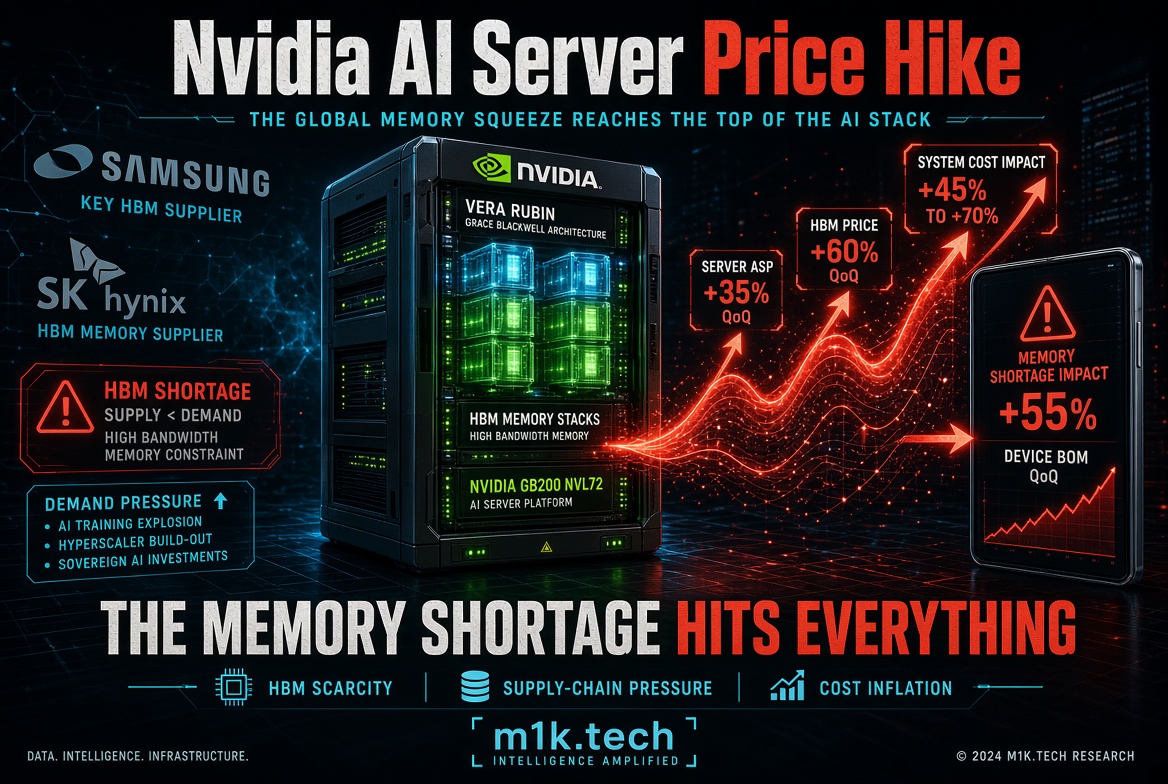
Bloomberg’s numbers landed on a Saturday afternoon: Nvidia’s AI server price hike runs past 15 percent on the systems built around Vera Rubin and Grace Blackwell, with the exact increase varying by chip generation and memory configuration, and it hits anything shipping in early 2027. CNBC confirmed the same figures within the hour, citing Bloomberg directly. Nvidia’s own explanation, per both outlets, is memory. Not the chip itself. The DRAM and HBM sitting next to it.
I’ve been writing about this exact squeeze since it was still a phone story. In July, Samsung tacked a hundred dollars onto every Galaxy foldable at Unpacked and told CNBC memory costs were part of the reason, and I pointed out at the time that Samsung sits on both sides of that transaction, selling you the phone and selling itself the memory that made the phone pricier. Nvidia doesn’t have that luxury. It buys its memory from somebody else, and this weekend it found out what that costs when the somebody else is Samsung, SK Hynix, and Micron running a DRAM market that’s already up something like 700 percent this year.
Except Nvidia isn’t only a memory customer either. Back in July it locked in a deal worth up to 500 billion dollars with SK Hynix, co-developing the next generation of HBM and, as I wrote at the time, effectively deciding how much of the memory shortage everyone else has to absorb. That deal was framed as insurance. Six weeks later, Nvidia is the one eating a bill big enough to pass 15 percent along to its own biggest customers. Locking up future supply apparently didn’t insulate it from what’s happening to the supply it’s buying right now, which says something about how tight this market is even for the company holding the largest single order on the books.
Some of this traces back to packaging, not just the memory dies themselves. TSMC has been outsourcing a growing share of CoWoS, the advanced packaging step that attaches an accelerator to its memory stack, because Nvidia alone reportedly locked up something like half of TSMC’s entire 2026 CoWoS capacity. When the company buying the most packaging capacity in the world is also the company whose own products get more expensive because packaging is scarce, that’s not two separate stories. It’s one bottleneck showing up on both ends of the same balance sheet.
What I keep turning over is the vendor financing angle I wrote about a couple of weeks ago, when Nvidia lined up half a trillion dollars from Apollo, Blackstone, Goldman Sachs, and four other firms to help its own customers afford the hardware in the first place. Raising the price of what you’re financing the purchase of doesn’t obviously break the arithmetic, since the financing terms and the sticker price are different levers, but it’s a strange moment to be simultaneously the vendor, the lender, and now the party citing its own supply costs as the reason the sticker went up. Vera Rubin buyers are the ones covering the gap between what memory used to cost and what it costs now, whether that gap shows up on the invoice or in the interest they pay to spread it out.
I don’t think this is Nvidia being greedy so much as Nvidia being exposed. The company built its moat on being the only name that matters in AI silicon, and that same position means it has nowhere to hide when an input it doesn’t control gets scarce. A GPU vendor with real competition might eat part of a 15 percent memory hit to protect its price position, the way Samsung ate part of its own increase to hold the line on foldables. Nvidia doesn’t need to eat anything. Its customers don’t have anywhere else to go for a system built around Vera Rubin, and everyone involved knows it.
I’m not going to pretend I know where this lands by the time these systems actually ship next year. Memory pricing has moved fast enough this year that a number quoted in August could look conservative or wildly pessimistic by the time Vera Rubin racks go out the door. What I do know is that the same shortage that made a Galaxy Fold cost more than it used to has now worked its way all the way up to the company sitting at the top of the AI hardware stack, and if Nvidia can’t shield its own margins from this, nobody downstream of it is getting a better deal.
Sources
- Bloomberg, Nvidia customers notified about AI-related price hikes above 15%, August 22, 2026
- CNBC, Nvidia customers reportedly warned about AI-related price hikes, August 22, 2026
- Automotive World (Reuters), Samsung hikes chip prices as much as 15% on AI demand, August 21, 2026
- CNBC, Samsung ups prices as it launches new foldable smartphones, July 22, 2026