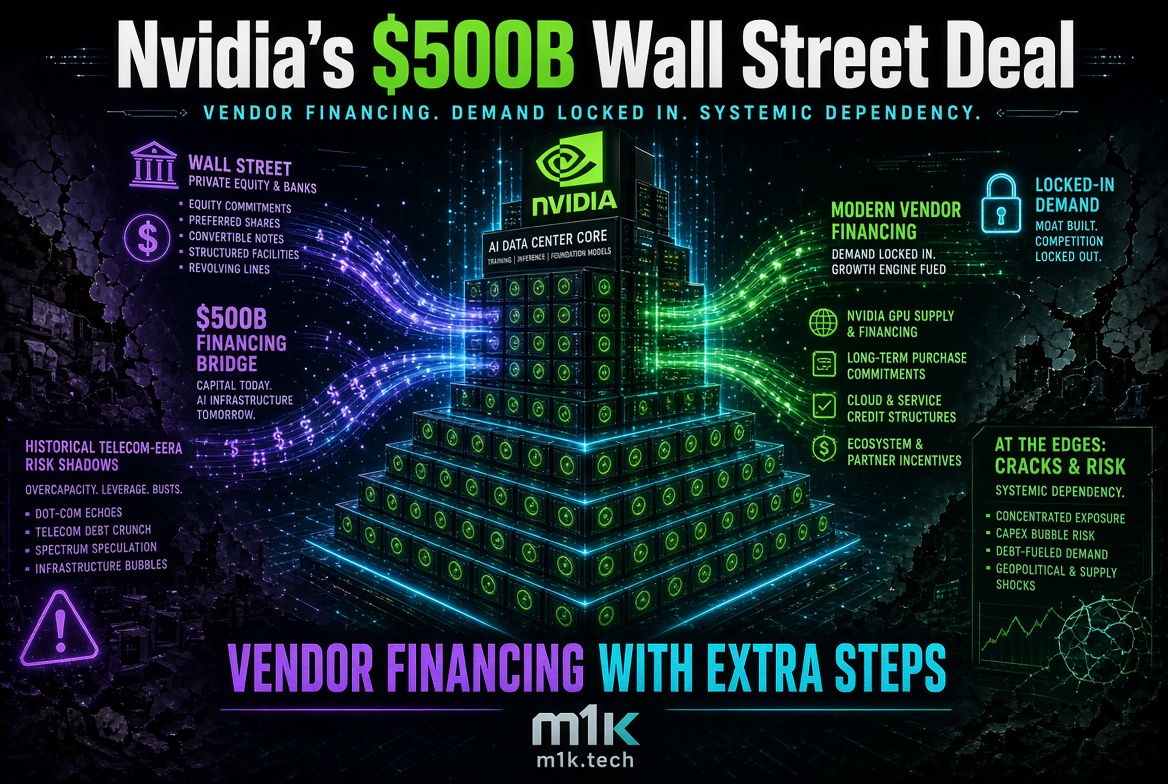
Nvidia doesn’t just want to sell you the GPU anymore. It wants to help arrange the loan you take out to buy it, and Monday’s report that it’s teaming up with six of the biggest names in private capital, Apollo Global Management, Blackstone, BlackRock’s Global Infrastructure Partners, Brookfield, Goldman Sachs and KKR, to mobilize $500 billion for AI infrastructure financing is the clearest version of that instinct I’ve seen yet.
The Financial Times broke this one first, and CNBC’s follow-up cites a source familiar with the matter rather than an official announcement, so treat the specifics as still forming. What’s not in dispute is the shape of the thing: this is money meant to help Nvidia’s own customers buy Nvidia’s own chips, build the data centers to house them, and lock down the electricity contracts to run them. Apollo and Blackstone are already in this business, having structured debt and equity financing for AI companies including Anthropic, so the mechanics aren’t new. What’s new is Nvidia showing up as the connective tissue between its GPU order book and the balance sheets that pay for it.
I keep turning this over because it rhymes with something I’ve read about but never lived through: the vendor financing that telecom equipment makers ran in 1999 and 2000, when Lucent and Nortel helped their customers borrow the money to buy Lucent and Nortel gear, and the revenue looked fantastic right up until the customers couldn’t pay the loans back. Nvidia isn’t Lucent. Its margins are absurd and its product actually works at scale. But the structural resemblance is hard to unsee once you notice it. When the company selling the shovels is also arranging the mortgage on the mine, the growth numbers stop telling you as much as they used to.
What makes this moment interesting is who’s asking for the financing and why. The AI capex supercycle has been running on the assumption that demand for compute is close to infinite and that whoever controls the GPUs controls the outcome. That assumption has taken a couple of hits recently. DeepSeek’s V4-Flash landed at something like a hundredth the inference cost of a frontier model from a major US lab, and AMD just bought Taalas on a bet that inference workloads stop needing a GPU architecture at all once the weights are etched straight into silicon. Neither of those kills the capex story on its own, but they’re exactly the kind of cost and architecture risk that should make a lender nervous about a twenty-year data center commitment. Arranging half a trillion dollars in financing right as those questions are getting louder is either supreme confidence or an attempt to lock in demand before the ground shifts further. Musk’s on-call Nvidia exclusivity commitment for Starmind AI1, the one tied to Terafab’s Texas buildout, reads like the customer-side mirror of the same instinct: lock in the relationship before anyone has to answer the hard questions about payback periods.
There’s also a sovereignty wrinkle I can’t ignore, because I’ve spent the last few weeks writing about enterprises getting nervous about exactly this kind of dependency. AXA walked back a Copilot rollout over sovereignty concerns. Mistral and Microsoft are still negotiating the terms of what European AI independence even means inside a Microsoft-hosted stack. Every one of those conversations is ultimately about who owns the infrastructure and who can pull the plug. A financing structure where Nvidia helps engineer the capital stack behind its own customers’ data centers doesn’t make that dependency problem go away. If anything it deepens it, because now the GPU vendor, the financier, and the landlord all have overlapping interests in the same buildout succeeding.
None of this means the deal collapses or that Nvidia’s playing a con. Real compute demand exists, real data centers need to get built, and somebody has to write the checks. I just don’t think Nvidia helping arrange $500 billion in financing for the industry it dominates is the neutral infrastructure story it’s being framed as. It’s a company using its position at the center of the AI economy to make sure the capital keeps flowing toward the outcome that benefits it most, and it’s worth remembering that the last time an equipment vendor got this deeply involved in financing its own demand, the story didn’t end with the vendor holding all the good news.
Sources
- CNBC, “Nvidia teams up with Wall Street asset managers on $500 billion AI infrastructure push” (Hugh Son), Aug 10, 2026: cnbc.com
- Financial Times, original report on the Nvidia financing consortium, Aug 10, 2026: ft.com
- Global Banking & Finance Review (Reuters wire), “Nvidia Partners Wall Street Giants to Raise $500 Billion for AI,” Aug 11, 2026: globalbankingandfinance.com