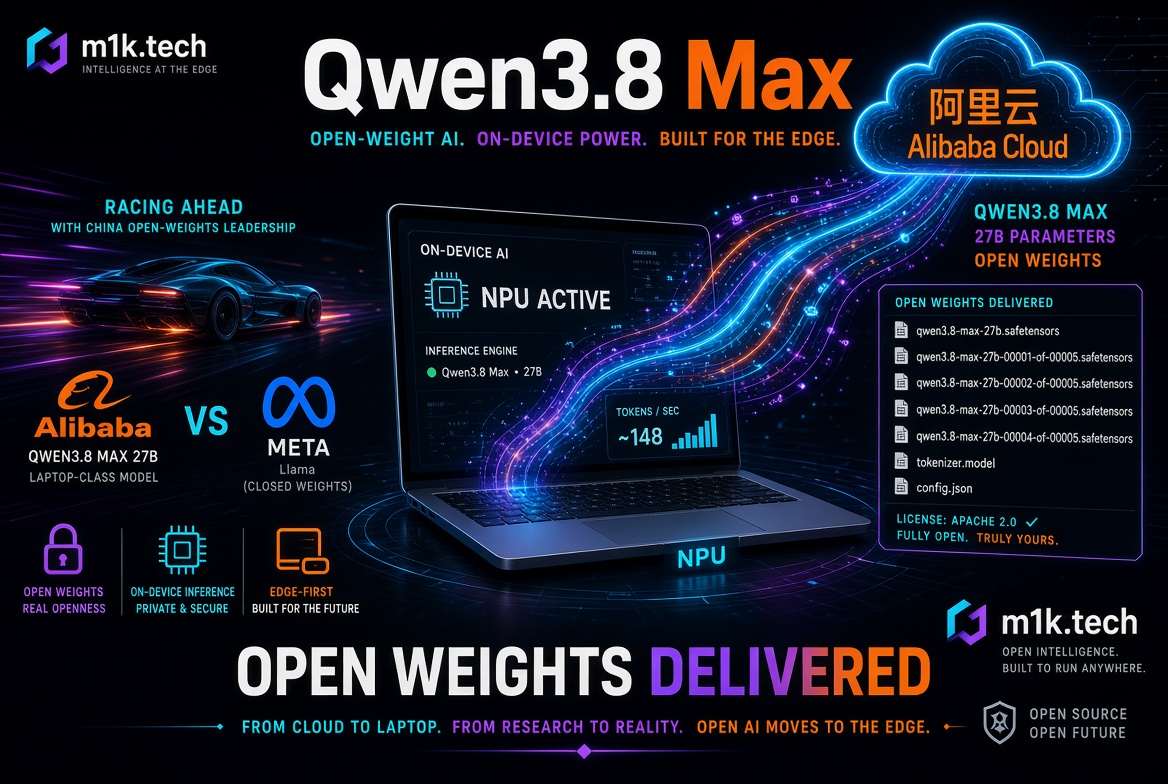
Some time ago, I wrote that Qwen3.8 Max’s open weights were still a promise: Alibaba had put out frontier benchmark numbers with no download link attached, and I said so at the time. On Monday, Alibaba delivered and didn’t stop there. It also shipped Qwen3.8-27B, a model built to run on a laptop instead of a data center rack, and claimed it matches the performance of something ten times its size.
The timing is not subtle. Meta announced last week that it would open-source its most capable model and launch a laptop-class family called Muse Glimmer, explicitly trying to reclaim the open-weight story from Chinese labs after two years of losing ground. I covered that pivot when it landed the same day OpenAI pulled back on Astra. Three days later, Alibaba answered with a model aimed at the same laptop-class niche Meta just staked out, plus the actual weights of its flagship, which is the part Meta’s own Llama era struggled to keep open once the models got good.
I want to be skeptical of the “matches a model ten times its size” line, because that is a claim Alibaba is making about its own benchmark suite, not one an outside lab has reproduced yet. A frontier-adjacent number from the company selling you the model is exactly the kind that deserves a raised eyebrow until someone else runs it. What I do trust is the download data, since that comes from Hugging Face rather than Alibaba’s own messaging: Qwen-based models now account for more than 151,000 derivatives on the platform, roughly 2.6 times Meta’s entire footprint. Alibaba didn’t write that benchmark. Developers are voting with their GPUs.
Alibaba has been the open-weight leader for a while now, with DeepSeek and Moonshot AI right behind it, and I have written about how that shifted from a preference to an imperative for anyone building on Chinese labs’ work after Fable 5 got export-banned. Qwen3.8 Max’s weights coming open is the same pattern playing out one rung higher: what used to be Alibaba’s ceiling model is now something you can pull down and run yourself, training data and methodology notwithstanding. Alibaba is explicit that it will not say how Qwen3.8 Max was trained, so the openness here is real but bounded. You get the weights, not the recipe.
The more interesting bet is Qwen3.8-27B, because it is not really competing with Qwen3.8 Max at all. It is competing for a spot on your laptop’s NPU, which is a fight I have been tracking since the local LLM privacy pieces I wrote about Android NPUs hitting a wall on model size. CNBC-quoted analysts framed this as the next battleground moving from the data center to the edge, and I think that is basically right, though I would push back on how settled that framing already sounds. On-device models are faster and keep your data local, sure, but they also cap out on context and reasoning depth in ways a 27B model cannot fully paper over no matter what benchmark table Alibaba publishes. Running fast and running well are not the same claim, and this industry keeps blurring them.
What actually matters here is not the specific parameter count. It is that Alibaba keeps forcing the pace on a story Meta explicitly tried to reclaim a week ago, and keeps doing it within days rather than quarters. I still do not know whether Qwen3.8-27B holds up against real agentic workloads the way Alibaba says it does against a model ten times larger. What I do know is that the open-weights letter crowd, the ones arguing that openness is a strategic necessity rather than a nice-to-have, just got their strongest evidence yet, and it did not come from a US lab.
Sources
- CNBC, Alibaba answers Meta’s AI challenge with new laptop-ready model, August 17, 2026
- CNBC, Meta’s open-weight AI pivot, August 12, 2026