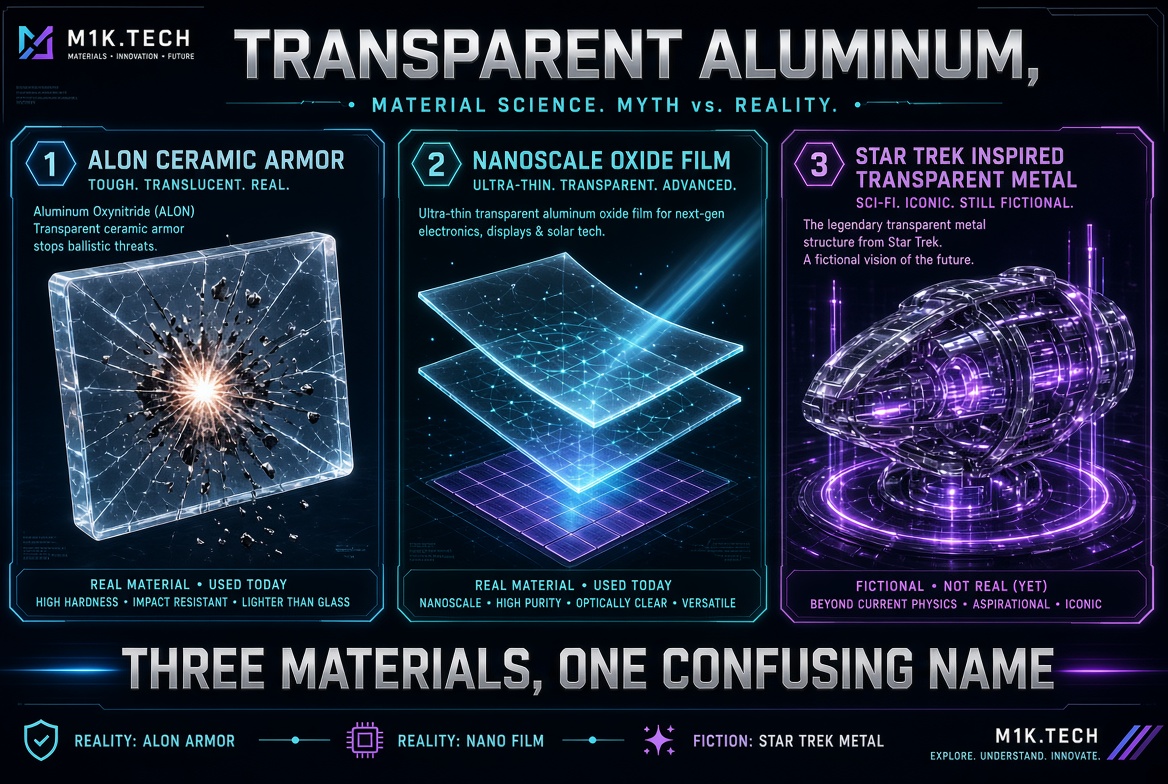
A drop of acid, two volts, and aluminum metal turns into a transparent oxide. That was the 2025 result that sent “transparent aluminum” ricocheting across every tech and science feed, collapsed into one breathless line: the stuff from Star Trek is finally real. Almost every word of that is wrong. The Star Trek material is fiction. The bullet-stopping armor it supposedly inspired has been around since the late 1980s and needs industrial furnaces past 2,000°C. And the 2025 breakthrough is a nanoscale thin-film trick aimed at touchscreens and solar cells, nowhere near vehicle armor. Three things, one shared name, and beyond that almost nothing in common.
The armor came first and gets misunderstood the worst. Aluminum Oxynitride, sold as ALON® Optical Ceramic by Surmet Corporation, isn’t a compound in the tidy sense. It’s a solid solution that lives across a phase field in the Al₂O₃–AlN binary system, roughly Al₂₃O₂₇N₅, though the exact stoichiometry drifts with how you process it. The nitrogen isn’t along for the ride. It holds the structure together.
ALON crystallizes into a cubic spinel lattice, space group Fd3̄m, and cubic symmetry means the material is optically isotropic: same refractive index in every crystallographic direction. Most ceramics are opaque even though their individual grains are transparent, because when a grain is optically anisotropic, light crossing a boundary hits a refractive index mismatch between neighbors pointing different ways, and it scatters. ALON never gets there. Its cubic phase holds a refractive index near 1.79 at 550 nm no matter how a grain is oriented, so grain boundaries stop scattering visible light, as long as they’re pore-free and the surface is polished smooth enough.
That “as long as” is the invoice. Making ALON means blending high-purity alumina and aluminum nitride powders in exact ratios, then sintering them at 1,900–2,150°C under a controlled nitrogen atmosphere. Let oxygen creep in during sintering and it wrecks the nitride phase, so atmosphere control isn’t a nice-to-have. Then the plate goes through Hot Isostatic Pressing, HIP, at high temperature and pressure to crush out whatever porosity is left, and the tolerance here is brutal: any pore bigger than about a tenth of a visible wavelength, 40 to 70 nanometers, becomes a scattering center. One pore that size in the optical path gives you haze. After HIP comes diamond-abrasive grinding and polishing down below Ra 1 nm, an optical-grade finish that can eat days per plate on its own. Laser interferometry checks homogeneity across the whole surface at the end. Weeks per finished plate, all told. Armor-grade ALON runs $10,000 to $15,000 or more per square foot, and Surmet, up in Burlington, Massachusetts, holds the dominant IP and supplies most of it to the U.S. military and aerospace.
What you get for that is a Vickers hardness around 1,800–2,000 HV. Fused silica sits at 500–600. Sapphire, single-crystal Al₂O₃, hits about 2,000, so ALON is essentially sapphire-hard while still being manufacturable in large plates, which sapphire is not, because growing big single-crystal boules is even harder and pricier than sintering polycrystalline ALON. Flexural strength lands near 300 MPa. Fracture toughness is 2.0–2.4 MPa·m^(1/2), which by metal standards is glass-brittle: aluminum metal runs 20 to 45. And the brittleness isn’t a defect in the armor job. It’s the whole mechanism.
A .50 BMG armor-piercing round hitting an ALON plate doesn’t get absorbed the way steel absorbs it. The ceramic shatters the penetrator core. That core, usually tungsten carbide or hardened steel, is harder than glass but softer than ALON, so on impact the ceramic fractures the tip and destroys its geometry, turning a coherent high-velocity penetrator into low-energy debris. A polymer backing layer catches the fragments and the shattered ceramic. The system works because the ceramic breaks. Army Research Laboratory testing pinned it down: 1.6 inches of ALON matches roughly 3.7 inches of traditional laminated glass for ballistic protection, and that weight-and-thickness cut is exactly what matters on a vehicle or an aircraft.
The optical side gets far less airtime. ALON transmits from around 0.2 µm in the ultraviolet out to roughly 5 µm in the mid-infrared, where standard borosilicate glass quits around 2.5 to 3 µm. So a single ALON window is a structural armor element and an IR-transparent optic at once. Missile seeker domes, aircraft sensor windows, targeting apertures can all be ALON, shielded against bullets and weather without blinding the sensors behind them. Sapphire matches that IR window but is unaffordable at large sizes, and ALON’s polycrystalline route makes big plates feasible where sapphire boules never will be.
The 2025 paper is a different animal entirely. Published in Langmuir by researchers at Ateneo de Manila University and the Nara Institute of Science and Technology, it describes anodic aluminum oxide, plain Al₂O₃ with no nitrogen, in thin-film form. The material is old news. The method and the spatial control are the point.
Anodization dates to the 1920s: drop aluminum in an acid electrolyte, apply voltage, and the surface oxidizes to Al₂O₃. The oxide grows as a porous film full of hexagonally packed nanopores, 10 to 100 nm across depending on voltage and acid strength, and that pore structure is why ordinary anodized aluminum looks matte or milky rather than clear. It scatters light. Crank the voltage for bigger pores and thicker films, drop it for finer, denser ones.
The Ateneo/NAIST team added localization. Their droplet-scale anodization parks a microdroplet of sulfuric acid on the aluminum and uses electrowetting-on-dielectric to steer the droplet’s shape and contact area with applied voltage. The anodization runs at 2 volts for 10 minutes, and that low voltage is the key move: it grows a thinner, denser oxide with a finer pore structure than a conventional bath. Once the pores are small enough against visible wavelengths and the film is thin enough to dodge cumulative scattering, the oxide comes out transparent, at a thickness of tens to hundreds of nanometers. That’s orders of magnitude thinner than an armor plate.
Confining the reaction to a droplet instead of a bath is what unlocks the real novelty: spatial selectivity. You can convert specific microscopic patches of an aluminum surface to transparent oxide while the neighboring metal stays metallic. Maskless patterning of a functional optical material, at room temperature, with dilute acid and milliamp current. No vacuum chamber, no laser, no photolithography.
The targets are microelectronics and photovoltaics. Al₂O₃ already does duty as a passivation layer in high-efficiency silicon cells, specifically PERC architecture, where a thin rear-surface Al₂O₃ layer cuts recombination losses. The catch is that today’s deposition routes, atomic layer deposition and plasma-enhanced CVD, both demand vacuum gear. Localized droplet anodization could do selective passivation without any of that. Patterned transparent insulating or sensing regions on aluminum substrates also open doors in MEMS, optical sensors, and display stacks. The “eco-manufacturing” framing in the coverage is fair in a narrow way, since it does displace energy-hungry vacuum deposition for certain patterning jobs, but it isn’t a general replacement for thin-film deposition and shouldn’t be sold as one.
Thin-film transparency is physically not the same thing as the bulk transparency of an ALON plate. A 200 nm anodic oxide film is transparent the way a soap bubble is transparent: thin enough that scattering and absorption barely register over that path. Bulk Al₂O₃ as single-crystal sapphire stays clear through centimeters of material. The 2025 result doesn’t lead there. It leads to transparent Al₂O₃ coatings and microscale patterns, and that’s the ceiling.
For a straight reference, here’s where the two real materials stand:
| ALON (Aluminum Oxynitride) | TAlOx (Anodic Al₂O₃, 2025) | |
|---|---|---|
| Chemical formula | Al₂₃O₂₇N₅ (approx.) | Al₂O₃ |
| Structure | Polycrystalline cubic spinel | Amorphous anodic oxide film |
| Nitrogen | Yes, essential to cubic phase | No |
| Thickness | Centimeters (armor plates) | Tens to hundreds of nanometers |
| Process temperature | 1,900–2,150°C | Room temperature |
| Process | Powder sintering, HIP, diamond polish | Acid microdroplet, 2V, 10 min |
| Hardness | ~1,800–2,000 HV | Not structurally relevant at film thickness |
| Cost | ~$10,000–$15,000+/sq ft | Low, commodity materials |
| Primary application | Armor, IR-transparent windows | Touchscreens, solar passivation, MEMS |
| Developed | Late 1980s, Surmet Corp | 2025, Ateneo de Manila / NAIST |
| IR transmission | To ~5 µm | Not characterized for bulk IR use |
Look at the price columns and the whole story inverts. The material that stops .50 caliber costs more per square foot than a lot of people make in a month and is basically locked behind military procurement. The 2025 material wants sulfuric acid and roughly a AA battery’s worth of voltage. The viral coverage read the cheap one as a step toward the expensive one, and it simply isn’t: different problems, different scales, different chemistry. If anything, the 2025 work matters more for consumer tech precisely because it’s cheap and accessible, and it could turn up inside a phone’s display stack within a few years, while ALON stays in missile domes and armored glass.
The Star Trek version, a structural material with glass-like clarity and metal-like toughness, is still fiction. What exists is one ceramic that turns transparent through cubic symmetry and stops rounds by being harder than whatever’s trying to punch through it, and one nanoscale oxide film that turns transparent by being too thin to scatter and earns its keep by patterning without a cleanroom. The name is all they share, and the name is the reason everyone got it wrong. The thing actually worth watching is whether that acid-and-a-battery process scales out of the lab into a real fab line, because if it does, it lands in your pocket long before any sci-fi supermaterial does.