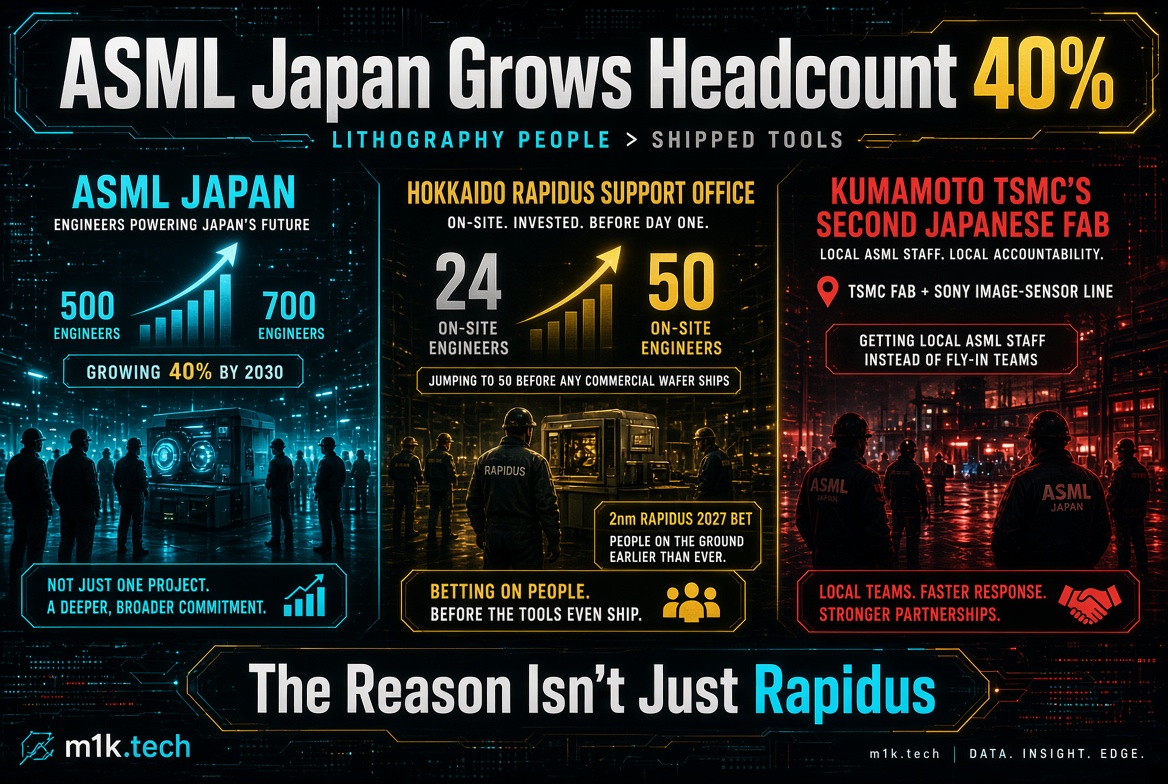
ASML Japan is planning to grow from about 500 employees to around 700 by 2030, according to ASML Japan president Fujiwara Shojiro, who announced the target at a Tokyo press conference on Thursday. A 40 percent headcount increase for a lithography equipment maker doesn’t sound like breaking news on its own; engineering firms grow local teams all the time, but where ASML is actually putting those new hires tells you more about the next few years of chipmaking than the topline number does.
Most of that growth is aimed at two specific places. ASML opened a Hokkaido office back in 2024 purely to support Rapidus, the Japanese government-backed foundry startup racing to bring 2 nanometer chip production online in 2027, and the on-site engineer count there has already gone from 24 to 50. That’s more than double in under two years, for a customer that hasn’t shipped a commercial wafer yet. I find that kind of pre-positioning more revealing than any Rapidus press release, because ASML doesn’t staff up ahead of a customer’s production date unless it actually believes the date is real.
The other target is Kumamoto, where TSMC is building its second Japanese fab, and ASML wants engineers stationed close enough to support it directly instead of flying teams in. TSMC keeps layering fresh bets onto that same site: it partnered with Sony on August 11 to build advanced image sensor chips for smartphones there, aiming for 2029 production, a much slower timeline than the A16 node TSMC is racing toward back home in Taiwan. Two customers, two very different node ambitions, and both are getting the same answer from their shared equipment supplier: more local engineers, sooner.
Compare that to how ASML treats the rest of the field, and the signal gets sharper. Samsung’s SF2 comeback bid leans on the same EUV tools everyone else queues for, and China’s homegrown DUV programs exist specifically because Beijing can’t buy the machines caught up in the export-control fight at all. Japan, by contrast, is getting ASML’s people, not just its shipments, and people are the harder thing to scale. A tool can be crated and shipped in months. An engineer who actually knows how to keep an EUV system running at yield takes years to train, and ASML just told two customers in two different cities it’s willing to spend those years on them specifically.
What nags at me is that none of this shows up in the stock chatter around ASML, which stays fixated on China export limits and quarterly bookings. The Japan buildout is the quieter bet, and it’s the one that actually tells you where ASML thinks 2-nanometer-class manufacturing outside Taiwan has the best odds of working. I’m not convinced Rapidus makes its 2027 date; foundry ramps slip constantly, and this would be Japan’s first from-scratch leading-edge fab in decades, but ASML clearly isn’t willing to bet against it in public, not with headcount it has to actually pay for.
Sources
- Nikkei Asia, ASML to Expand Japan Workforce to Aid Next-Gen Chipmakers Rapidus, TSMC, September 4, 2026
- Taiwan News, ASML Japan Expanding Workforce to Aid Rapidus and TSMC, September 4, 2026
- Rapidus Corporation, Technology Roadmap
- TSMC, TSMC and Sony Semiconductor Solutions Announce Collaboration, August 11, 2026