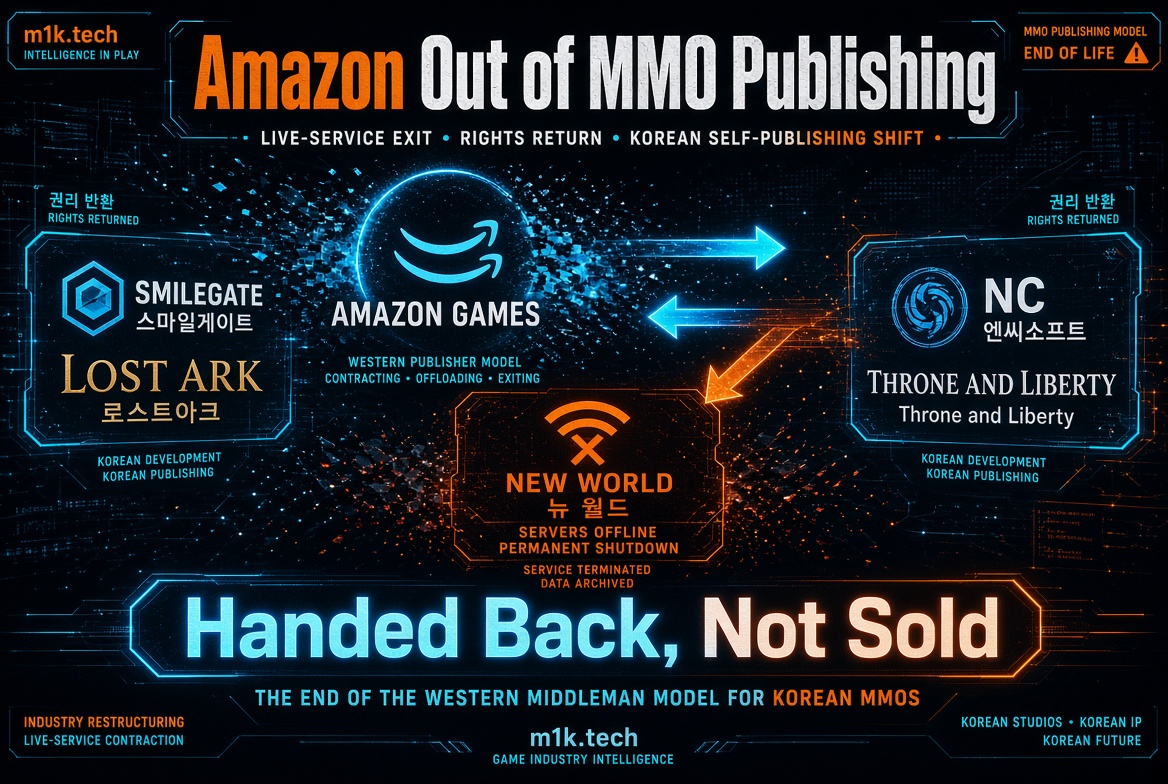
Amazon signed the Throne and Liberty publishing deal with NCSoft in February 2023, reportedly worth 90.7 billion won (around $70 million), on a term running through October 2029. On August 12, it walked out of the last three years of that contract and out of MMO publishing altogether. NC, as NCSoft renamed itself in April, told investors the next day that the end date had been pulled forward to February 1, 2027, and that it would bring the global service in-house before then through its FirstSpark Games subsidiary, targeting Q4 2026. Lost Ark follows in early 2027, back to Smilegate, almost exactly five years after Amazon launched it in the West.
Nothing was sold. That’s the detail I keep circling back to. Amazon didn’t shop the western rights, didn’t find a publisher looking to buy into a live genre at a discount, and didn’t even bundle the two into one announcement: the news went out as separate blog posts on each game’s own community page. The Lost Ark post calls it a positive outcome for players “as we are handing the game back to the developers,” which is the line you write when the alternative framing is that nobody wanted them. Two functioning MMOs with real revenue and real populations, and the exit strategy was to give them away to the people who built them.
For players, the migration is about as boring as it gets, which is the point. Characters, progression, inventory, entitlements, purchases, and wallet balances all carry across, including Royal Crystals, Blue Crystals, Gold and Silver on the Lost Ark side and Lucent, Loyalty Points, Sollant and Ornate Coins on Throne and Liberty. Cross-play between Steam, PlayStation and Xbox survives, and Throne and Liberty picks up NC’s PURPLE launcher with cross-progression between PURPLE and Steam, though not to console. What doesn’t survive is the social residue: in-game mail, friends list memos, group names, guild member nicknames, blacklist entries, chat history. Amazon is telling Lost Ark players to empty their mailboxes before the cutover date gets set. FirstSpark has also warned that the Nix update may sit on the shelf until after the transition, because you don’t ship a major content patch into a live data migration if you want to keep your job.
The contrast with New World is the whole story, though. That one Amazon actually made itself, and it doesn’t get a handoff because nobody is there to take it. It was delisted on January 15 this year, the in-game store closed on July 20, and the servers go dark permanently on January 31, 2027, five years and change after a launch that peaked north of 913,000 concurrent players on Steam. Lost Ark managed 1.32 million at its own peak and was briefly the most-played game on the entire platform. Those numbers were the proof point for the whole Amazon Games thesis, and both of them now end with somebody else holding the keys or nobody holding them at all. I’m not getting into the preservation and consumer-rights fight over the New World shutdown here; that deserves its own post, but it does sit badly with me that the only one of the three that permanently dies is the one Amazon owned outright.
Everything since October 2025 has been a controlled demolition. That month’s 14,000-person layoff hit Amazon Game Studios hardest in Irvine and San Diego, plus the central publishing team, and Steve Boom’s memo said the quiet part directly: the company was halting a significant amount of first-party AAA development, specifically around MMOs. The Lord of the Rings MMO in Orange County died with it. King of Meat, which Glowmade shipped in October 2025 behind a MrBeast video and custom-wrapped London buses, wanted 100,000 concurrent players and peaked at 320, then closed on April 9 with full refunds. Studio head Christoph Hartmann left in January during the next round of layoffs. Maverick Games, the studio founded by the Forza Horizon 5 director, was released from its publishing agreement in February and told to go find someone whose “strategic priorities are better aligned.” The Montreal team’s MOBA, March of Giants, went to Ubisoft.
What’s left is a licensing deal and a storefront. Amazon still publishes Tomb Raider: Legacy of Atlantis this year and Tomb Raider: Catalyst in 2027, both built by Crystal Dynamics on IP that belongs to Embracer, both feeding a Prime Video series. And on July 23 it folded Luna into the Prime Video app as a Games tab on Fire TV in the US and UK, roughly a hundred titles at no extra cost to Prime members, run by Jeff Gattis, an ex-Xbox executive who now oversees both Luna and what remains of Amazon Game Studios. A company that spent a decade and an enormous amount of money trying to become a game maker has landed on being a distribution channel with a Lara Croft licence attached. I don’t think that’s a failure of ambition so much as an admission that the ambition never had a mechanism behind it, and it rhymes uncomfortably with how Microsoft cut 3,200 jobs and divested four studios rather than keep pretending it could fund everything at once.
So who steps up? Nobody, and that’s the actually interesting answer. No white knight publisher is circling these games, because the job Amazon was doing has quietly stopped existing. Western publishing for a Korean MMO used to mean localization, payment rails, marketing spend, server infrastructure, and a relationship with platform holders, and in 2020 that was worth handing over a cut of your revenue for. Now Steam does the storefront, PURPLE and STOVE do the launcher, PS5 and Xbox certification is a solved process, and AWS will rent you the servers without requiring you to also give Amazon your game. NC already self-publishes Throne and Liberty in Korea, Taiwan, and Southeast Asia, and has run Lineage, Aion, and Blade & Soul directly for decades. Smilegate is explicitly framing the takeover as a way to close the content gap between the Korean and Western builds, with simultaneous releases as the long-term goal, plus more livestreams and actual offline events. Both describe the middleman as the problem.
The numbers back them up more than I expected. NC’s PC MMO portfolio pulled roughly $243 million in Q2 2026, up 8% and its best stretch in years, carried largely by Aion 2 since its Korean and Taiwanese launch last November. Aion 2 goes global in September on Steam and PURPLE, self-published across North and South America, Europe and Japan, with no Western partner anywhere in the arrangement. Guild Wars 2 had its strongest quarter since 2017. Guild Wars 3 has a beta penciled in for late 2027. NC is talking about ten new games by the end of next year and branching into shooters with Cinder City and Time Takers. Whether Aion 2 survives contact with western players after the pay-to-win backlash that greeted it in Korea is a completely open question, and I’d be lying if I said I had a read on it, but the strategic posture is unambiguous.
That’s the shift worth writing down. The last few years of MMO contraction have mostly been told as a genre story, one about live-service costs and the death of the big persistent world, and it’s a fair story as far as it goes given how much of it I’ve already watched play out across console strategy, Sony’s own reversals, and the layoff wave now tangled up with memory prices. But Korean MMOs are not contracting. They’re just no longer willing to rent access to their own audience from an American company that treats the entire category as a line item it can zero out in a restructuring memo. Amazon paid $70 million for a seven-year relationship and got out at year three. If I’m sitting in Pangyo or Seongnam deciding who publishes my next global launch, that number is the only slide I need.
Sources
- Amazon Game Studios, transition notices on the Lost Ark and Throne and Liberty community pages, August 12, 2026
- PC Gamer, Amazon drops Lost Ark and Throne and Liberty, August 12, 2026
- Variety, Amazon Game Studios Divests Lost Ark, Throne and Liberty, August 12, 2026
- UPI, NCSoft, Smilegate to take global games in-house after Amazon split, August 13, 2026
- New World, The Future of New World: What to Expect, January 15, 2026
- The Game Business, Amazon abandons its open world driving game with Maverick Games, February 24, 2026
- GeekWire, Amazon puts Luna gaming service inside its Prime Video app, July 23, 2026