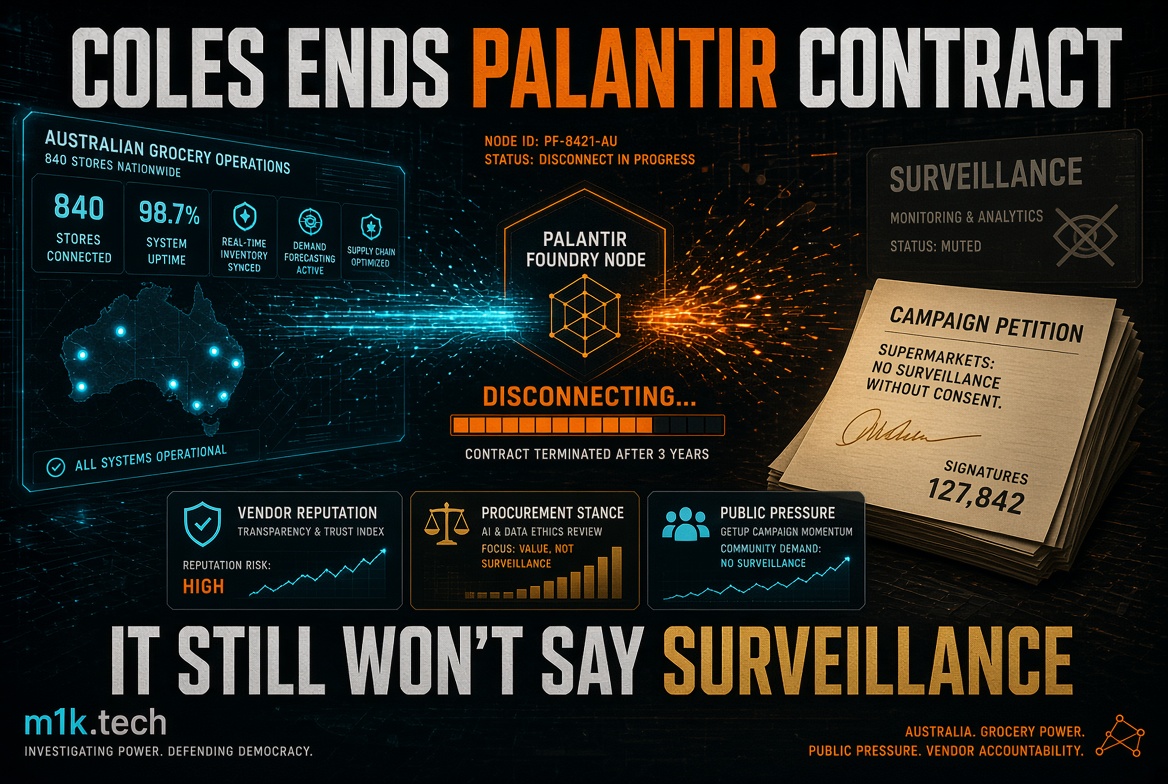
Coles spent three years running Palantir’s Foundry platform across more than 840 stores before agreeing this week to end the deal, and the retailer’s spokesperson still will not use the word its critics have thrown at it for a year: surveillance.
The contract dates back to February 2024, when Australia’s second largest supermarket chain signed on for Palantir’s Foundry and AI tools to pull staffing, bakery production, and trading performance data into one system across the country. It is exactly the kind of unglamorous operational plumbing Palantir has quietly built a business on outside its more famous defense and intelligence contracts, and by 2025 Coles had around 300 data and intelligence staff working alongside vendors including Microsoft, Snowflake, Databricks, and SAP. None of that stopped advocacy group GetUp from spending a year collecting 86,000 petition signatures and pushing for a shareholder vote at Coles’ annual general meeting, campaigning specifically against Palantir’s ties to US intelligence and defense work.
This week Coles and Palantir agreed to conclude the partnership, with the exact transition timing still being worked out but the arrangement not expected to run past 2027. GetUp immediately claimed it as a campaign win. Coles, in its own statement, credited the software with real operational value, saying it helped get products on shelves when customers needed them and staff in the right place at the right time, then went out of its way to reject the framing entirely: the platform is deployed within Coles’ own environment, operated and isolated under Coles controls, and Palantir does not control the data or get to repurpose it independently. That is a company ending a three-year relationship while simultaneously insisting the thing everyone spent a year campaigning against was never actually true.
I have watched this exact shape play out enough times now to stop being surprised by it. AXA walked back its Copilot rollout under similar pressure a month ago, dressing a sovereignty retreat up as a routine productivity decision. Ryanair went the opposite direction and leaned all the way into Google Cloud the same week Airbus was quietly walking away from it. What is consistent across all of these is that the company never has to agree with the campaign’s substance to still act on its pressure. Coles gets to keep saying the surveillance framing was wrong. GetUp gets to keep the win. Both statements can be true at once, because the actual decision was never really about whether the technical claims held up; it was about whether a consumer-facing grocery brand wanted a CIA-linked vendor’s name showing up in headlines next to its own before an annual general meeting.
The bigger pattern I keep circling back to is who gets to be the acceptable vendor once a company hits this threshold. Coles is not walking away from AI or automation; it is walking away from one company with a reputational problem, and the 300-person data team is presumably still standing there needing a replacement platform. That is the same fork Denmark hit when it built its own sovereign AI control layer instead of just picking a foreign cloud outright, and the same fork every enterprise hosting Chinese model weights through a European provider is quietly navigating. Nobody is opting out of the infrastructure. They are all just getting pickier about whose name is on the contract.
I am not going to pretend I know whether Coles’ operations actually get worse without Foundry; that is an internal retail logistics question I have no visibility into. What I do know is that Palantir just lost a marquee Australian retail reference customer in the same week it is cashing in on ballooning US government and defense revenue, and that trade looks a lot better for Palantir’s income statement than it does for its consumer brand. GetUp gets its victory lap, Coles gets to say nothing was ever wrong, and Palantir gets to lose a supermarket chain while gaining several agencies. Everyone’s version of the story is technically accurate. That is usually how these end.
Sources
- iTnews, Coles to end data analytics work with Palantir, September 4, 2026
- The Sydney Morning Herald, Coles cuts ties with controversial, CIA-linked data giant Palantir, September 3, 2026
- GetUp, Victory: Coles is ditching Palantir, September 2026