A Target employee got filmed by a stranger wearing Ray-Ban Meta glasses this month, and the clip went viral before her shift ended. That’s the story The Verge led with this week, and it isn’t really about one confrontation. It’s about what happens when the only entity willing to write rules for camera glasses is everyone except the government.
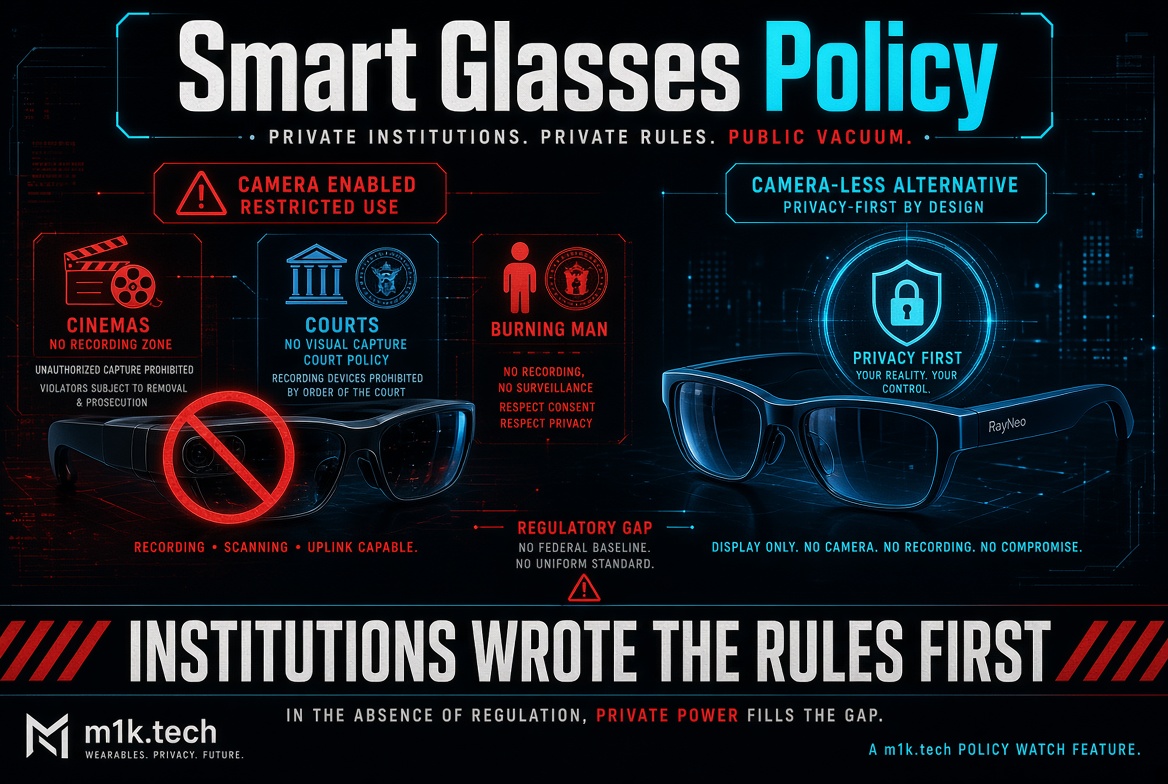
UK cinemas moved first, or at least loudest. The UK Cinema Association confirmed British operators are introducing restrictions on camera-enabled smart glasses, Meta’s included, over piracy and privacy, following England and Wales courts banning the devices earlier this month and a German advocacy group’s criminal complaint against Meta before that. Reuters noted that policies vary by venue rather than forming a single industry mandate, and operators say they’ll still accommodate accessibility use cases. That patchwork detail matters more than the ban itself. Nobody handed cinemas a rulebook. Each one is drafting its own, on the fly, because the alternative is letting customers record whatever they want off a screen that costs millions to license.
Burning Man arrived at the same place from the opposite direction. The 2026 Survival Guide now explicitly names smart eyewear in its consent-to-record rules, requiring permission before filming anyone with a phone, camera, or glasses. Organizers say the underlying privacy norm isn’t new; it’s just been updated to say the quiet part out loud now that the hardware has spread. A festival built on radical self-expression and a multiplex chain protecting box office receipts landed on the same conclusion within days of each other, for completely different reasons. That’s not a coincidence. That’s what happens when a product category ships hardware faster than anyone drafts law for it.
I wrote earlier this month about the week Apple, Meta, and Samsung all quietly admitted trust was the actual product being sold in this category, not specs. Apple prototyped camera-less builds, the same year Samsung shipped intelligent eyewear running the AR1 chip Meta had already used for three years. Meta walked back a feature cap after a Verge reporter proved its justification was fake. Samsung tried selling durability instead of AI because it already knew specs weren’t winning the argument. Now that fight is leaving the boardroom and landing on institutions that never asked to referee it. Courts, cinema chains, festival organizers, and now retail employers are writing ad hoc policy in the exact vacuum where actual privacy law should be, and every one of them is guessing where the line goes because nobody upstream drew it for them.
RayNeo’s answer, announced the same week, is to remove the argument entirely. The iO Smart Glasses weigh 33 grams, run a monochrome green display instead of a camera feed, and ship September 4 with no camera at all, just voice and on-device AI for everyday wear. It’s a clean solution to the trust problem: nothing can film you with a device that can’t film. It’s also, and I say this as someone who covers this category closely, kind of a retreat to 2021, when Ray-Ban Stories shipped as a deliberately modest audio-and-camera device nobody worried about because almost nobody owned one yet. Cameraless glasses solve the backlash by giving up the exact feature that made this product category interesting in the first place.
Meanwhile, the hardware keeps moving regardless. XREAL’s AURA, the first glasses running Google’s Android XR, passed 10,000 reservations this week on Birdbath Optics and a tethered puck pairing Qualcomm’s Snapdragon Reality Elite with XREAL’s own X1S coprocessor, the same platform I wrote about when it launched at Augmented World Expo. Ten thousand reservations at up to $1,500 a unit is a real number for a category everyone insists is one privacy scandal from collapsing. Both things are true at once. The backlash is real, institutional, and spreading fast, and the buyers keep showing up anyway- the same split I noticed when I compared Samsung’s battery claims against the public’s actual appetite for wearing a camera on its face.
I don’t think cinemas banning glasses solves anything structural, and I don’t think RayNeo removing the camera solves it either; it just moves the argument to a different SKU. What I think is actually happening is a decade-late rerun of the smartphone camera panic, except this time every institution that got burned by waiting for regulation the first time around is refusing to wait again. Nobody in Washington or Brussels is anywhere close to writing binding rules for camera wearables. Cinemas and campgrounds got tired of waiting and wrote their own. I’m skipping the workplace-liability angle here- whether an employer can be sued for a customer’s glasses filming staff- because that’s a legal question that deserves its own post, and I don’t have a lawyer’s answer to it yet.
Sources
- Reuters, UK cinemas restricting Meta AI, other smart glasses over piracy concerns, August 20, 2026
- The Verge, Meta glasses draw workplace-surveillance complaints, August 20, 2026
- Business Insider, Burning Man updates its smart-glasses recording policy, August 20, 2026
- Engadget, RayNeo unveils iO Smart Glasses and GT-series AR glasses, August 21, 2026
- Road to VR, XREAL AURA passes 10,000 reservations, August 20, 2026