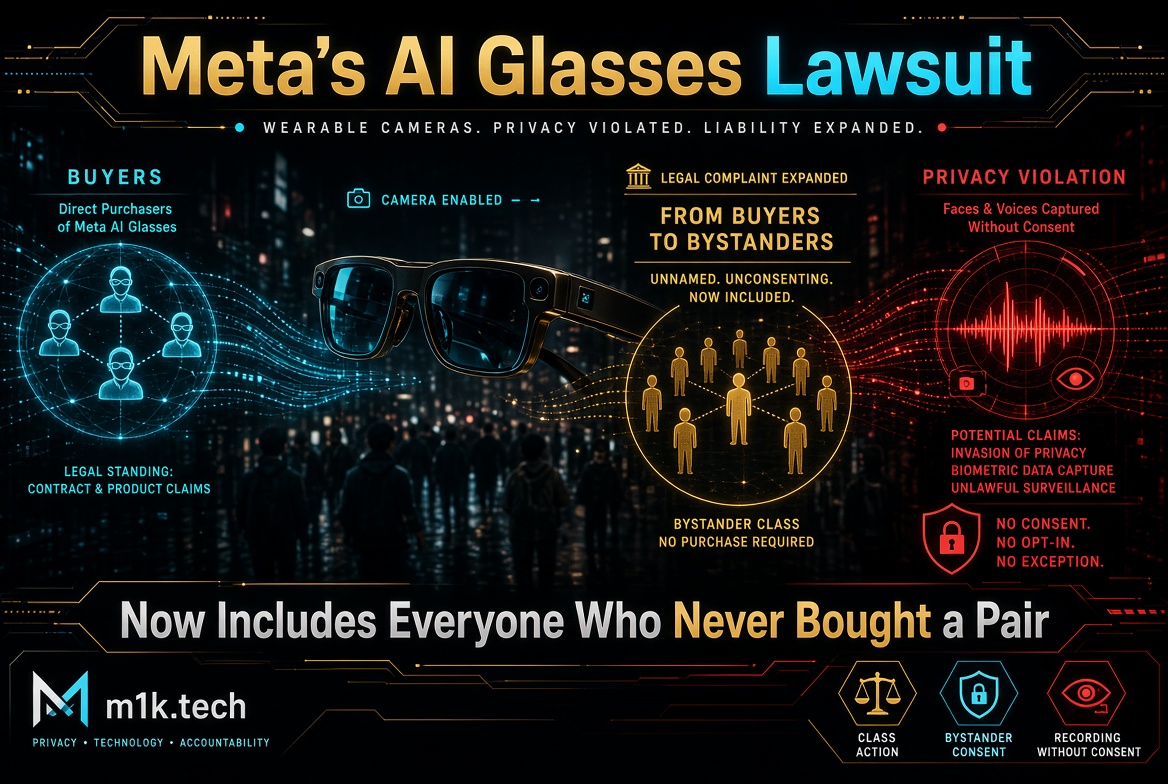
Meta’s AI Glasses lawsuit added a new group of plaintiffs this week: people who never owned a pair of Ray-Ban or any other Meta smart glasses. The amended complaint calls them “bystanders,” and the theory is straightforward once you say it out loud. If someone near you was wearing the glasses with the AI features running, your face, voice, and body could have been captured, reviewed by a human contractor overseas, and folded into Meta’s AI training data without you ever knowing it happened.
The underlying case has been running since March, when a joint investigation by two Swedish newspapers found that footage from Meta’s AI Glasses was being routed to human reviewers at Sama, a Kenyan content-moderation outsourcer Meta has used for years. One of the contractors described what showed up in the queue: “In some videos you can see someone going to the toilet, or getting undressed. I don’t think they know, because if they knew they wouldn’t be recording.” Others described watching people have sex and reviewing documents with personal identifying information sitting in plain view.
Meta marketed these glasses as “designed for privacy,” with users “in control of your data and content.” That’s the language the original lawsuit went after. What changed this week is scope. The amended complaint argues that “no reasonable consumer” would read those phrases and understand them to mean a stranger’s most intimate moments could end up in front of overseas reviewers and inside a training set, and it extends that argument to everyone who happened to be standing near the glasses, regardless of purchase history. Some of the new bystander plaintiffs are minors. The filing claims millions of people may have been swept in without ever getting the chance to say no.
Meta’s position, in a statement to Futurism, was short: “we disagree with these allegations and will fight them.” The company says it filters footage to strip identifying information and that reviewing AI interaction data “works the same way as many other companies.” Neither claim addresses the actual complaint, which isn’t about how carefully Meta reviews the footage; it’s that a bystander never agreed to be recorded in the first place.
None of this is happening in a vacuum. Norway’s digitalization minister Karianne Tung announced back in late August that she wants to regulate camera-enabled wearables more strictly than today, up to and including banning facial-recognition features in public spaces, and named Meta and Snap specifically. She’s assembling an expert group to work out how far the country can actually go. I wrote in August about how cinemas, courts, and Burning Man ended up setting smart glasses policy because nobody else would; Tung’s proposal was the first sign an actual government wanted the job instead. Meta’s amended complaint reads like the evidence file for exactly the scenario she described: a camera capturing someone who never consented to any of it, worn by a device its own maker sells as privacy-protective.
Every major player is racing into this category regardless of where the lawsuits land. Samsung’s already shipping glasses that beat Meta on battery life using the same underlying chip, and Qualcomm’s entire wearables strategy is built on betting this category keeps growing straight through the backlash. Google and Apple are in some earlier stage of the same bet, for what that’s worth. A few weeks ago I called this industry’s reckoning its most honest week yet. A bystander class action and a government minister naming names in the same stretch make that week look like a warm-up.
I don’t think Norway gets a ban through parliament cleanly; camera glasses are already too popular and too useful for that, and I doubt this lawsuit ends with Meta writing a check big enough to actually change how the product works. What it does do is give regulators like Tung a real record to point at instead of a hypothetical, and that’s worth more to her argument than the ban itself would be.
Sources
- Futurism, Meta Hit With Sweeping New Claims That Its AI Glasses Violated the Consent of “Millions” of Bystanders in Searing Lawsuit, September 2026
- TechCrunch, Meta sued over AI smartglasses privacy concerns after workers reviewed nudity, sex and other footage, March 5, 2026
- The Local Norway (AFP), Norway to crack down on use of smart glasses, August 25, 2026
- CNBC, Ray-Ban maker EssilorLuxottica triples sales of Meta AI glasses, February 11, 2026