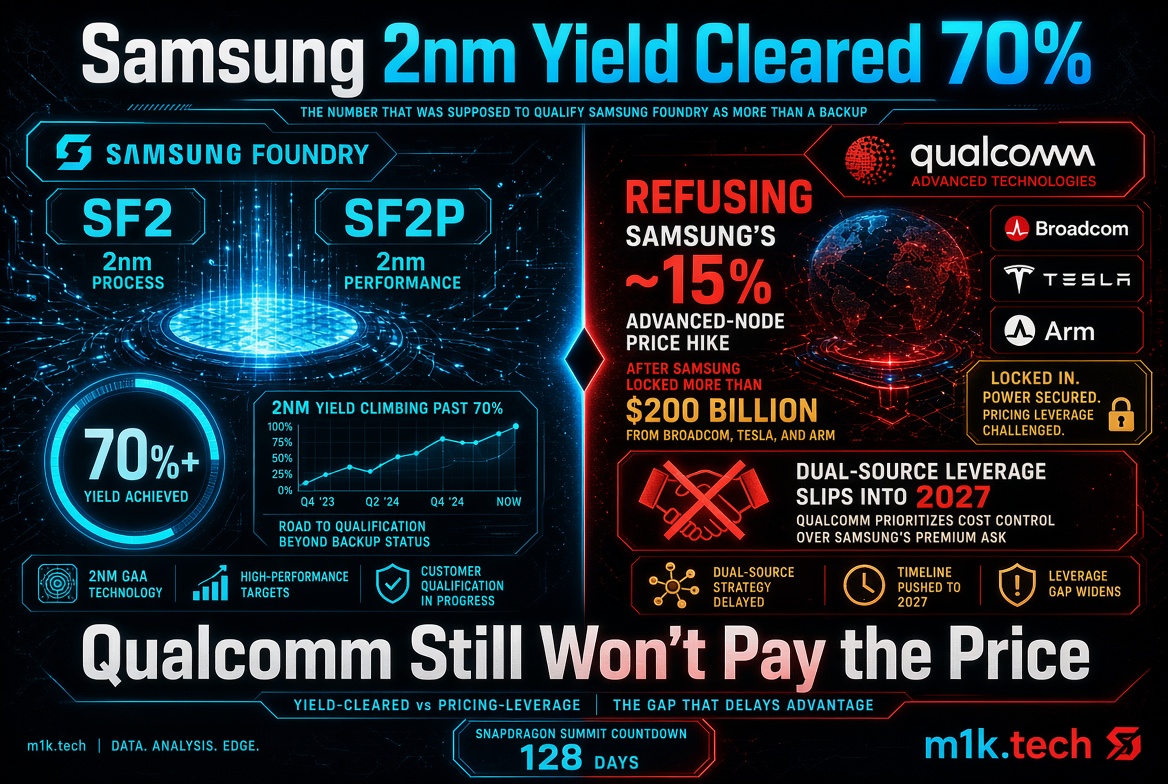
Samsung’s 2nm process finally cleared the bar Qualcomm has set for years. Yields on the SF2 and SF2P lines have climbed past 70 percent, up from under 50 percent as recently as early this year, according to Korean outlets The Bell and Maeil Business Newspaper. That’s supposed to be the number that ends a decade of Qualcomm treating Samsung Foundry as the backup that never quite qualifies. Instead, the two sides are stuck on price, and production that once looked plausible for this generation is now more likely to slip into 2027.
I’ve written before about how Samsung’s own marketing for the Exynos 2700 leaned harder on its foundry story than its benchmarks, because foundry yield is what actually sets cost in this industry now, not clever chip design. This is the flip side of that same argument. Samsung’s yield finally got good enough to compete for Qualcomm’s business, and Samsung still couldn’t close the deal, because Samsung raised advanced-node prices by roughly 15 percent after locking in more than $200 billion combined in commitments from Broadcom, Tesla, and Arm. A foundry that spent a decade discounting to win any external logic customer at all suddenly has enough backlog that it doesn’t need Qualcomm’s order badly enough to negotiate. That’s a genuinely new position for Samsung Foundry to be in, and it’s worth sitting with: the constraint on Qualcomm’s next flagship chip isn’t process technology anymore. It’s Samsung’s newfound pricing leverage.
Qualcomm currently leans on TSMC for the bulk of its 2nm production, including the Snapdragon 8 Elite Gen 6 and Gen 6 Pro getting their full unveiling at Snapdragon Summit on September 22. A second qualified source at Samsung would have given Qualcomm real leverage against TSMC pricing and real insurance against TSMC capacity constraints, the same dual-sourcing logic that’s kept the rest of the chip industry from being entirely hostage to one fab. I covered TSMC’s own High-NA EUV commitments earlier this week, and the subtext there was the same as it is here: TSMC keeps getting to set the terms because nobody else has managed to make themselves a real alternative at the volumes that matter. Samsung got the yield right this time. It just also decided it doesn’t need to be the cheap alternative anymore, and that’s a harder problem for Qualcomm to route around than a process node ever was.
None of this touches this week’s other Qualcomm chip news: leaked Geekbench scores showing the Snapdragon 8 Elite Extreme Gen 6 clearing MediaTek’s Dimensity 9600 Pro by a real margin on both single- and multi-core, with the prime core reportedly clocking past 5.11GHz. Performance was never really Qualcomm’s problem this generation. Supply chain leverage was, and a stalled Samsung negotiation means Qualcomm heads into its biggest launch of the year with exactly the single-foundry exposure it’s spent the last two years trying to engineer its way out of.
I don’t think this kills the Samsung relationship outright. Pricing disputes at this scale get renegotiated more often than abandoned, and Samsung still wants Qualcomm’s name on a wafer contract for the credibility it buys, with every other fabless customer watching this play out. But 2027 is a long time to wait for leverage Qualcomm was hoping to have in hand three weeks from now.
Sources
- SammyGuru, Qualcomm Likes Samsung’s 2nm Process but Not the Price, September 11, 2026
- BigGo Finance, Samsung-Qualcomm 2nm Foundry Talks Hit Pricing Wall, Pushing Production to 2027, September 11, 2026
- Gadgets360, Snapdragon 8 Elite Extreme Gen 6 Outperforms MediaTek’s Upcoming Flagship Smartphone Chipset, September 11, 2026