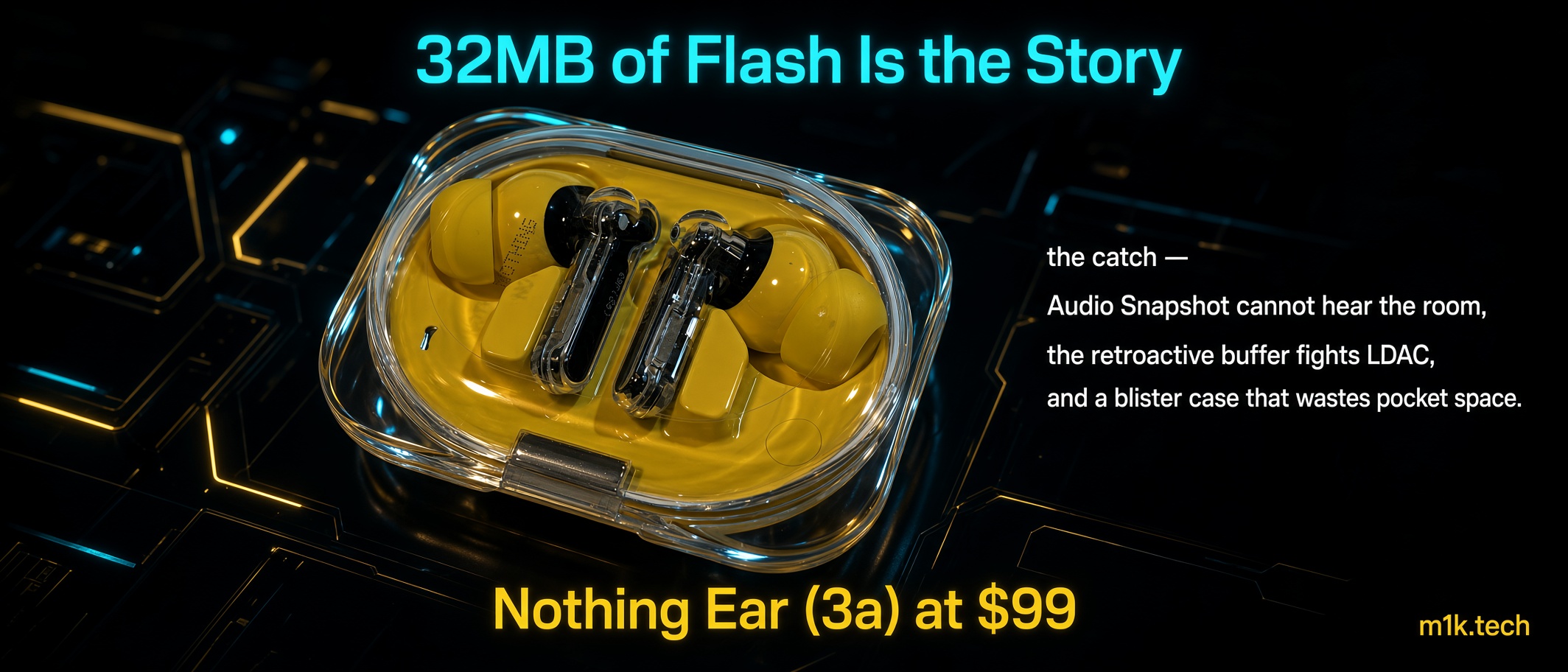
Thirty-two megabytes. That is the entire storage budget inside the Nothing Ear (3a), and it’s why these $99 earbuds do something no competitor does. Not “does better.” Does at all. You pinch both stems and the buds write audio to onboard flash, no phone involved, no app running in the foreground, no cloud round-trip. Thirty-two megabytes is nothing. A single decent phone photo eats more. And Nothing built two features on top of it that I keep thinking about a week later.
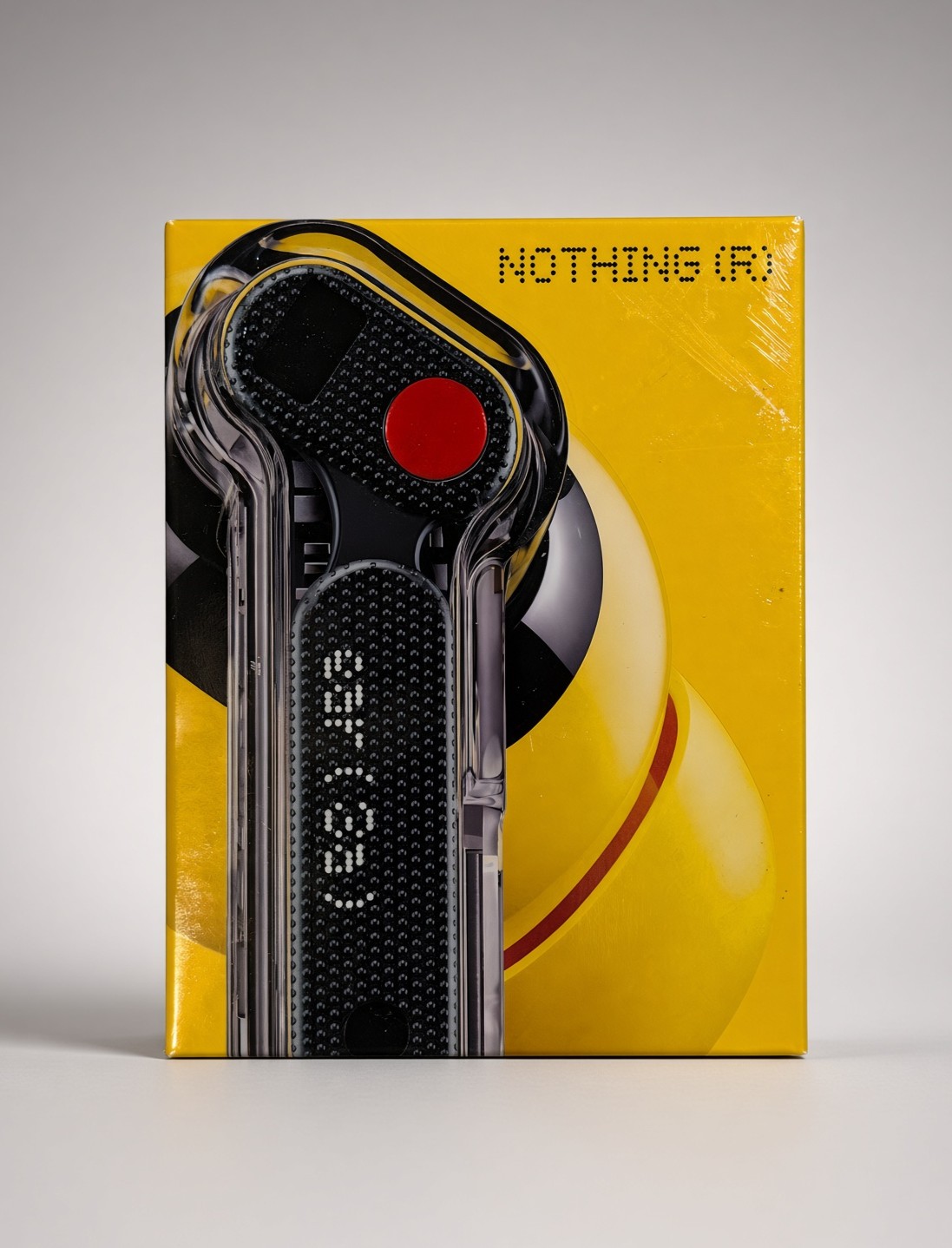
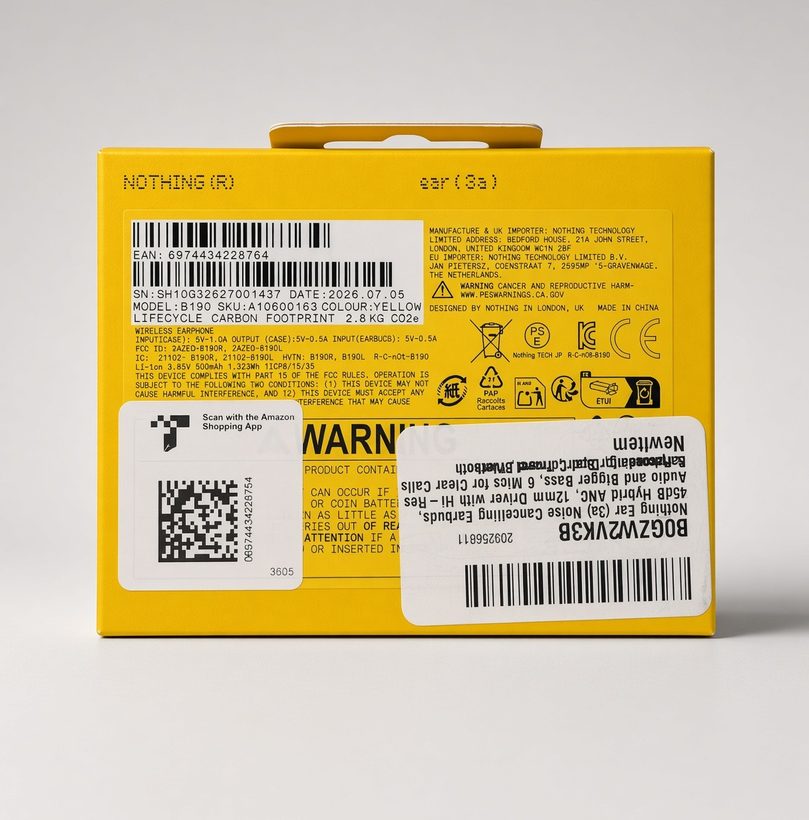
The rest of the earbud is a competent, slightly over-bass-heavy, well-priced set of buds. I will get to all of that. But the storage is the story, so let me start by explaining how Nothing arrived at a product where the headline spec is measured in megabytes.
Five years, seven earbuds, one confusing naming scheme
The Ear (1) shipped in July 2021 as Nothing’s first product, full stop. Before the phones, before Glyph, before any of it. It cost £99 / $99 / €99, ran an 11.6mm dynamic driver in a 0.34cc chamber, weighed 4.7g per bud, and spoke Bluetooth 5.2 with SBC and AAC only. It launched in 45 countries and sold in limited drops because Carl Pei understood hype cycles better than he understood supply chains. In October 2022, Nothing raised the price 50% to $149 and blamed cost increases, which stung at the time and started a pattern: the flagship line drifts upward, and a cheaper line gets invented to backfill it.
The Ear (stick) came in November 2022, unveiled at London Fashion Week as part of a Chet Lo collaboration, which tells you how much of Nothing’s early strategy was styling rather than acoustics. Half in-ear, no silicone tips, 12.6mm drivers, no ANC because without a seal there is nothing to cancel against. It also introduced pinch controls, which every Nothing bud since has kept. Nothing has made a successor, and the Ear (stick) is the model the community still asks about.
March 2023 brought the Ear (2) at £129 / $149 / €149. Same 11.6mm driver, better materials, Bluetooth 5.3, LHDC 5.0 for hi-res, 40dB of ANC, and an IP55 case over IP54 buds. Software is where it actually mattered: dual pairing, the 8-band advanced equalizer, an ear tip fit test, and personalized sound profiles all arrived here. Most of what makes Nothing X good in 2026 traces back to this release.
Then, in April 2024, the fork in the road. Nothing dropped the numbering and shipped a product simply called “Ear” at £129 / $149 / €149, with LDAC and LHDC 5.0, a 500mAh case, 46mAh buds, 45dB ANC, and 2.5W wireless charging. Alongside it, the Ear (a) at £99 / $99 / €99, in yellow, with the same 45dB ANC and the same battery cells but no LHDC, no wireless charging, and a stripped-back three-slider EQ instead of the parametric one. That was the moment the segmentation crystallized. The unnamed “Ear” was a naming disaster that people still call Ear (2024), and when the Ear (3) arrived in September 2025, the confusion got worse, but the product ladder underneath was clean.
Between those, September 2024’s Ear (open) at £129 / $149 / €129, with 14.2mm drivers, 8.1g hooks over the ear, AAC and SBC only, and no ANC at all. It got a blue colorway in May 2026 and nothing else. It is a form factor, not a tier.
The Ear (3) landed 25 September 2025 at £179 / €179 / $179, and it is the one the (3a) has to be measured against. Recycled aluminum in the case base and the bud stems, 71g all in, 12mm drivers with 20Hz to 40kHz response, adaptive 45dB ANC, Bluetooth 5.4, LDAC plus LHDC 5.0, three-directional MEMS mics per bud plus a bone-conduction voice pickup unit, and the Talk button on the case that fires “Super Mic.” Nothing’s own experiment in putting a microphone in the charging case so you could hold it up to your mouth on calls. It works, in the sense that it functions. Reviewers largely decided they didn’t want to hold a charging case to their face.
So the ladder in mid-2026 reads: CMF as the sub-brand floor, where CMF Buds start around $39 and the Buds 2a and Buds Pro 2 fill in below $80. The (a) suffix as the value tier at $99. Bare numbers as the flagship at $179. (open) as a separate form factor at $149. That is a four-rung ladder built in under five years, and the interesting part is that the gap between rung two and rung three keeps closing.
The hardware, and where the money went
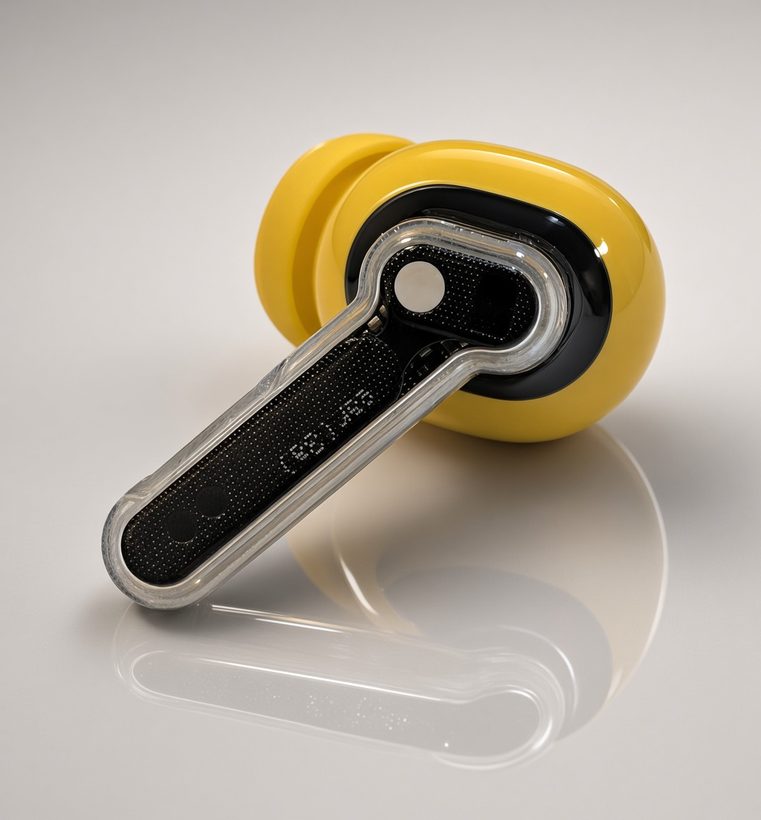
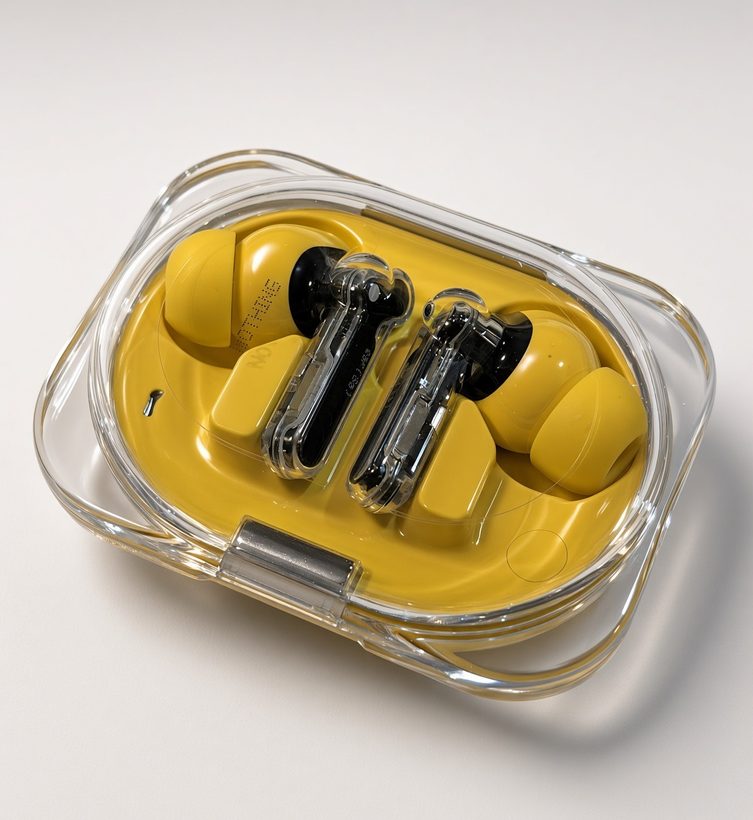
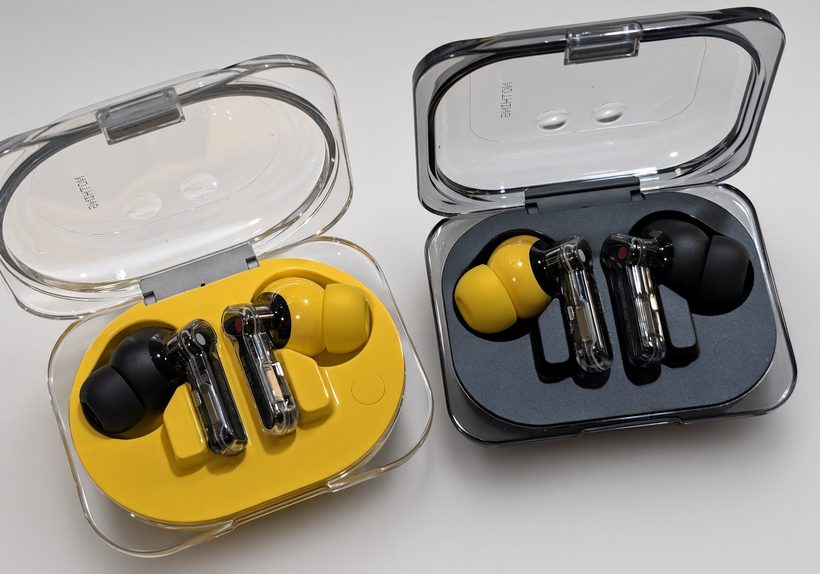
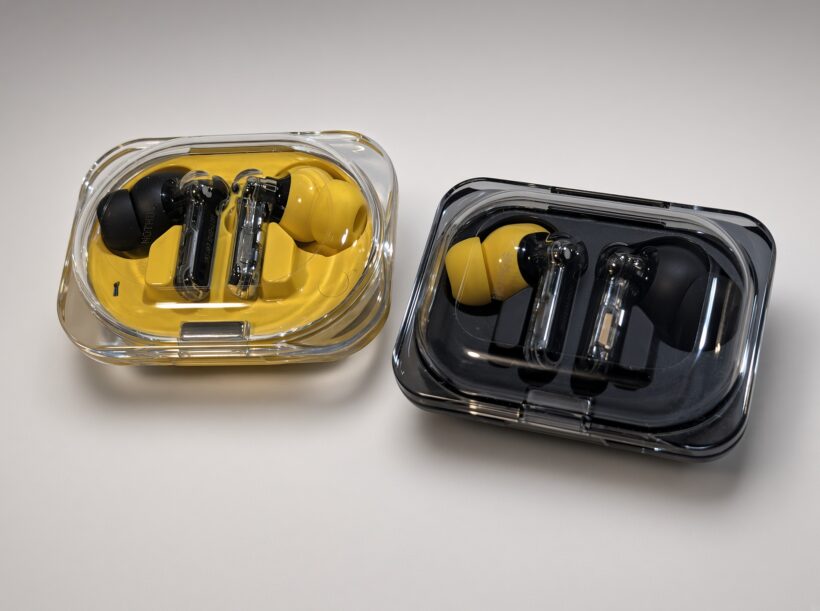
The Ear (3a) ships in Black, White, Yellow, and a new Pink at $99 / £99 / €99, A$179, ¥15,960, or 1,290 kronor. It went on sale 7 July 2026. We should have received them before D1; we didn’t because the last mile, whatever the country is, is always a mess. So here I have the Pink variant (yellow would have been more vibe). I will say colorful tech, or translucent, for me, are summer tech. It should be cheap, keeping it for at best 4 months, like a summer love, and back to business when you come back for work in September. That’s how I loved my summer when I was younger.
Each bud runs a 12mm dynamic driver, up from the 11mm in the Ear (a), with a PMI dome and TPU surround, 32 ohm impedance, and a claimed 20Hz to 40kHz range. Nothing says the bigger driver buys 5dB more bass. It does, and then some, which I will complain about shortly. Each bud weighs 4.53g, the case adds roughly 41g, and the whole package sits just under 50g on paper. Someone put a scale under it and got 51g, so call it accurate.
IP54 covers the buds and the case, which is less common than it sounds because most manufacturers protect the buds and leave the case naked. Nothing also says it baked the case at 75°C for 96 hours, a spec that reads like padding until you have left earbuds on a car dashboard in August.
Connectivity is Bluetooth 6.0 with a 15m claimed range, Google Fast Pair, dual-device multipoint across Android, Windows, and iOS, and a low-latency mode for gaming. Codec support is SBC, AAC, and LDAC at up to 24-bit/96kHz, with Hi-Res Audio certification. LHDC 5.0 is absent, which is the cleanest single line you can draw between this and the Ear (3). If you have a phone that speaks LHDC and you care, that is your $80.
Bluetooth 6.0 is worth a paragraph on its own because most coverage treated it as a version-number bump. The 6.0 spec mandates LE Audio and Auracast, and neither is exposed on the Ear (3a) at launch. The silicon is there. Whether Nothing ships it in firmware is an open question, and I wouldn’t buy these on that promise. What Bluetooth 6.0 gives you today is better connection stability in RF-dense environments, which is what actually shows up on a crowded train.
Batteries are 55mAh per bud and 500mAh in the case, matching the Ear (3). Nothing quotes 10 hours ANC off and 6 hours ANC on from the buds, 42 hours and 25 hours respectively with the case, and one hour of playback from a five-minute charge. I tried once and hit almost 10 hours, which is unusual, honestly, from a marketing department. I didn’t have the patience to run that multiple times, but as I almost achieved that, I think with time and battery wear, you will get less, but still that’s a nice number versus the pricing. Independent runs hit a low-battery warning at 9 hours with 10 to 15% left, so consistent. The number nobody advertises: turn on ANC and LDAC together, and you are down around 4/4.5 hours in the buds and roughly 20 hours total. Full bud charge takes about 70/80 minutes. There is no wireless charging, and it is USB-C or nothing. I mean, never mind; I’m using a short USB-C to USB-C and charging my buds using my phone anyway.
Three MEMS microphones per bud, six across the pair, with denser acoustic mesh over the ports for wind, and Nothing’s “Clear Voice” DSP trained on what the company says is 28 million scenarios. No bone-conduction VPU here; that stayed with the Ear (3).
| Ear (3a) | Ear (3) | Ear (a) | |
|---|---|---|---|
| Launch | Jul 2026 | Sep 2025 | Apr 2024 |
| Price | $99 | $179 | $99 |
| Driver | 12mm PMI | 12mm | 11mm |
| ANC | 45dB adaptive | 45dB adaptive | 45dB |
| Bluetooth | 6.0 | 5.4 | 5.3 |
| Codecs | SBC/AAC/LDAC | SBC/AAC/LDAC/LHDC 5.0 | SBC/AAC/LDAC |
| Mics per bud | 3 MEMS | 3 MEMS + VPU | 3 |
| Onboard storage | 32MB | none | none |
| Bud battery | 55mAh | 55mAh | 46mAh |
| Playback (ANC off) | 10h / 42h | 10h / 38h | 9.5h / 42.5h |
| Weight per bud | 4.53g | ~5g | 4.8g |
| IP rating | IP54 buds + case | IP54 | IP54 |
| Wireless charging | no | no | no |
| Parametric EQ | 8-band | 8-band | 3-slider only |
The ANC number and the ANC reality
Nothing claims 45dB of wideband adaptive cancellation and a 17.1% improvement over the Ear (a), with the gains concentrated between 400Hz and 2000Hz where traffic hum and office chatter live.
Obviously, I don’t have equipment for that; I can only compare them with my little ears :D.
So I searched for that, and some pro reviewers measured an average 80.9% reduction in perceived loudness across their samples, against roughly 57% for the Ear (a). That is not a percentage-point improvement; that is the difference between muffling a bus and mostly deleting it, and it is the single strongest generational argument the (3a) has. Isolation alone (the passive seal, before any electronics) came in around 62%, with a visible dip in the highs that better aftermarket tips would probably close. I tend to agree with these numbers in my comparison, but I guess it depends on everybody’s listening experience. And always check your tips to find the best ones for passive seal; it changes the experience a lot here.
What it does not do is compete with $250 earbuds. Every reviewer who took these on a subway reported hearing train screech and PA announcements bleeding through, and nearby human voices slip past more easily than low-frequency drone. Adaptive mode adjusts to your surroundings but does not do conversation detection, so no auto-pausing when someone talks to you at the coffee counter. Three fixed levels plus adaptive, and a transparency mode I have no complaints about: no artificial hollowness, no heavy compression, and Nothing uses its own sound effects instead of a recorded voice when you switch modes, which is a small charming thing.
Now, the part that annoyed me. The default tuning is a mess. Not broken, but the “Balanced” preset ships with dramatically over-emphasized bass and a dip just under 226Hz that pushes the mids down and makes the low end sound even louder than it measures. On busy tracks, the kick drum walks all over the vocals.

You will have to spend time fine-tuning them to your liking, and I’m wondering whether, at this price point, people will really take the time or think about it. But they should (as for a $250 or $ 500-worth product)
The app is the actual product
This is where I want to spend the most time, because Nothing X is the best companion app in consumer audio and the reason I would recommend these over a spec-equivalent competitor.
The equalizer has three layers. Simple gives you four presets (Balanced, More Bass, More Treble, Voice) plus a circular custom control with Bass, Mid, and Treble. Advanced gives you a real 8-band parametric EQ where each band exposes gain, center frequency, and Q factor. That is not a glorified tone control; that is the kind of tool you would find in a DAW plugin, sitting inside a $99 earbud app. Explore is the third layer, and it is a marketplace: EQ profiles built by Nothing, by collaborating artists, and by other users, shareable via QR code. I have not seen another manufacturer do this, and it is the correct answer to a bad stock tuning. SoundGuys published their own correction profile as a QR code, and even the quick fix (Simple tab, Bass at -5, Mid at +1, Treble at 0) pulls most of the boom out.
Controls are more flexible than the hardware suggests. Single pinch is locked to play/pause and answer/end call. Everything else is remappable: double pinch, triple pinch, pinch-and-hold, double-pinch-and-hold, and the both-buds-simultaneously gesture that no other earbud I have used offers. Pinching both stems at once is a new input, and it is what triggers recording. There are no swipe gestures for volume and no head-gesture nod controls, so volume means reaching for your phone or burning one of the hold gestures on it.
The rest of the panel: noise control with Low/Mid/High/Adaptive, transparency with no adjustment at all, a spatial audio toggle that quietly rewrites your EQ when you enable it (I leave it off), low lag mode, in-ear detection, multipoint device management, a codec switch between LDAC and AAC, Find My that plays a chirp from whichever bud is lost, and firmware updates. Pair these with a Nothing phone, and you get hands-free ChatGPT and Essential News AI briefings on top, which is ecosystem lock-in dressed as a feature.
Recording, and the four asterisks nobody put in the headline
Audio Snapshot writes up to 60 seconds of whatever is playing through the buds to that 32MB of flash. The clever bit is retroactive capture: the buds run a rolling buffer, so you can save up to 30 seconds that already happened before you pinched. Call Recording uses the same gesture and runs up to two hours, with an audible alert to both parties and a three-second countdown before it starts. Everything syncs to Nothing X where you can replay, crop, adjust playback speed, transcribe, and cut quote cards.
Then the asterisks.
It cannot record the room. Audio Snapshot captures the audio stream your phone is playing, not ambient sound around your head. Hands-on testing confirmed this directly, and it kills a large chunk of the use cases people imagined, including the “capture the melody in my head” pitch that music-industry coverage ran with.
The retroactive buffer requires LDAC to be off. Senses found this one, and it is the most consequential caveat in the whole review: the feature Nothing is marketing hardest is mutually exclusive with the codec Nothing is marketing second hardest. Pick hi-res audio or pick time travel.
Call recording is not available in the Nordics at launch, and Nothing’s language about “necessary regulatory and legal approvals” and market-by-market availability suggests other regions may be in the same position. Half the marquee feature set simply does not exist for those buyers.
And the transcription tiering is a subscription in a trench coat. Three models: fast and standard both run offline and stay free; pro runs in the cloud and is more accurate. You get three months of Pro free with 120 minutes of cloud time per month, after which there is a monthly fee. Nothing has been announced about when the plan will launch in September (need to check closer). Speaker identification, summaries, and calendar reminders were all slated to arrive after launch rather than in the box. The free offline models are fine for most things, and transcription quality on both English and Japanese source material tested well, including filler words.
I am not getting into how these stack up against the wider $99 field (EarFun, Soundcore, the Sony WF-C710N), because that comparison deserves its own post and its own listening time.
However, for their next one, paired with the mic-in-the-charging-case idea, it could be a nice feature/improvement, depending on the situation or what you want to live-capture.
Where I land
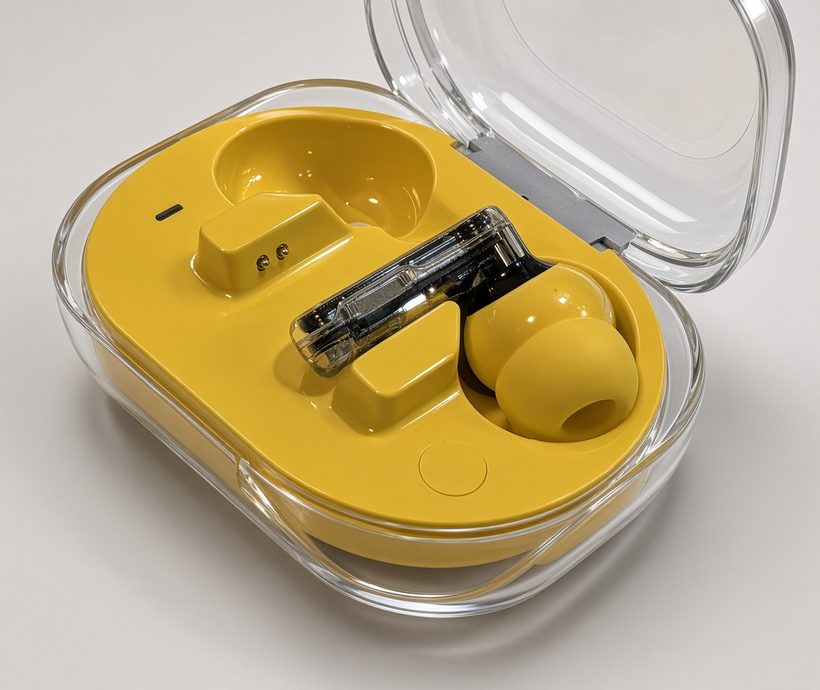
The case is a genuine design failure, and I want to say so plainly. Nothing wrapped a small, sensible pill-shaped core in a thick transparent frame inspired by blister packaging, and the result takes up meaningfully more pocket than the hardware inside it requires. There is no lip to grip, so you need a fingernail to pry it open, and one-handed opening takes practice. It is the only part of this product where the design language wrote a cheque the engineering had to cash.
Everything else, I would buy. At $99 ($79 during sales on Amazon), you get better cancellation than the buds it replaces by a wide margin, ten verified hours of playback, Bluetooth 6.0, LDAC, an IP54 case, microphones that handle wind better than anything else at this price, and a parametric EQ with a community profile marketplace attached. The stock tuning is bad, and you will fix it in four minutes with a QR code.
What I cannot shake is that the Ear (3) is $179 and the delta is LHDC 5.0, a bone-conduction pickup, a Talk button most people ignore, and a better case. Nothing has spent five years building a flagship tier and then kept shipping a value tier that eats it. If the (3a) sounds indistinguishable from the (3) to reviewers who own both, and it does, then the flagship’s job description is now unclear.
The 32MB is the bet worth watching. Not because Audio Snapshot is finished (it is not; it cannot hear the room, and it fights with your codec), but because putting writable storage in an earbud is the first structural change to the TWS form factor since ANC. Somebody with a bigger R&D budget is going to see this, remove the caveats, and ship it in 2027. Ask me then whether Nothing got credit for it.