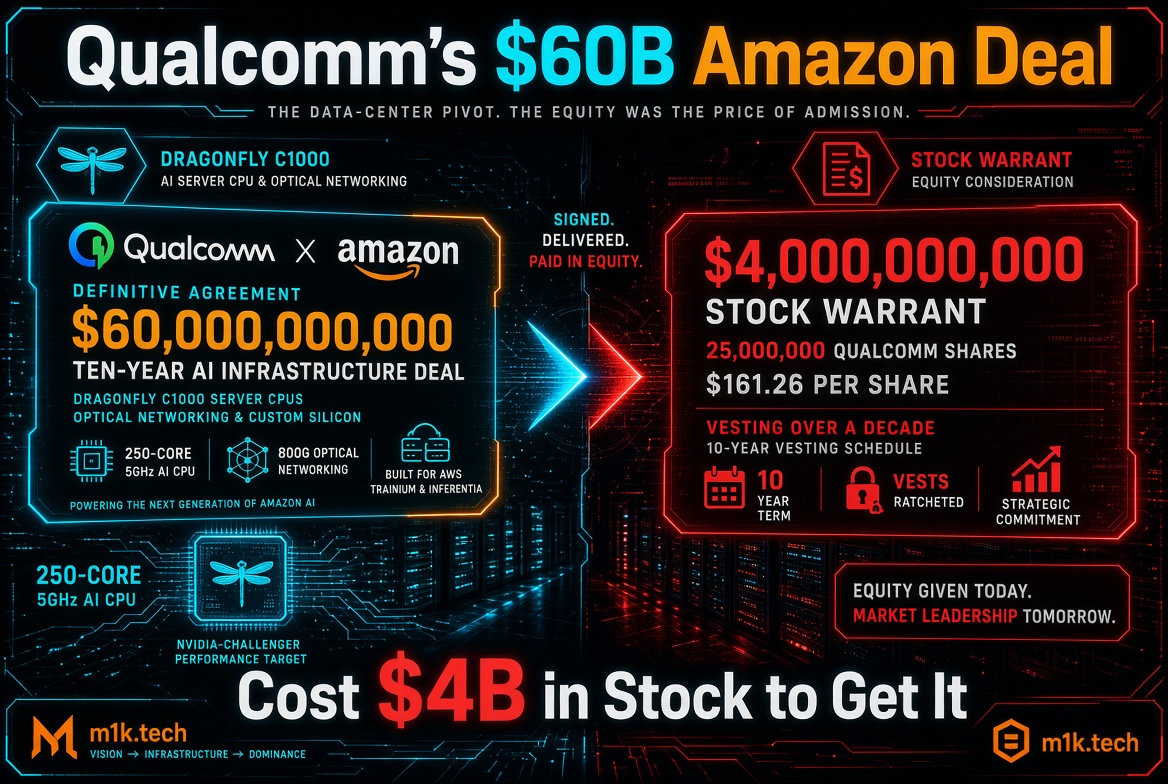
Qualcomm and Amazon signed an AI chip deal this week worth up to $60 billion in business, and Qualcomm threw in a $4 billion stock warrant to help close it. Amazon can now buy up to 25 million Qualcomm shares at a fixed $161.26 apiece over the next decade, vesting in tranches as the two companies actually strike the business agreements the warrant is tied to. Qualcomm’s stock jumped more than 7% Tuesday morning on the news, which tells you the market read the warrant as a feature, not a discount buried in the fine print.
Three months ago Qualcomm locked in a multi-generational AI chip contract with Meta for its Dragonfly C1000 server CPUs, chips with more than 250 cores at over five gigahertz in their most advanced form. Before that, it said Microsoft was on board too. Now it’s Amazon, and Qualcomm is also supplying the optical networking gear tying those chips together: SerDes and DSP silicon, including a CO400 chip that can push data twelve miles down fiber between data centers. That’s not a company diversifying out of smartphones anymore. That’s Qualcomm assembling an entire AI datacenter product line, chips and interconnect fabric both, three hyperscalers deep.
The warrant structure is the part I find more interesting than the chips themselves. Marvell ran almost the identical play with Google a few weeks back, a custom silicon deal wrapped around a stock warrant worth up to $12.2 billion, vesting against future orders. Qualcomm and Amazon just did the same thing at roughly a third of Marvell’s size. I wrote about Qualcomm’s $4 billion Modular acquisition as a bet against Nvidia’s software moat, and this is the hardware supply chain version of the same anxiety: if you’re not Nvidia, you apparently need to hand your customers equity just to get them to commit to volume. Whether that’s smart capital allocation or a sign these deals wouldn’t close on chip merit alone depends entirely on how many of these hyperscale contracts actually convert into shipped silicon over the next decade, and nobody outside these companies’ finance departments can verify that yet.
None of this happens in a vacuum for Qualcomm specifically. Apple’s modem business, which used to anchor a meaningful slice of Qualcomm’s revenue, is winding down as Apple finishes its move to in-house silicon, and Qualcomm has spent roughly the past year pitching cloud providers on an alternative to Nvidia’s dominant AI accelerators as the replacement business. Qualcomm’s AI pivot has mostly been described so far in terms of a roadmap and ambition. Three named hyperscale customers with actual contracts, even ones with vesting warrants attached, is the first time that pivot has looked like revenue instead of a slide deck.
I’m skeptical that this makes Qualcomm a genuine Nvidia threat anytime soon. Qualcomm’s own data center chip revenue is projected to hit something like $15 billion by 2029, which sounds enormous until you remember Nvidia does multiples of that in a single quarter. What this deal actually proves is narrower, and I think more useful: the chiplet and custom silicon trend I’ve been tracking as the thing quietly eroding Nvidia’s software moat now has Qualcomm as a credible third or fourth name at the table alongside Broadcom and Marvell, not just Amazon’s and Google’s own in-house Trainium and TPU efforts. Apple’s $30 billion Broadcom deal showed the same hyperscaler-goes-shopping-for-a-chip-partner pattern from a different angle a couple of months back. Equity attached, not just a purchase order, is becoming the default way these relationships get structured now.
On the side, I don’t know yet whether tying supplier and customer together through stock warrants ages well, or just delays the reckoning if the AI capex cycle ever actually slows down. That’s something time will tell.
Sources
- Reuters (via KFGO), Qualcomm strikes AI chip deal with Amazon, offers right to buy about $4 billion in stock, September 8, 2026
- SiliconANGLE, Qualcomm inks AI chip, optical networking deal with Amazon, September 8, 2026
- The Elec, Qualcomm, Amazon strike AI chip and optical networking partnership, September 8, 2026