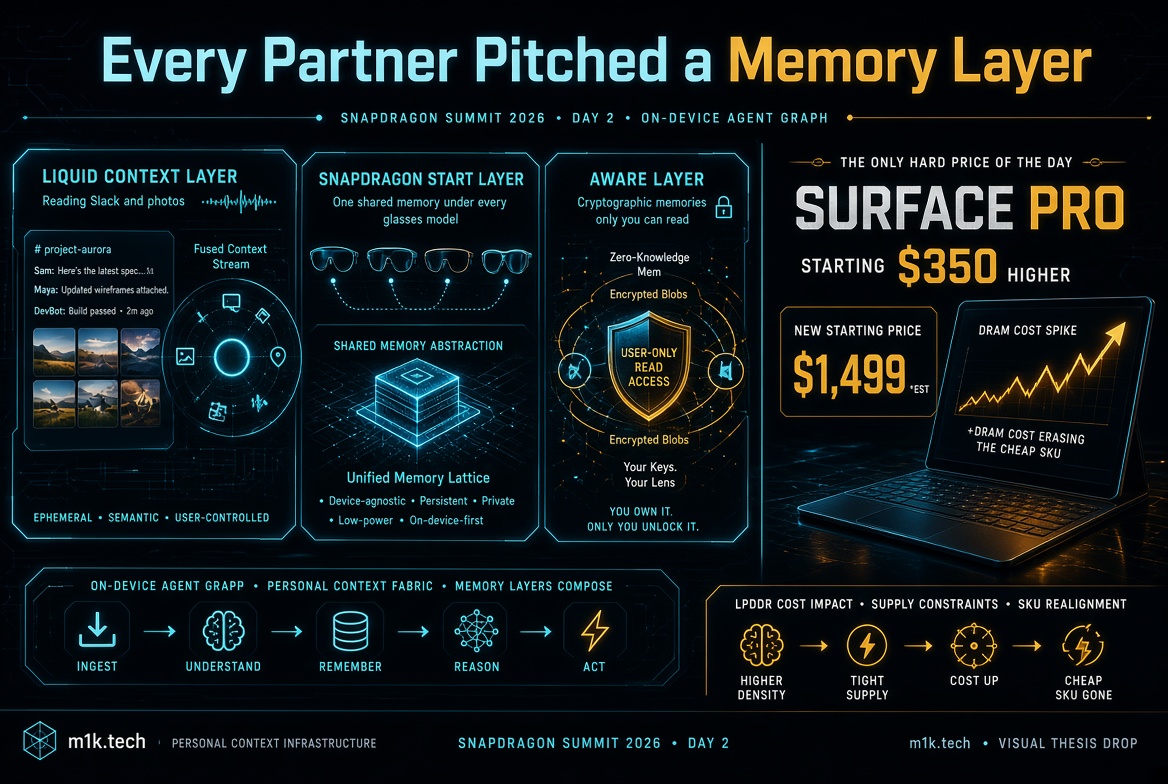
On the second morning of Snapdragon Summit 2026, Ramin Hasani showed Cristiano Amon an agent that had read his Slack, notes, and photos, and was drafting a post for X on its own because it had noticed he posts there constantly. It ran on the Hexagon NPU of a Snapdragon device, with the Sensing Hub feeding it signals and the CPU handling what Hasani called agentic sampling. The Liquid AI co-founder framed the whole demo as consent: “With my permission, it consumes all of whatever I give it access to.” Amon, moderating from the other chair, treated it as proof of everything Qualcomm had said in Maui the day before.
I kept rewinding that line, because it is Day 2 in miniature. Yesterday I argued that memory, the physical LPDDR kind, is what really decided where Qualcomm drew the line between the Snapdragon 8 Elite Gen 6 and the Extreme. Day 2 kept the word and swapped the meaning. Liquid AI announced a memory layer, Qualcomm pitched its own glasses software around one memory shared by every model, and a startup called Awear promised memories stored cryptographically so only you can read them. Everyone on stage wanted to be the part of the machine that remembers you. Then Microsoft showed up with the only hard price tags of the day, and the smallest Surface Pro now starts $350 above where last year’s launched. I don’t think it’s a coincidence that the other kind of memory got expensive in between.
Liquid Context on Snapdragon is two things glued together. One is a memory component that reads, compresses and writes whatever you let it see across your devices, abstracting your preferences into something an agent can query. The other is an agent layer that sits on top of that memory and runs locally. Hasani leaned hard on the word proactive: the agent is supposed to decide when to bring you something instead of waiting for a prompt, which is either the future or the most elaborate notification system anyone has built. Liquid’s models are small on purpose, 200 million to 24 billion parameters with open weights, pulling around 1.4 million Hugging Face downloads a week by his count, and he said the second generation of them was designed specifically for Snapdragon. His goal is to have LFMs on half of all devices manufactured each year by 2029. Liquid already has a production foothold behind that ambition, since it runs fully local in-car intelligence for Mercedes-Benz on Snapdragon Digital Cockpit.
The sentence I care about came in the back half of the conversation. Liquid Context is a B2B product: phone makers license it, customize the model and the harness, and, in Hasani’s words, “OEMs can own their own intelligence.” Put that next to Rick Osterloh’s pitch on Day 1, where Gemini Intelligence is supposed to carry your context from phone to car to Googlebook, and you get the fight that actually matters at this Summit, which has nothing to do with cloud versus edge. Amon called arguing about cloud and edge “a useless exercise” on stage, and I half agree with him, because once you drop that argument, the question left standing is who holds the file. Google would like to. Xiaomi or Honor could, with Liquid underneath. Qualcomm, through its own glasses platform, would also quite like to. Personal Scribe on the Gen 6 already builds a private knowledge graph from your conversations, and at least three companies are now proposing to be the layer on top of it.
Hasani also borrowed “slop grenades”, a phrase he credited to Shopify’s CEO, to describe what AI-assisted developers keep lobbing into codebases. On a stage paid for by a company selling AI to developers. I laughed at my desk.
Ziad Asghar’s keynote opened with the history-of-interfaces slide every wearables talk now carries: keyboard and mouse for the PC, touch for the phone, something new for agents, and then got specific faster than I expected. Per Qualcomm, the Snapdragon AR1 and AR1+ are the first personal AI platforms to support multiple 1-bit models at once, with PrismML supplying the models. The demo that sold it for me was the plainest one of the day: glasses running an assistant in airplane mode, describing an apple to someone who can’t see it and guessing Gala, Fuji, or Honeycrisp. I’ve been around Snapdragon pre-release hardware since 2006 and have sat through more glasses demos than I can count, and most of them want you impressed by an overlay. This one wanted the wearer to be independent.
Snapdragon START is Qualcomm trying to shorten the road from chip to shelf. It bundles a tiny AR1+ module, a software stack spanning the glasses, a companion phone app and a cloud service, and white-label designs for brands that don’t want to build from scratch. Cameron Slaviero’s demo booked a restaurant through Yelp and started music through SoundCloud without touching a phone. The design choice I liked more than the demo sits underneath it: brands can pick different models from a catalog, but START keeps a single memory under all of them, so swapping the model doesn’t wipe what the assistant knows about you. Qualcomm promised “clear visibility into what information is remembered.” Good. Show me that screen.
The partner who stole the morning wasn’t a tech company. Robin Totterman has spent 38 years in eyewear. Inspecs owns its own factories and sells through 75,000 optical and retail outlets in 80 countries, and he opened by joking that the spring hinge was his industry’s last real breakthrough. His pitch reframes the camera-on-your-face problem I’ve been writing about for months. Hundreds of millions of workers put on safety glasses every shift because a regulation says so, and nobody has to make that aspirational. On a factory floor or an oil rig, a camera is already part of the job, which means the bystander fight playing out in the class action over Meta’s AI glasses mostly doesn’t exist there. Qualcomm invested in Inspecs in June, and Totterman says his team went from kickoff to a working device in four months on AR1+ Gen 1. The family has an impact-rated enterprise frame with a camera in the bridge, an audio-only version, and a pair that combines prescription lenses with hearing assistance.
That last one got me. Totterman said people wait around nine years before doing anything about hearing loss, and it isn’t the cost that stops them; it’s that the loss creeps up until one day a restaurant is too loud. Glasses stopped being a purely medical object a long time ago; hearing aids never made that jump. A frame you’d buy anyway that quietly handles the restaurant problem is the first smart-glasses use case I’ve heard this year that I would recommend to people who will never read this blog.
Awear’s Ash Saulsbury went for the grand speech, Steve Jobs’ bicycle for the mind and all: “For 40 years, we have been pedaling the bicycle. That era ends today.” His Agentic System One puts eyewear at the center of your devices, and his demo folded seven apps into one spoken request for an Italian dinner near Asghar’s hotel. I’ve heard “the apps disappear” at roughly every other keynote since the chatbot craze of 2016, so I’ll wait for the product. The part I will hold him to is the memory claim, stored cryptographically and built to be accessible only to you. It was the strongest privacy promise anyone made in Maui, and it came from the smallest company that made one.
Qualcomm also previewed a personal AI pin reference design on Snapdragon Wear Elite, with standalone 5G, dual cameras and on-device AI, and promised more next year. We all remember how the last famous AI pin went, so I’d rather talk about this one once a partner’s name is on it. Speaking of names, back in August I flagged two unshipped products Asghar had mentioned in an interview, Motoko and Maxwell. Neither came up on stage. Google’s Shahram Izadi filled the partner slot instead: Pixel Watch 5 runs Snapdragon with Gemini Intelligence, Android XR glasses built with Gentle Monster and Warby Parker arrive later this year on AR1, and XREAL’s Aura becomes the first device on Snapdragon Reality Elite. Snap brought its Specs, launched the week before, and Asghar said Qualcomm is working with Samsung on watches, XR and eyewear. I’m not getting into Aura’s puck architecture or the state of Android XR here, that’s its own post.
The Personal AI Health Alliance goes in my call-me-when-there’s-a-study pile. Qualcomm launched it with Global Health Connector and a first cohort of Optum Health, Scripps Health, Merck KGaA, the Digital Medicine Society and Biocom, pitching wearables that predict falls (the keynote video cited 37 million a year) and ambient documentation for physicians who spend about six hours a day in electronic health records. On-device processing is the privacy argument. There are no products and no results yet, only proofs of concept promised on PAIHealth.org.
Snapdragon Sound Elite Gen 2 is where the personal AI story gets a chip you can put in something. The headline isn’t audio. For the first time Qualcomm has integrated Bluetooth and micro-power Wi-Fi 6E on the same audio platform, so earbuds can reach a cloud service directly instead of relaying every request through your phone. On top of that sits Snapdragon Sound Apps and Agents, effectively an app ecosystem for hearables, with Cinemo and Roon on board and a route to services like Qobuz. The on-board eNPU is rated at 128 GOPS, double the previous generation, and Qualcomm claims a 30% smaller footprint and up to 40% lower power. Keep some salt handy for that last figure, because it comes from simulation and final silicon isn’t in yet. aptX Lossless, fifth-generation Adaptive ANC and an AI-enhanced cVc voice stack fill out the spec sheet, HP is building a product on the platform, and Bose is working with Qualcomm on future generations.
The Cleer concept is the part I’ll be arguing with people about. It’s an earbud with a camera, and Qualcomm’s framing is that it collects context for your agent rather than taking photos or video. I wrote about exactly this move when Apple’s own software leaked its camera AirPods: earbuds don’t announce that they’re watching the way a lens on a pair of glasses does, which is great for bystander comfort and terrible for bystander consent. The context-versus-photos distinction matters to the engineer who wrote the pipeline. The person sitting across from you at dinner has no way of knowing which one is running.
Chris Lattner’s first Snapdragon Summit talk was the most technically candid session of the week. Mojo hit 1.0 last month and is now open source under Apache 2.0, MAX handles serving, Modular Cloud handles deployment, and Lattner said the stack now runs on six accelerator architectures from six different vendors, one of them Qualcomm’s own Dragonfly data-center family. Microsoft’s Logan Iyer appeared on video to confirm native Windows support for Mojo is in the works. When Qualcomm announced the Modular deal in June, I wondered how long Switzerland stays Swiss once it has a landlord with a chip roadmap. Three months after the close, six vendors is decent evidence that it still is. The caveat came from Lattner himself, who said bringing the stack to Snapdragon has only just started, so the phone-side payoff of the Hexagon NPU becoming an ordinary compile target is still a promise. His best line of the Summit: “AI hardware’s only going to get weirder.”
Kedar Kondap’s PC keynote brought a lot of numbers and no new silicon. More than 7,300 apps now run natively on Windows on Snapdragon, across more than 170 designs, sold in 12,000 stores in 120 countries. The “agentic PC” is the Snapdragon X2 Elite that has been shipping in laptops since spring, now quoted at up to 85 TOPS. When I went back over the X2 Elite two years into the Snapdragon X story, the NPU was 80 TOPS, and nobody in Maui explained where the extra five came from. The local-agent demos ran AnythingLLM, LLMWare and OpenClaw, backed by claims of a 200,000-token context window, 30-billion-parameter models and 228 GB/s of memory bandwidth, all of them describing a chip that was already on store shelves before summer.
The part of that keynote I’ll actually use is Linux, and this time the word Qualcomm attached to it is official. “Developers are asking us for one thing: Linux on Snapdragon. We have heard you,” Kondap said, and Qualcomm’s own write-up now calls Linux the third operating system on the platform. Debian comes first, with support by the end of this year. Canonical is certifying Ubuntu for the Snapdragon X2 Series with a first-half-of-2027 target, and HP, ASUS and HUMAIN all say they’re planning Linux support in that same window, with ASUS naming the Zenbook A14 and A16 as its first Ubuntu machines. What makes me take it more seriously than the dates is the driver plan. Qualcomm says it is upstreaming the core X2 drivers, the Hexagon NPU through fastRPC and the Adreno GPU through the open-source Mesa stack (Freedreno, Turnip and Rusticl), which is the difference between a supported platform and a vendor kernel you pray over after every update.
I’ve been burned by this promise before, so the fine print matters. In May 2024 Qualcomm said X Elite kernel patches would land within days, an experimental Debian installer followed that only ran on reference hardware, and for two years Linux on shipping Snapdragon laptops was mostly Linaro, Tuxedo and the community doing Qualcomm’s homework. The developer preview available now pairs a Debian 13 userspace with a custom kernel, and you build the kernel and device tree yourself before flashing a boot image onto the machine, so it’s aimed at people who enjoy that sort of evening. Official support starts at the X2 Series, which leaves every first-generation X Elite owner out, including, awkwardly, the Googlebooks Qualcomm just launched on that chip, even though the same blog post lists Googlebook as Linux’s sibling on the platform. SteamOS isn’t in the plan and the Red Hat side of the Linux world isn’t part of the first push. Realistically, nobody buys an X2 laptop that ships with Linux before mid-2027. I’ve wanted a properly supported Linux Snapdragon laptop since the first X Elite, and it took a second generation and more than two years to get a date on a slide. HUMAIN also confirmed its Horizon Ultra, an agentic-OS machine on X2 Elite, for the first half of 2027.
Google’s John Solomon built the Googlebook case around what he called the toggle tax of bouncing between an Android phone and a laptop, and promised up to 19 hours of battery, the full Play Store and a Linux environment where developers can run tools like Claude and Codex CLI. The NPU figure on his slide was 45 TOPS, which is the first-generation X Elite I complained about yesterday. It keeps being the part of this partnership I can’t get past: Google’s new laptop platform launched on Qualcomm’s 2024 chip in the same week Qualcomm spent an hour telling me its 2025 chip is the agentic one.
Then there was Microsoft. The Surface Pro 12-inch and Surface Laptop 13-inch move to a six-core Snapdragon X2 Plus with an 80 TOPS NPU, both ship October 13, and Microsoft claims 22 hours of battery and 95% faster local AI inference on the Laptop. The Pro starts at $1,149.99 and the Laptop at $1,199.99, against $799 and $899 when the first versions launched in 2025. Part of that jump came with April’s lineup-wide price increase, and a like-for-like 16GB/256GB Pro is only about $100 more than before. The rest of the gap is a configuration that no longer exists, because Microsoft dropped the 8GB model and every unit now ships with 16GB or 24GB. Qualcomm’s Hexagon pitch as its answer to the RAM crisis was about squeezing models into less memory. Microsoft’s answer, in the middle of a DRAM shortage, was to stop selling the machine with less memory in it. A $79.99 haptic Surface Mouse and a Manchester United limited-edition Surface Laptop you have to win through a QR contest were the lighter moments.
So I’m leaving Day 2 with two meanings of memory that never talked to each other on stage. The physical kind is quietly deleting the cheap tier of every product it touches, Qualcomm’s flagship on Day 1 and Microsoft’s smallest PCs on Day 2. The context kind is what every partner wanted to hold. Liquid wants your phone maker to own it and Google wants Gemini to carry it from car to laptop; only Awear, the smallest company in the room, phrased the promise around me. I’d trade those extra five TOPS for a settings page that shows me what the agent remembers and lets me delete it. Nobody demoed that screen this week. Ask me in six months whether anyone shipped it.
Sources
- Investing.com, Qualcomm at Snapdragon Summit 2026: full Day 2 keynote transcript, September 23, 2026
- The Gadgeteer, Snapdragon Summit 2026: Qualcomm’s AI bet reaches phones, earbuds and PCs, September 23, 2026
- HotHardware, Qualcomm Snapdragon Sound Elite Gen 2 Brings AI Agents To Your Earbuds, September 23, 2026
- Qualcomm, Inside Snapdragon Summit 2026: Agentic AI PCs, Googlebooks and Linux, September 23, 2026
- ITdaily, Linux officially coming to Snapdragon X2: Debian by end of year, Ubuntu certification in 2027, September 23, 2026
- ServeTheHome, Qualcomm Announces Snapdragon X2 Debian and Ubuntu Support, September 23, 2026
- ITdaily, Qualcomm applies new label to Snapdragon X2 Elite, September 23, 2026
- ITdaily, Qualcomm aims for ‘personal AI’ in your ears and in healthcare, September 23, 2026
- 9to5Google, Microsoft launches 12-inch Surface Pro with Snapdragon X2 Plus and 5G, September 23, 2026
- Tom’s Hardware, Microsoft brings Snapdragon X2 Plus to 13-inch Surface Laptop, 12-inch Surface Pro, September 23, 2026