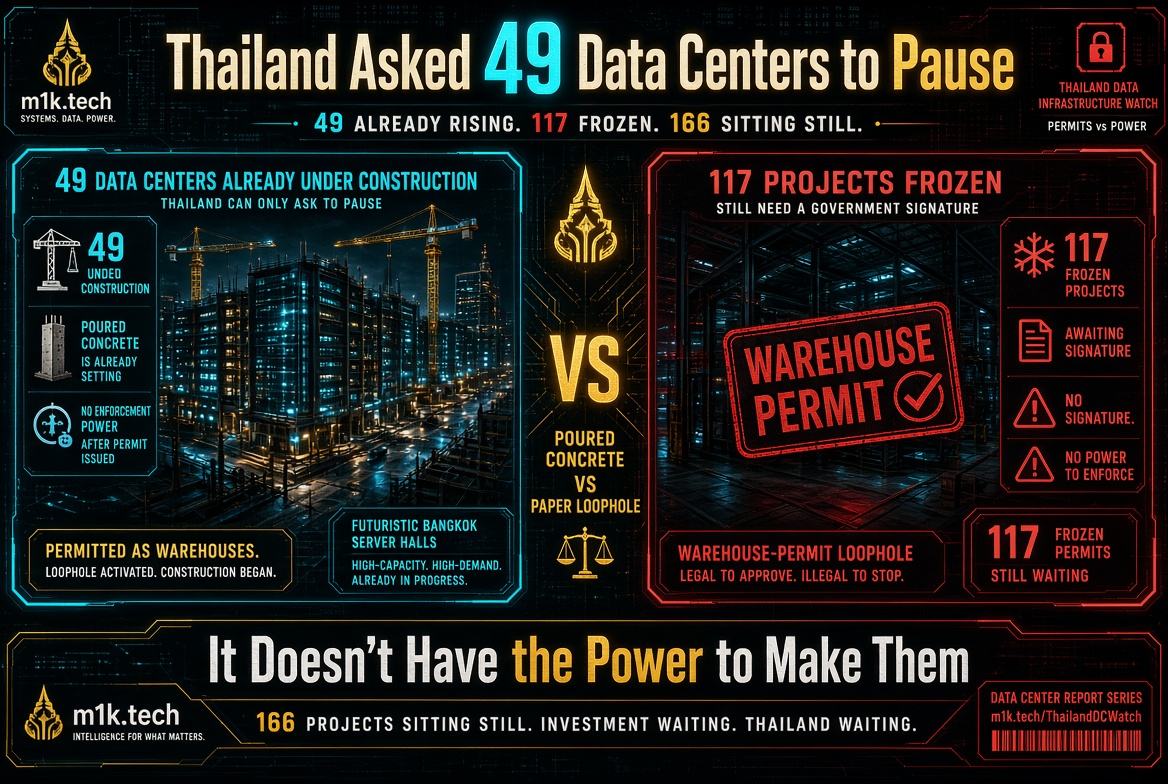
Danucha Pichayanan said what officials usually don’t admit. His own council, Thailand’s National Economic and Social Development Council, lacks the legal power to stop the 49 data centers currently under construction across the country. It can only ask. Last Friday it asked anyway, telling every operator with concrete already poured that it would appreciate them holding off, purely as a favor, while the government spends the next month writing rules it probably should have written years ago.
The part it can actually control is different. All 117 projects still waiting on government approval got frozen outright, no request-and-hope-for-cooperation dance required, since those need a signature to move forward at all. Add the 49 under voluntary pause, and you get 166 projects sitting still at once, more than the 35 data centers Thailand currently has up and running. I don’t think I’ve seen a country freeze more capacity than it operates before, not like this, not in one afternoon.
What forced the meeting wasn’t a blackout. It was a data center going up next to a hospital in Bangkok, close enough that residents complained loudly enough for Governor Chadchart Sittipunt to go looking for the paperwork behind it. What he found was a filing category: data centers in Thailand have apparently been getting permitted as warehouses, a classification built for pallets and forklifts, not tens of megawatts of server racks and the water needed to cool them. One facility was separately caught stockpiling 200,000 liters of diesel in underground tanks without a permit, which is the kind of detail that makes a loophole sound less like an oversight and more like a habit.
None of this reads as Thailand turning hostile to an industry it has spent two years courting. Microsoft committed over a billion dollars to cloud and AI infrastructure there back in March. Google opened a Bangkok cloud region in January that it says will put forty billion dollars into the country over five years. The Board of Investment approved 88 AI and data center projects worth roughly 27 billion dollars in the first half of this year alone. Prime Minister Anutin Charnvirakul framed the goal as making the rules airtight, not closing the door, and four subcommittees now have one month to write standards covering town planning, building separation, backup fuel storage, and the environmental review a warehouse permit was never going to require.
I’ve watched American cities try a version of this that looks nothing like what Thailand just did. New York drew a hard line at 50 megawatts and forces anything above it through review, one clean threshold applied evenly. Chicago went the opposite way, an executive order that never actually defines what a data center is, used as leverage against one specific project at the old US Steel site while the neighborhood still fights for a community benefits agreement in writing rather than a mayor’s press release. Both of those are scalpels. Thailand reached for the whole pipeline at once, willing operators and unwilling ones together, because by the time regulators noticed the warehouse trick, it wasn’t an edge case anymore. It was apparently how the industry had been getting built.
What actually gets me is how unglamorous the workaround was. Nobody forged a document or bribed an inspector. Somebody filled out a form that said warehouse for a building that draws tens of megawatts, and it worked long enough for over a hundred more projects to line up behind the same trick. This lands the same week Europe is still treating AI sovereignty as a panel topic while whoever shows up with capital builds the actual infrastructure. Thailand just exercised the bluntest sovereign tool a government has: the power to stop signing permits, and it took one afternoon, not a summit.
The 49 already under construction aren’t going anywhere regardless of how this shakes out. That concrete is poured whether the government’s request lands or not. The number I’d actually watch is 117, the ones still waiting on paper the government controls completely, and whether the standards due next month close the warehouse gap or just give it a new stamp. I have no idea which way that goes yet, and neither, from the sound of it, does Danucha.
Sources
- The Register, Thailand pauses all datacenter builds and approvals, September 7, 2026
- AFP via The Phuket News, Thailand moves to tighten data centre rules, September 6, 2026
- The Next Web, Thailand halted more data centres than it has running, September 6, 2026
- DataCenterDynamics, Thailand pauses construction on 49 data centers, as it plans new regulations, September 7, 2026