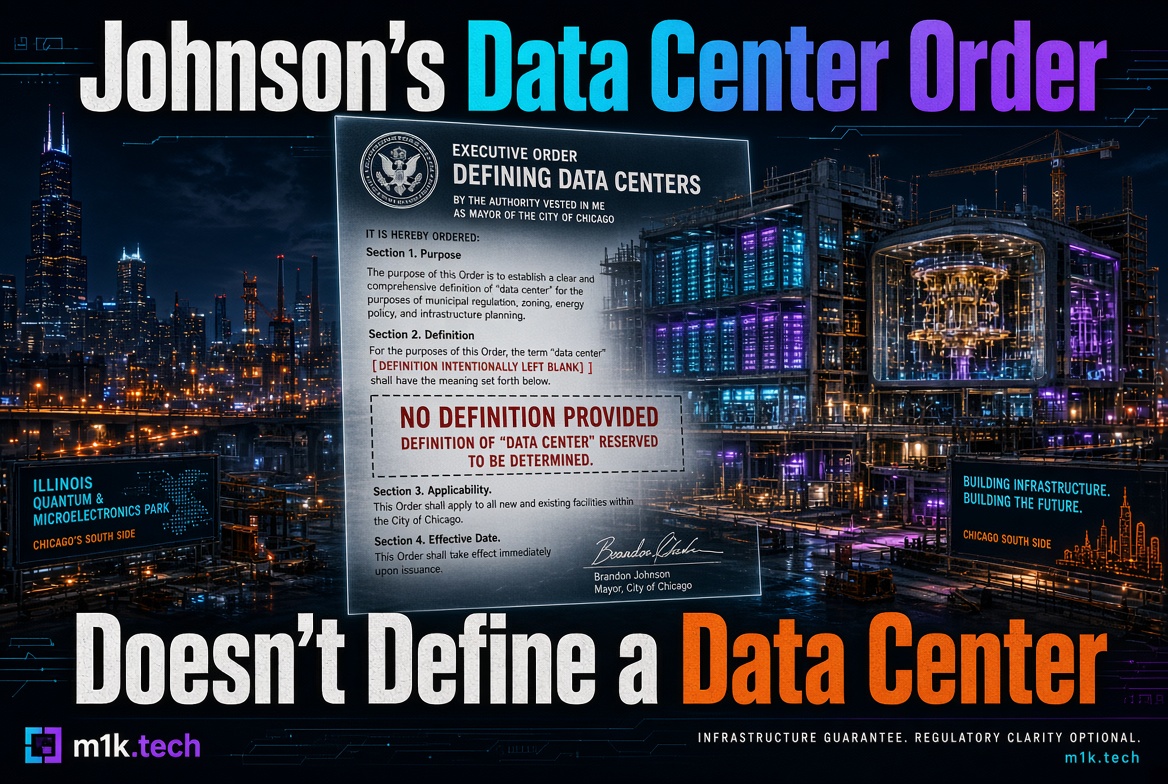
Chicago’s new data center order runs six pages, cites eleven chapters of the municipal code, and never once says what a data center is. The definition is homework. Executive Order 2026-5 tells the Chief Sustainability Officer that her new air-permit conditions “shall include a clear description of the types of data centers to which the conditions shall apply,” and Section 2 tells her to write noise rules for data centers “as that term is defined by those rules.” Ninety days from August 11, so roughly November 9, Chicago will finally learn which buildings the mayor just spent a press conference at Northerly Island promising to regulate.
Four days after signing it, Brandon Johnson walked into a packed room in South Chicago and used that order as collateral. Residents had come to demand he oppose the Illinois Quantum and Microelectronics Park going up on the old U.S. Steel South Works site, which they call a data center and which the campus CEO calls a research and development campus. Johnson did not oppose it. What he offered instead was this: “I did receive a letter from the developers of the campus saying they will not proceed with a data center on this particular campus. If they were to do that, they would be strictly bound by to the executive order that I put forth to provide stronger regulations.”
A letter and an order. I read the order because the letter is not public and the order is, and the order does not do what he says it does.
The part of Executive Order 2026-5 that would actually reach a project like this is Section 3, which requires enhanced interdepartmental review of “every proposed Planned Development that includes a data center.” Projected electricity demand, water consumption, backup generation, cumulative environmental impact, all of it goes into the record, and four commissioners get sixty days to attach conditions the planning department must then write into the ordinance. That is a real mechanism. It also targets planned developments still in the pipeline. Quantum Shore’s is not in the pipeline. The Chicago Plan Commission approved the rezoning of more than 400 acres at that site in November 2024, after a nearly six-hour hearing at Harold Washington College where most of the seventy-plus people who signed up to speak spoke against it, and City Council signed off in December. The zoning is done. The land changed hands in September 2025, and the whole 440 acres went into the state EPA’s voluntary remediation program a month later.
Then there is the line at the very bottom of the order that I did not expect to find, and which nobody covering the signing seems to have mentioned. Section 3 “shall be automatically rescinded upon the effective date of an ordinance enacted by the City Council establishing a temporary moratorium.” The enhanced review deletes itself the moment Johnson gets the thing he is publicly asking the Council for. That is defensible drafting, since the moratorium is supposed to be a harder stop than the review it replaces, and it is still a strange guarantee to wave at a hostile room. The mayor’s assurance rests on a definition that hasn’t been written, applied through a section that expires on his preferred outcome, to a development whose approvals are already in hand.
The thing about the “it’s not a data center” line is that the site plan disagrees with it, or at least did before this became politically hot. PsiQuantum’s first phase is an 88,000-square-foot office and lab building on the southeast corner of the 128-acre park, with a cryogenic cooling facility and three data and computing buildings queued for later phases. Beyond that, per the master plan reporting, nearly 300 acres sit open for additional office and lab space, data centers, and other computing infrastructure. The Wikipedia article on the park now opens by asserting it “is not an AI data center,” which tells you where the argument has landed and how thin the ledge is. Meanwhile, the city’s own Sustainable Data Centers Working Group, whose July report this executive order is built on, waved off hyperscale facilities as “unlikely” inside city limits, even though one has already been pitched for a South Side site that is zoned to allow it.
I want to be fair to the physics here, because this is my lane and the technical case for the distinction is real. PsiQuantum’s machine runs on silicon photonics with superconducting detectors cooled to the two-to-four-kelvin range in a closed helium-and-nitrogen loop, which is why the state funded a $200 million cryoplant rather than a cooling-tower farm. That is a completely different resource profile from a GPU cluster training a frontier model, and the working group’s own numbers put a typical Chicago data center at around 300,000 gallons of water a day against roughly five million for a hyperscale facility. When I wrote about the park a few days ago, I argued that Illinois deliberately bought the whole table rather than betting on one qubit architecture, and that shared cryogenic infrastructure is the actual product. None of that changes because activists showed up on a Saturday.
But the categories are collapsing in real time, and I say that having watched Oracle physically install a Quantinuum Helios machine inside one of its own cloud data centers last week specifically so GPU workloads could sit microseconds away from qubits. Co-location is where this industry is going, and the scramble to bolt dedicated generation onto compute campuses is the clearest signal of how much power everyone expects these sites to eventually pull. A 440-acre master-planned district financed by Blue Owl Capital, a private-credit house that is one of the largest backers of AI and data-center infrastructure on the planet, with roughly 300 unallocated acres and tenants nobody has named yet, is not a building. It is a zoning envelope. Asking whether the quantum computer is a data center is the wrong question. The question is what fills the other 300 acres in 2031, and whether the definition being drafted right now in the Department of Environment will say anything about it.
The money is where the viral version of this story gets both its force and its errors. The CODEPINK Chicago piece that has been circulating since August 13, headlined “The Quantum Con,” is the source of most of what people are reposting, and it is filed under that organization’s national data centers campaign. Its strongest claims hold up. DARPA is on the site as the Illinois-DARPA Quantum Proving Ground, with $140 million in federal funding matched by the state. Southside Together collected enough signatures for a nonbinding referendum asking whether officials should stop the project, and the Board of Election Commissioners struck it from the March ballot on a single-subject technicality, only the third such challenge since 1980. The public money is enormous: about $960 million committed so far, roughly $700 million from Illinois, $20 million from Cook County, and $5 million pledged by Johnson from a strained city budget.
Where it slips is on the specifics people are repeating fastest. Quantum Machines is described as an investor; it is the park’s sixth tenant, an announced lab, and while its management sits in Tel Aviv, the company is incorporated in the U.S. with a majority of American shareholders and subsidiaries across four countries. One tenant is not an “Israeli company.” And “Illinois taxpayers are footing most of the bill” was closer to true in February than it is now, because in May the Commerce Department signed CHIPS Act letters of intent worth a combined $1.2 billion with four companies slated to operate at the campus, taking minority equity stakes in exchange. Federal money is now the larger line. That does not make the criticism weaker. If anything, it makes the Pentagon half of the complaint more accurate and the state-taxpayer half less so, which is not the trade the post was going for.
I am not going to litigate the war-machine framing itself, which is a real political argument about what quantum research is for and who it eventually serves, and which deserves better than a paragraph from me at the end of a piece about municipal permitting. Other people are making that case at length, and you should read them.
Look at the jobs math, because it is the one number that has not moved in eighteen months of promises. The state’s tax incentive agreements with quantum companies at the park require 240 new jobs. Total known IQMP-related jobs across every public announcement sit just over 300. PsiQuantum’s own initial phase projects at least 150, and its community contribution so far is the $250,000 it put into South Chicago classrooms this summer. Set that against $960 million in public commitments, thirty years of Cook County Class 8 MICRO property tax relief, and a mayor who has told audiences the project could bring 175,000 jobs and $20 billion. That gap is not a rounding error, and it’s why a room full of people in South Chicago did not accept a letter as an answer.
So watch November. The rules the Chief Sustainability Officer publishes will contain the only definition that matters, and the shape of it will tell you everything. If it lands on a megawatt threshold, the quantum campus probably clears it for years, and the argument moves to whoever leases those 300 acres. If it lands on use, on what the computers inside are actually doing, then the sorting gets messy fast, because a cryoplant feeding a photonic machine and a diesel-backed rack hall are not the same building in any sense a noise ordinance can measure. Every jurisdiction writing these rules right now is discovering that “data center” was never a legal category, just shorthand everyone agreed on when it didn’t cost anything.
Johnson had a defensible answer available on Saturday. He could have said the campus is already zoned, that the enhanced review does not reach backward, that a developer’s letter is worth exactly what a developer’s letter is worth, and that the moratorium he wants from Council would not touch this site either. Instead, he offered a guarantee built on a document that leaves its central term blank. The room booed. Given what is actually in the order, I am not sure they were wrong to.
Sources
- City of Chicago, Executive Order No. 2026-5, “Protecting Chicagoans’ Clean Water, Clean Air, Energy Affordability, and Quality of Life,” August 11, 2026
- WTTW News, Johnson Calls for Temporary Moratorium on Data Centers, August 11, 2026
- WTTW News, What Does Sustainable Data Center Development Look Like? Chicago Working Group Makes Recommendations, August 13, 2026
- CBS Chicago, South Side residents protest new development at former South Works steel site, August 15, 2026
- Chicago YIMBY, Illinois Quantum And Microelectronics Park Moves Closer To Groundbreaking, September 11, 2025
- WBEZ, Chicago Plan Commission approves controversial quantum computing project at old South Works site, November 22, 2024
- Capitol News Illinois / Illinois Answers Project, How much public and private money is powering Chicago’s quantum push?, February 2026
- Illinois Answers Project, Chicago’s quantum hub has some of the highest state funding per job, February 5, 2026
- The Quantum Insider, Quantum Machines Becomes Sixth Tenant at Illinois Quantum Park, February 4, 2026
- Hyde Park Herald, Trump administration takes equity stakes in four Illinois quantum campus companies, June 2026
- CODEPINK, The Quantum Con: How Chicago’s Southside Became a Sacrificial Altar to the War Machine, August 13, 2026
- Illinois EPA, IQMP / Quantum Shore site remediation