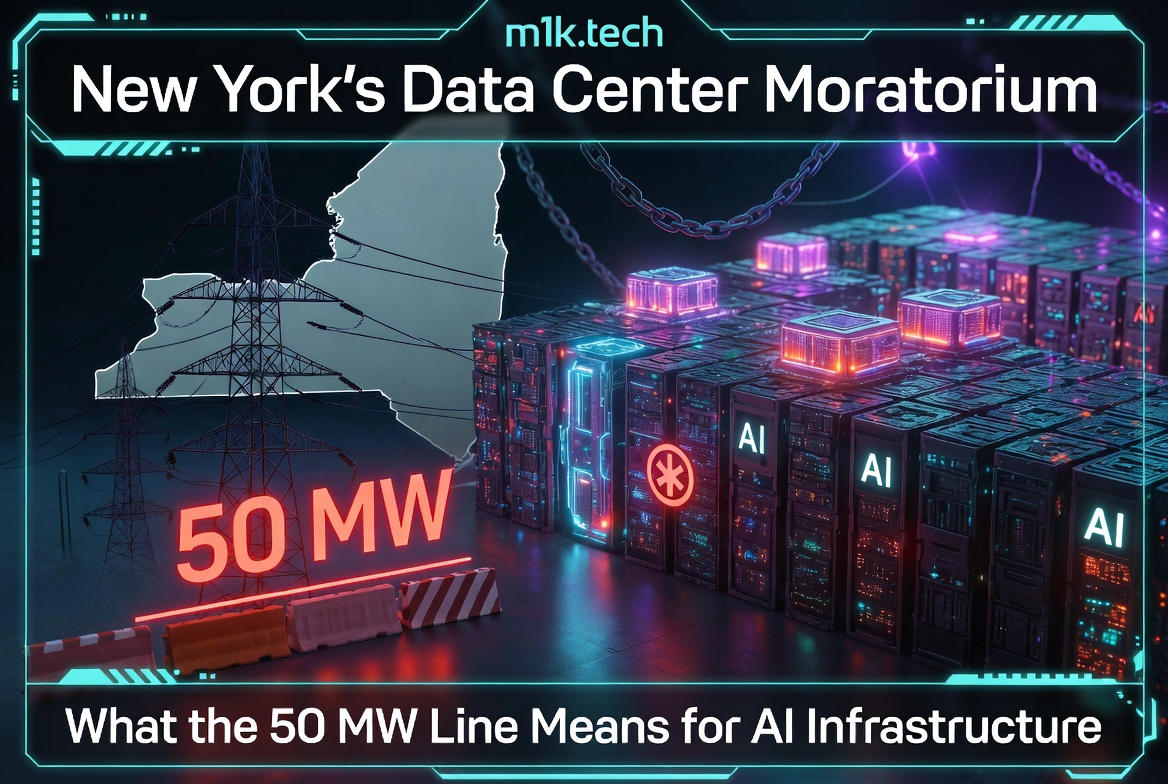
New York Governor Kathy Hochul signed an executive order on July 14, 2026, making New York the first state to halt construction of new large-scale AI data centers, freezing any hyperscale facility drawing 50 megawatts or more for up to one year. The moratorium is driven by rising residential electricity rates, local opposition to proposed campuses, and polling showing broad bipartisan voter support.
The policy uncertainty extends beyond the executive order, as pending legislation could lower the threshold to 20 megawatts and proposed measures to eliminate sales tax exemptions may reshape the economics of building in New York long after the freeze lifts. Investors face stranded pre-development costs, and capital is already redirecting to competing states, raising the question of whether New York’s eventual regulatory framework will function as a managed pause or a lasting deterrent to AI infrastructure investment.
On July 14, 2026, Kathy Hochul signed a moratorium that made New York the first state in the country to halt construction of new large-scale AI data centers. One signature, and an unknown number of projects went dark. The message to everyone else in the business was louder than the freeze itself: the politics of AI infrastructure are moving faster than the people building it planned for.
Read the fine print, and it’s a moratorium, not a permanent ban, a distinction that will matter enormously to developers, investors, and the towns caught in the middle. Right now the practical effect is identical to a ban. Any hyperscale project pulling 50 megawatts or more can’t break ground in New York for up to a year while the state figures out how it wants to regulate the next wave.
That 50 MW threshold targets the hyperscalers, the giants built by or for AWS, Azure, Google Cloud, and Meta. Run the math at typical power usage effectiveness, and a 50 MW facility is somewhere around 40,000 to 50,000 servers at full tilt, the kind of campus that anchors regional AI training and inference. Build anything below the line, and the order doesn’t touch you.
Which opens up a very awkward gap. The State Legislature already passed the Responsible Data Center Development Act, and its trigger sits at 20 MW, less than half of what Hochul’s order covers. She hasn’t signed it. She’s said she’ll “further review” it, which is not nothing. So picture a developer with a 35 MW facility on the drawing board: outside the executive order, squarely inside a bill that could get signed on any random Tuesday of the moratorium. No capital committee on earth green-lights construction spending when the rules might move under the project mid-build, so for anyone in the 20 to 49 MW band the freeze is real even though the paper says otherwise.
Sign that bill and the whole thing expands well past the hyperscalers. A 20 MW data center is a serious facility but hardly a monster, and plenty of colocation and enterprise operators build right at that size. Hochul’s signature would drop the ban into the mid-market, not just the top tier.
Electricity bills are driving this shift now. New York’s average residential rate is up roughly 68% since 2019, seven straight years of a number climbing on people’s monthly statements, and that turns utility costs into live political voltage. A single hyperscale campus can eat what a small city eats, so the argument that these things strain the grid and push rates higher had been simmering in the exact communities being asked to host them. Proposed facilities in Lansing and East Fishkill drew heavy local pushback before Albany ever weighed in statewide.
The polling made the decision easy. A Siena Research Institute survey in June 2026 found 46% of New York voters calling the moratorium good for the state against just 21% calling it bad, and the spread survives crossing the aisle: Democrats favor it by 37 points, Republicans by 13. Hochul is running for reelection with a 20-point lead over her Republican challenger, Nassau County Executive Bruce Blakeman. Signing carried essentially zero electoral cost and real upside with voters who’ve been paying more to keep the lights on for most of a decade.
Kirsten Gillibrand pitched the order as a matter of public trust; State Senator Kristen Gonzalez pointed straight at grid strain and utility bills. The coalition holding this thing up is broad enough that industry lobbying alone probably won’t crack it, and operators need to weigh that durability when they decide whether New York is a speed bump or a genuinely new operating environment.
The opposition is real, just outgunned. Assemblyman Scott Gray made the case that siting belongs to towns and villages rather than Albany, a point about local control that lands hard in places that actually want these campuses for the property tax and the construction jobs. A statewide freeze steamrolls those local preferences whether or not a given town voted to welcome a facility. Pennsylvania’s John Fetterman posted “China wins” on X, reaching for the national-security frame, and it isn’t baseless: AI compute is a strategic asset, and throttling the domestic buildout while China keeps pouring concrete is a legitimate worry. It hasn’t caught fire in New York politics so far, but it’s the industry’s most durable weapon, especially if Washington starts leaning on the state.
The Democratic split is the part worth staring at. Janet Mills in Maine and Abigail Spanberger in Virginia, both Democrats, have openly warned against doing what New York just did. Both states run big data center markets, and their math is different: at current scale, the tax revenue and development from these projects outweigh the grid and rate anxiety. Hochul’s order drags that intra-party disagreement into the open.
Lifting the freeze takes two things Hochul spelled out, and neither is a weekend project on a twelve-month clock. The state has to build a full framework to help municipalities evaluate and manage proposals, and it has to write real construction standards for new facilities. On top of that she pushed the Department of Public Service to look at forcing data centers to fund their own clean generation, distributed energy resources and battery storage specifically, as a price of operating. Her office is also chasing legislation to repeal the sales tax exemptions big operators currently enjoy. Those breaks have long been a serious sweetener, and pulling them reshapes the economics of building in New York even after the moratorium clock runs out.
Stack all of that together and the New York that emerges on the other side, assuming the framework actually ships on time, will likely demand grid-neutral or grid-positive energy sourcing, meet fresh efficiency standards, and do it without the sales tax relief that made the state cost-competitive against Virginia, Georgia, and Texas. The ban grabs the headline. The policy running alongside it defines the decade.
Every project at or above 50 MW without a shovel in the ground on July 14, 2026 is frozen. Nobody’s said publicly which companies had active builds in that bracket, and the grandfathering question, whether permitted-but-unstarted projects are caught, hasn’t been clarified either. That silence is its own problem, because developers holding permits and no construction are staring at a legal ambiguity that probably only litigation or fresh legislation resolves.
Investors just inherited a fat line item of stranded pre-development cost. Site acquisition, environmental review, grid interconnection studies, permitting for a large New York project runs to tens of millions in sunk money, none of it recoverable if the freeze drags, the framework bites hard, or the sales tax repeal makes the numbers stop working. Data center REITs and hyperscaler capex programs that had earmarked New York capacity now have to send that money elsewhere, and a one-year window is short enough that a lot of it just leaves for another state rather than sit and wait.
CNBC ranked New York among its best-positioned states to grab AI data center investment in its Top States for Business analysis, citing its power infrastructure, fiber, proximity to finance and media firms that burn through AI compute, and existing incentives. That calculus just changed. Connectivity and the customer base don’t evaporate, but they now sit against regulatory uncertainty, the likely death of the sales tax break, and the odds that whatever framework emerges saddles operators with costs their competitors don’t carry.
New York went first, not alone. Fourteen state legislatures had introduced bills restricting new data center construction by mid-2026, and none had become law before Hochul moved. The open question is whether her order reads as a proof of concept that emboldens the rest, or whether the bill comes due fast enough, in lost investment and jobs that land elsewhere and tax revenue that never shows, to scare the imitators off.
Virginia and Maine have signaled they’ll sit this one out, and both are built to swallow the redirected money. Northern Virginia’s corridor is already the densest concentration of data center capacity on the planet, with the grid, the workforce, and the regulatory muscle memory to absorb new projects fast. Georgia, Texas, and Ohio have been elbowing each other for hyperscale investment and aren’t about to write restrictive law anytime soon.
The states to actually watch share New York’s ingredients: high electricity rates already squeezing households, organized local opposition to proposed campuses, the conditions that made this politically survivable. If any of the fourteen with pending bills moves to enactment in the next twelve months, it’ll be one of those, and the Siena numbers will get quoted in every committee room to justify it.
New York proved a statewide moratorium on large AI data centers is politically doable in a high-cost, high-density state with engaged voters and bipartisan anger about utility bills. What it hasn’t proved, and what I’d bet the whole outcome on, is that the state can build a replacement framework that protects the grid without strangling the investment it still wants. Ship a framework that scares off capital New York claims to want, and the moratorium stops being a pause and starts being an exit. The industry doesn’t get to file state regulation under theoretical risk anymore.