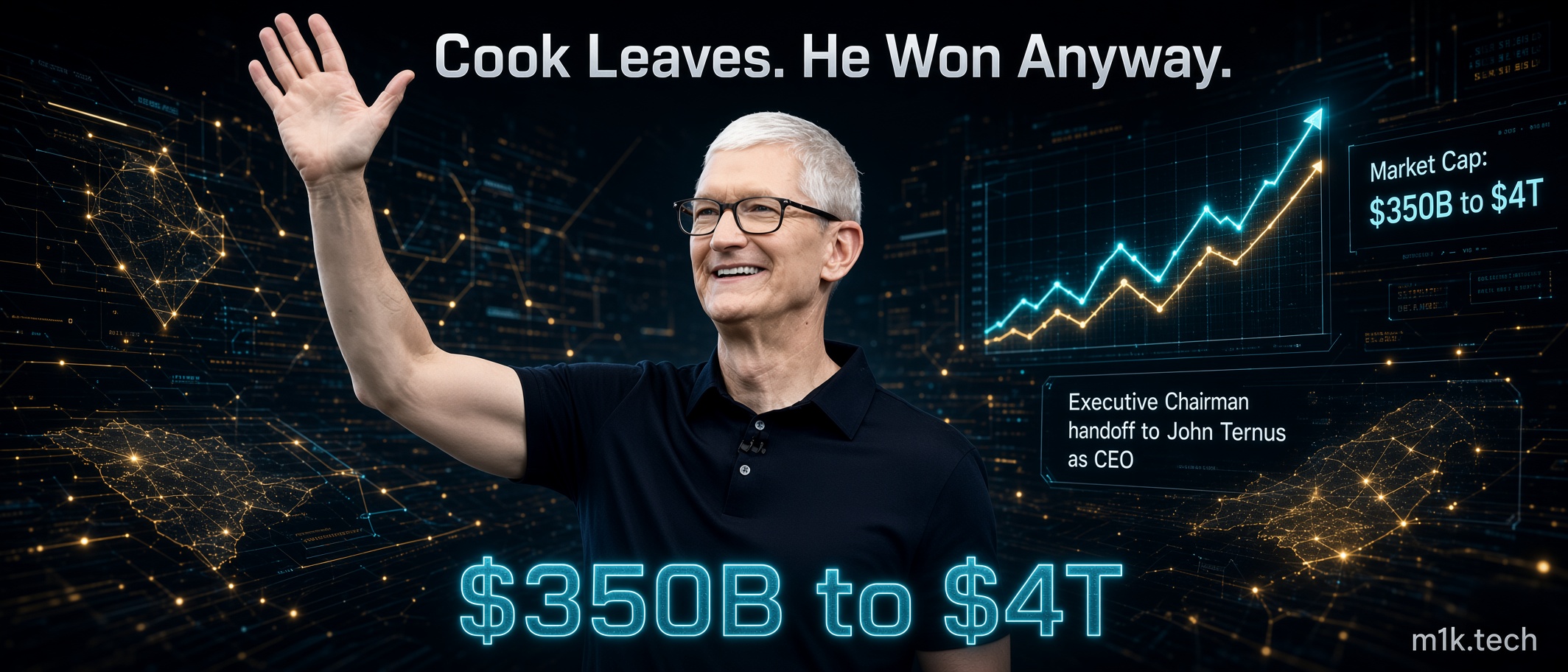
Tim Cook sent his last memo as Apple CEO on Monday, and the line that stuck with me wasn’t the thank-you to employees; it was the part where he said he’s “not leaving Apple.” He’s not. He’s sliding into the executive chairman seat, keeping the Trump and Beijing relationships on his personal desk, and handing the actual company to John Ternus on September 1. Fifteen years, and Cook engineered his own exit with the same operational precision he brought to everything else: no drama, no forced retrospective tour, just a memo and a going-away party a week earlier that most of the tech press missed entirely.
I want to start with the part everyone forgets, because it explains everything that came after. Cook didn’t arrive at Apple as a product guy. He spent twelve years at IBM in procurement and manufacturing, did a stint at a reseller nobody remembers, then landed at Compaq running corporate materials, which is a fancy way of saying he moved boxes efficiently. Jobs pulled him into Apple in 1998 specifically to fix the supply chain, and Cook did something that still gets taught in operations courses: he took a company sitting on months of unsold inventory and got it down to days, sometimes hours. That’s the actual origin story. Not design, not marketing, inventory turns. It’s an unglamorous foundation for running the most culturally important consumer electronics company on Earth, and I think that mismatch between Cook’s skill set and Apple’s mythology is the single most misunderstood thing about his tenure.
The Jobs relationship gets romanticized in ways that don’t hold up well against what Cook has actually said about it. He’s called Jobs “the most unusual CEO I’d ever met,” which is a colder line than it sounds, coming from someone who spent thirteen years next to him. Cook filled in as acting CEO three separate times during Jobs’s medical leaves, in 2004, 2009, and again starting in January 2011, before the board made it permanent that August. By the time Jobs died in October 2011, Cook had already been running the day-to-day for the better part of a year. What actually gets me is that Cook has said he still feels Jobs’s presence at Apple Park, and that’s part of why he stuck around so long instead of cashing out a decade ago the way plenty of executives in his position would have. Whether that’s sentiment or strategy, I can’t tell, and I don’t think it matters. The company he handed off Monday is unrecognizable from the one Jobs left him, in every dimension that counts.
Here’s the number that does the heavy lifting in any honest account of the Cook era: Apple’s market cap sat around $350 billion when he took the job in 2011. It has since touched $4 trillion, becoming the first company to cross $1 trillion in 2018, then $2 trillion in 2020, then $3 trillion, in a run that no company in history has matched. People credit Jobs with vision and Cook with execution, and that framing undersells what Cook actually built, because vision without a machine that can manufacture 200 million iPhones a year on a predictable cadence is just a nice idea. Cook turned Apple into the most disciplined capital-return operation in corporate America, running buyback programs that retired a staggering share count over the decade, while simultaneously growing a services business, Apple Music, iCloud, App Store, Apple TV+, AppleCare, into something that now throws off tens of billions in high-margin revenue every quarter, insulating the company from the hardware cycle in a way Jobs-era Apple never had.
The product record is where I’ll admit my own bias, because what I respect most from the Cook years isn’t the Watch or AirPods, both of which were genuinely good bets that became real category leaders. It’s the Apple Silicon transition. Moving the entire Mac line off Intel and onto in-house ARM chips, starting with the M1 in 2020, is one of the cleanest architecture transitions I’ve watched any company execute, and I’ve watched a lot of them. No stumbling generation, no years of subpar Rosetta-emulated software while developers caught up, just an immediate and durable performance-per-watt advantage that forced the rest of the PC industry into a multi-year scramble to respond. That’s a chips story as much as a product story, and it’s squarely the kind of thing I geek out over, so take my enthusiasm here with the appropriate grain of salt. Cook’s actual last major product launch as CEO landed just days before he handed off the title: the M6, Apple’s first 2 nanometer chip, shipped quietly inside an $899 Mac mini rather than anything with Apple’s name on the showroom floor. Closing a fifteen-year run on the cheapest machine in the lineup is either careless sequencing or exactly the kind of unglamorous, inventory-manager instinct that got him the job in the first place.
Not everything landed. The Vision Pro shipped in 2024 to a wave of genuine technical admiration and almost no actual sales, and Apple has since gutted the headset’s gaming and content team entirely, folding what’s left into the group rebuilding Siri while it figures out whether spatial computing is a real product category or an expensive research exercise. HomePod never dented the smart speaker market Amazon and Google had already locked up. And the App Store, the single highest-margin business Apple runs, dragged Cook through a decade of regulatory fights that Jobs never had to deal with at this scale, from Epic’s lawsuit to the EU’s Digital Markets Act forcing sideloading onto iOS to a US Department of Justice antitrust case that’s still working its way through the courts. Cook’s version of Apple made a lot more money than Jobs’s version ever did, and it also spent a lot more time in front of regulators explaining why.
Market share is where the story gets messier than the trillion-dollar headline suggests. Apple has never led global smartphone unit volume; Samsung and increasingly Xiaomi and other Chinese OEMs move more phones worldwide, but Apple has consistently captured a wildly disproportionate share of the industry’s actual profit, sometimes north of 80% of smartphone operating income from a device that’s a fraction of unit share. That’s the real Cook-era achievement in hardware: not winning the volume war, winning the margin war so completely that volume stopped mattering. Where it’s gotten actively uncomfortable is China, where Huawei’s return from the US sanctions wilderness with its own Kirin silicon has eaten into iPhone’s premium-tier position in a market that used to be an automatic growth engine, forcing Apple into pricing moves and local partnerships it wouldn’t have needed a few years ago.
Which brings me to what I think will define how history judges this handoff, more than the market cap chart or the product list: Cook is leaving Ternus a company meaningfully behind in the one technology shift that matters most right now. Apple Intelligence launched in 2024 to a muted reception, and the promised Siri overhaul- the actually personalized, actually context-aware assistant Apple demoed at WWDC that year- got delayed so badly that one Apple executive reportedly called the state of the project “ugly” in an internal all-hands. The fix Apple landed on says a lot: rebuilding Siri on top of Google’s Gemini models rather than Apple’s own foundation model, a full-scale rollout expected this September. I’ve covered enough silicon roadmaps to recognize what that concession means. Apple, the company that famously builds its own everything- chip, modem, operating system- decided the AI model layer was one place it couldn’t win alone, at least not on the timeline the market was demanding. On his final earnings call, Cook tried to frame on-device processing as Apple’s structural advantage over cloud-dependent rivals. I don’t think that argument survives contact with the fact that the actual intelligence behind the rebuilt Siri is coming from Mountain View, not Cupertino. I’ve written before that the same on-device, walled-garden instinct that makes the M-series untouchable is the instinct that left Siri stranded while everyone else’s assistant went to the cloud, and nothing about the Gemini deal changes that read; it just admits it out loud.
Ternus inherits all of it starting Tuesday: a foldable iPhone launching at the September 9 event, arriving into a memory market that already forced Samsung’s own foldables $100 higher this summer, the new Siri rollout riding on borrowed AI, a wearables pipeline (smart glasses, an AI pendant, camera-equipped AirPods, even a home robot) that’s been quietly delayed because the software wasn’t ready to support any of it, and a leadership bench that’s turning over almost entirely at once. Jeff Williams, the COO who’d been at Apple since 1998 and was long seen as the likely successor, is retiring; Sabih Khan moves up from supply chain to replace him. Luca Maestri already handed the CFO job to Kevan Parekh. Phil Schiller is stepping back from running the App Store and product events. Art Levinson takes over as lead independent director. It’s a full generational reset happening in the same quarter, not staggered over years, and that’s either careful sequencing on Cook’s part or a sign that Apple waited a beat longer than it should have to start the succession clock.
Ternus himself is a hardware lifer, at Apple since 2001, running hardware engineering since 2021, and about as low-key publicly as Cook was when he first took over, which might be the point. He’s already told employees Apple won’t ship AI features “just to ship it,” a restrained framing that reads either as principled product discipline or as cover for a company that’s still catching up. I don’t know which yet, and I’m not going to pretend I do three days before his first product event. What I do know is that Cook spent fifteen years proving that operational excellence and margin discipline can substitute for the kind of category-defining product magic Jobs was known for, right up until the one category, generative AI, where discipline without a foundation model of your own isn’t a strategy so much as a wait. Ternus gets to find out on September 9 whether the wait paid off.
Sources
- Bloomberg, Apple’s Cook Says He ‘Will Miss This Work’ as He Leaves CEO Role, August 31, 2026
- 9to5Mac, Read Tim Cook’s full memo to Apple employees on his last day as CEO, August 31, 2026
- MacRumors, Tim Cook Steps Down as Apple CEO Tomorrow, August 31, 2026
- Yahoo Finance / qz.com, John Ternus becomes Apple CEO, with AI as first big challenge, August 31, 2026
- Fortune, Apple’s new era: Can John Ternus’s low-key style survive the AI revolution?, August 31, 2026
- PhoneArena, No one’s ready to replace Tim Cook, and Apple is fine with that, 2026