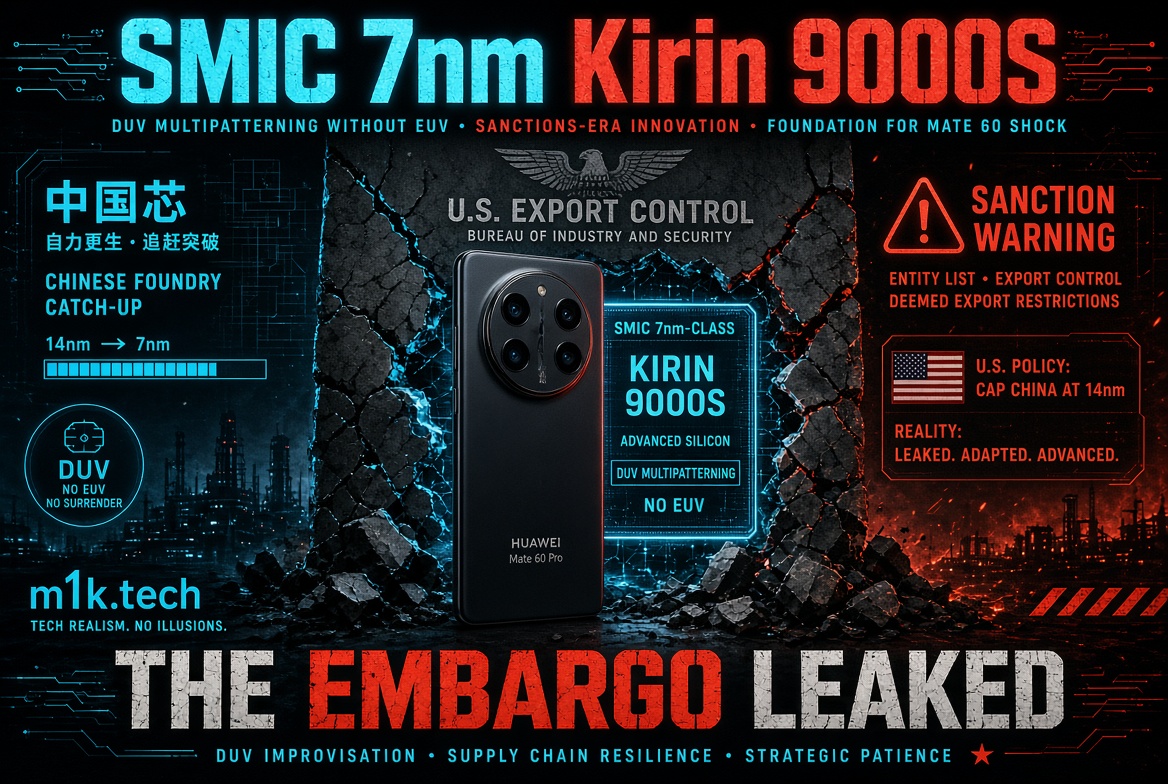
A phone went on sale in China this week and set off a panic in Washington. The Huawei Mate 60 Pro shipped, quietly, with no fanfare, and inside it is a processor called the Kirin 9000S built on SMIC 7nm, a 7-nanometer-class chip made in Shanghai without a single EUV machine. The node SMIC was straining to prove on DUV two years ago is now in a consumer phone, in volume, on shelves. Everyone who said it could not be done, or not soon, or not at scale, is looking at a teardown report and recalculating. SMIC 7nm is real, and it changes the whole argument.
SMIC did it the only way left open, the brutal way, DUV multipatterning, printing each fine layer in multiple stacked exposures because the EUV that would do it in one pass is forbidden to China. It is the path TSMC walked through years ago on its first 7nm and then abandoned for EUV, and SMIC has now made permanent residence there work well enough to fill a flagship phone. The yields are reportedly poor and the cost per chip is high, far higher than what the leaders pay, and none of that matters to the headline. The headline is that the embargo was supposed to cap China at 14nm, and China just shipped 7nm anyway. The cap leaked.
The timing makes it as much a message as a product. The United States tightened its controls again last October, a sweeping set of rules meant precisely to stop this, to deny China the tools and the capability to build advanced logic, and ten months later a Chinese 7nm phone lands in stores during a high-profile visit by an American official. Whether or not that timing was deliberate, it read as defiance: the controls were supposed to make this chip impossible, and here it is. The reaction in Washington is a mix of alarm and a hard question, which is whether export controls actually work or whether they just make China build the thing itself, slower and dearer but sovereign.
SMIC 7nm is a real achievement and also an expensive, low-yield one that depends on tools SMIC stockpiled before the controls bit and cannot easily replace. The triumph on one side and the alarm on the other both oversell what a single teardown can mean. It is years behind the leading edge; TSMC is shipping 5nm and below while SMIC celebrates a 7nm-class node the leaders ran in 2018. Building it in volume, sustainably, at an acceptable cost, with a tool base that can no longer be replenished from abroad, remains an open question. SMIC proved it can make the chip. Whether it can keep making it, and make the next one, is not settled by one phone.
A determined state with enough money and enough talent can push past a technology embargo, slower and at ruinous cost, but past it. For everyone who assumed the controls were a hard ceiling, that is the sobering part. The controls work more like a tax than a wall, a heavy one, making every node slower and more expensive for China without making it impossible. SMIC is now the proof of concept for sovereign chipmaking under siege, and other countries watching the US-China fight are taking notes. The embargo was meant to stop SMIC. Ten months later it shipped a 7nm phone instead.
Before this phone, SMIC was a follower nobody in Washington worried about. The Mate 60 made it the central node in a technology cold war. Perso, I think the next few years are a grind: SMIC holding 7nm and reaching toward 5nm on DUV at costs that would bankrupt a normal company, the United States tightening controls further to plug the leak, and the two locked in a race between Chinese improvisation and American restriction with no clean ending. The chip in this phone is no victory lap. It is a flag planted on a brutal slope, the climb only getting steeper, because DUV runs out of road eventually and the next node is harder still. SMIC proved the embargo leaks. What it has not proved, and what the next node will test, is whether it can keep leaking all the way to the leading edge, or whether 7nm is where the improvisation finally runs into a wall that will not move.