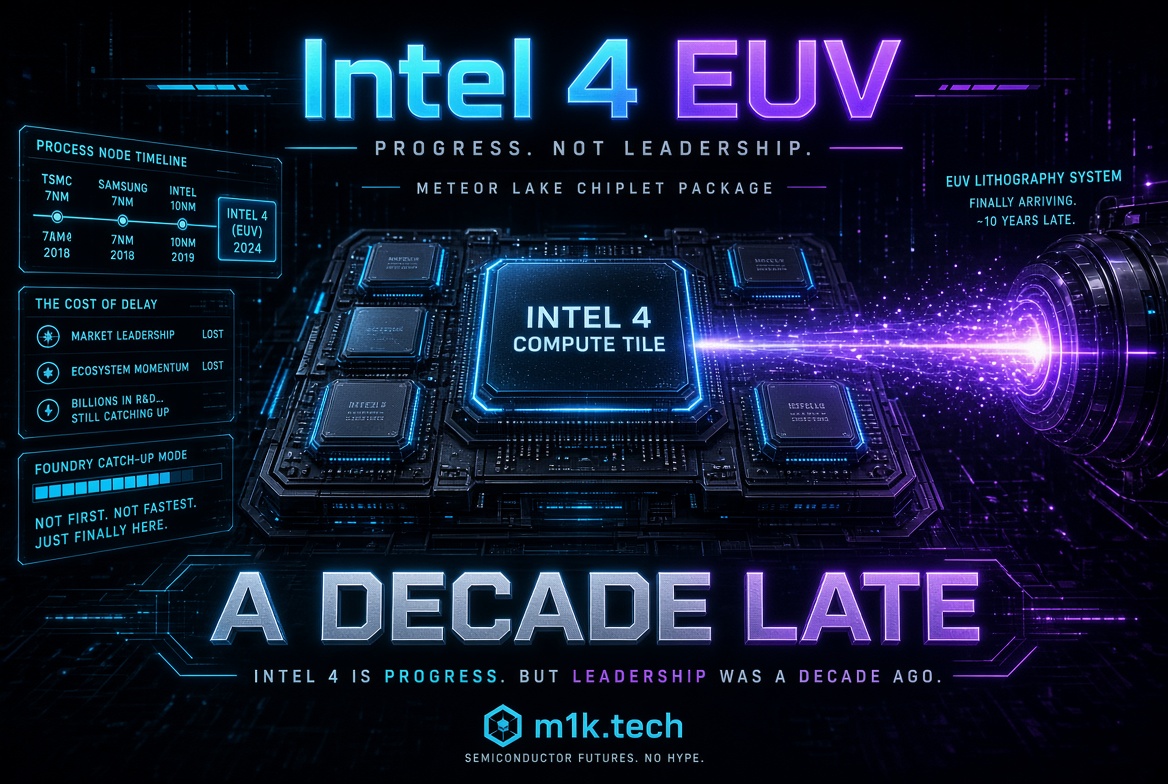
Intel 4 ships this month in Meteor Lake, and it is the first Intel node built with extreme ultraviolet lithography, the technology Intel could have adopted years ago and chose not to. EUV is what Samsung put into a chip back in 2019 and what TSMC brought to its 7nm line the same year, and it is the light Intel refused at 10nm, betting it could push the old approach one more generation. That bet is what broke 10nm. Intel 4 is Intel finally admitting the bet was wrong and buying the machines everyone else bought half a decade ago.
EUV draws the smallest features in a single pass instead of the stacked multiple exposures that made 10nm such a yield nightmare, which means fewer steps and far better yields than the old way could manage at this size. Intel 4 is a real step forward in density and efficiency, and Meteor Lake is the first Intel chip built from chiplets, separate tiles stitched together in a package, the compute tile on Intel 4 and the rest built elsewhere. It is a more modern way to build a processor, and it signals an Intel that has stopped pretending it must do everything the old way on one big die.
Intel 4 is progress, not parity. It is roughly competitive with the 5nm-class nodes the foundries shipped a couple of years ago, which means Intel has closed part of the gap and is still behind the 3nm TSMC is selling today. That is the honest read. The five-nodes-in-four-years sprint is roughly on pace, Intel 7 and now Intel 4 have arrived, and the company is moving faster than it has in fifteen years. It is moving fast because it is behind. The node closes distance to where the leaders were, not to where they are.
For the foundry ambition, EUV is non-negotiable, and getting it working is the price of admission. No serious customer was going to build a leading-edge chip on an Intel process that still refused the light the rest of the industry runs on. The foundry business Gelsinger committed to in 2021 only becomes real once Intel can offer EUV nodes a Qualcomm or an Nvidia would actually consider, and Intel 4 is the first one that clears that bar. The node matters as much for who it lets Intel court as for what it does in a laptop.
Everything now rides on the two nodes after this. Intel 4 and Intel 3 are the warm-up, the nodes that prove Intel can execute again. Intel 20A and Intel 18A are the ones meant to put Intel back in front, with a new transistor and a new way of delivering power that nobody, not even TSMC, has shipped yet. Land those two on time and the comeback is real, a foundry with something to sell the leader cannot. The other way, if they slip like 10nm slipped, the sprint turns into one more broken Intel promise and takes the foundry pitch down with it. Intel 4 earns the company the right to be taken seriously again, nothing more.
The relief of watching Intel ship EUV is real, and it should not be undersold; the company that refused the light is finally using it, on schedule, in a product. Perso, I read Intel 4 as the first time the turnaround showed up as actual silicon, which is the thing that matters. The nodes Intel just shipped were the recovery nodes, the ones that close a gap. What comes next, the new transistor and the backside-power bet, has to work the first time against a competitor that does not miss. Intel adopted the future this month, a few years after everyone else built it. The harder question, whether it can get back to inventing the future instead of importing it, is what the next two nodes decide, and Intel has been wrong about exactly that kind of question before.