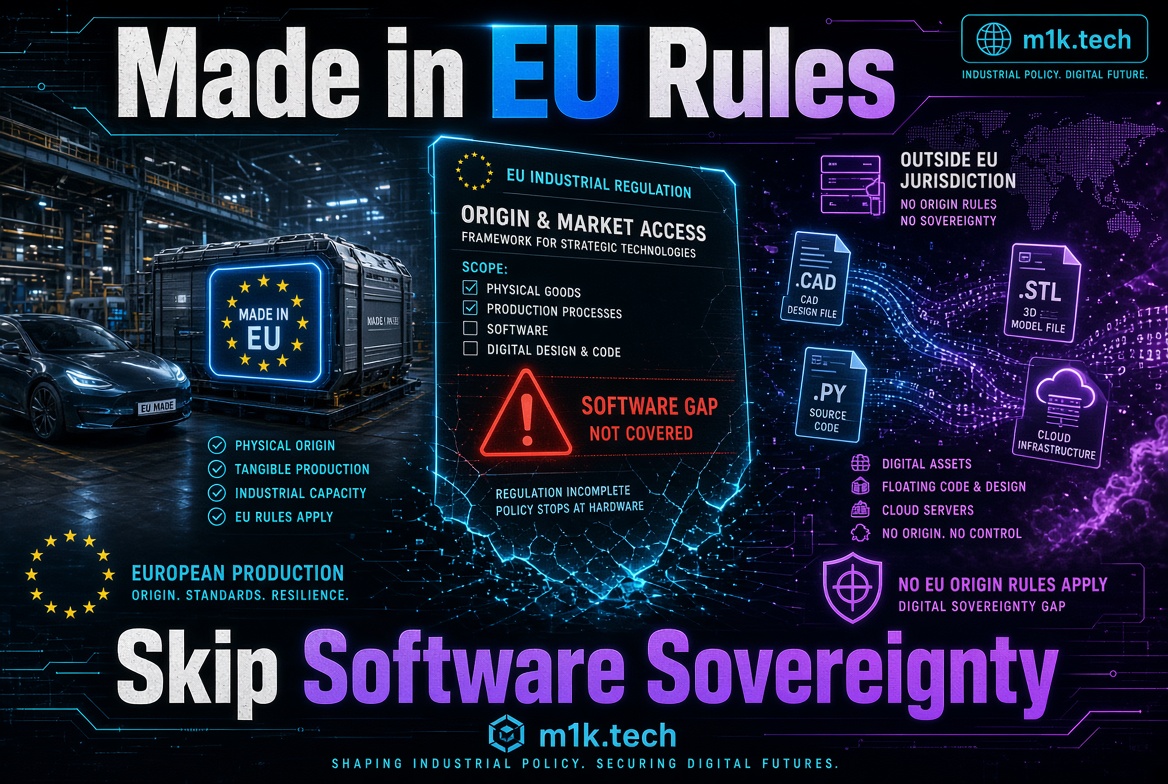
Five percent is the number sitting at the center of the EU’s new “Made in EU” rules, and it’s a strange place to hang a sovereignty argument. Starting January 2029, concrete and mortar used in buildings, infrastructure, or vehicles must have at least 5 percent Union-origin content. Aluminum gets 25 percent. Steel skips origin rules entirely and instead uses low-carbon criteria. Electric and hybrid vehicles get the real teeth: EU assembly requirements, minimum component thresholds, and specific battery sourcing rules, landing six months after the Act clears Parliament and Council, which it hasn’t yet. Tabled in March as COM(2026)100, the Industrial Accelerator Act is still a proposal working through ordinary legislative procedure.
I’ve spent time on this exact terrain before, writing about the Electron Gap, Europe’s habit of ordering enough AI chips to fill a continent and then discovering it has nowhere reliable to plug them in. The Industrial Accelerator Act is the same reflex pointed at physical manufacturing: legislate a percentage of local content and assume the rest of the supply chain follows, the same demand-side logic behind the EU’s seven AI gigafactories, which throw money at capacity without fixing what feeds it. What actually stopped me this week wasn’t the 5 percent figure, small as it is. It’s what the Act never touches: software.
A European CAD platform founder argued in an interview this week that the Act should extend beyond physical goods to the tools that design them. Every revision, every piece of design IP, sits on infrastructure outside EU jurisdiction the moment a European engineering team opens a US-hosted CAD tool, and a “Made in EU” label on the finished product does nothing to change where the file lived while it was being drawn. It’s the same argument behind Orange and Morrison’s sovereign cloud deal in France, and the one Airbus made when it built its own cloud with Scaleway instead of renting from an American hyperscaler: sovereignty over a physical object means very little if the design process that produced it runs somewhere else entirely.
I have to be honest about the source, because it matters. The founder making this argument runs an EU-hosted, end-to-end encrypted CAD platform that competes directly with the American tools she’s describing as a jurisdictional risk. That doesn’t make her wrong. It does mean she benefits if the rules move her way, and I’d rather flag that up front than pretend the interview was neutral.
The part of her case with no commercial angle attached is the stronger one anyway. Component sourcing for European hardware startups is a real, separate problem, and the Act does nothing for it either. Enclosures can be built in Europe or the US without much trouble. The electronics inside them frequently can’t, because the component ecosystem, the manufacturing expertise, and the entrepreneurs who know how to move fast on a board respin all sit clustered together, mostly in China, at a density Europe hasn’t matched. China builds 97 percent of the humanoid robots shipped worldwide, which is the kind of number that makes the depth of that ecosystem hard to argue with. I flagged the same underlying pattern when I wrote about French quantum startups risking a sale to outside capital before they ever scale: Europe’s early stage hardware and deep tech companies keep hitting the identical wall, real technology, no local money willing to fund the unglamorous middle. A founder who needs 20,000 or 50,000 euros to get from schematic to one working prototype is chasing a completely different kind of money than this Act was built to move.
That’s the actual gap, and the Industrial Accelerator Act was never designed to close it. It’s a demand-side instrument tuned for volume goods that governments buy in bulk: cars, batteries, solar panels. It says nothing to a five-person team trying to fund one working prototype, and even less about where that team’s design files live while they’re building it.
There’s a provision buried in the Act that I find more interesting than the origin percentages, and it doesn’t name a country, though everyone reading it will know exactly which one it means. Foreign investments above 100 million euros get screened wherever the investor’s home country accounts for at least 40 percent of global production in battery technology, EV and fuel cell vehicles, solar photovoltaics, or critical raw materials. The investor then has to clear four out of six conditions, including taking a minority stake, committing at least 1 percent of EU revenue to R&D, and keeping half the workforce inside the Union. It’s a targeted door dressed up as a general one.
None of this settles cleanly, and I don’t think it’s supposed to. Whether Parliament or Council extend the origin rules past physical goods is the change the CAD founder is actually arguing for, and as of this week nobody has formally tabled it. Whether the thresholds climb matters too: 5 percent survives a lobbying fight easily, 25 percent might not. And the derogations clause, which waives origin requirements whenever local supply is too expensive or too slow, is exactly the kind of sensible drafting that becomes the whole loophole once contracting authorities lean on it by default. Europe keeps writing rules that look serious on the label and modest in the fine print. I’m not convinced this one breaks that pattern, and I’d rather say that plainly than pretend a 5 percent concrete mandate is the start of something bigger.
Sources
- The Next Web, Europe’s ‘Made in EU’ rules start at 5%, and they do not mention software, August 14, 2026
- tech.eu, Europe is entering a new hardware age: ‘Made in EU’ starts long before the factory floor, August 13, 2026
- European Commission, Industrial Accelerator Act
- The Next Web, China builds 97% of the world’s humanoid robots