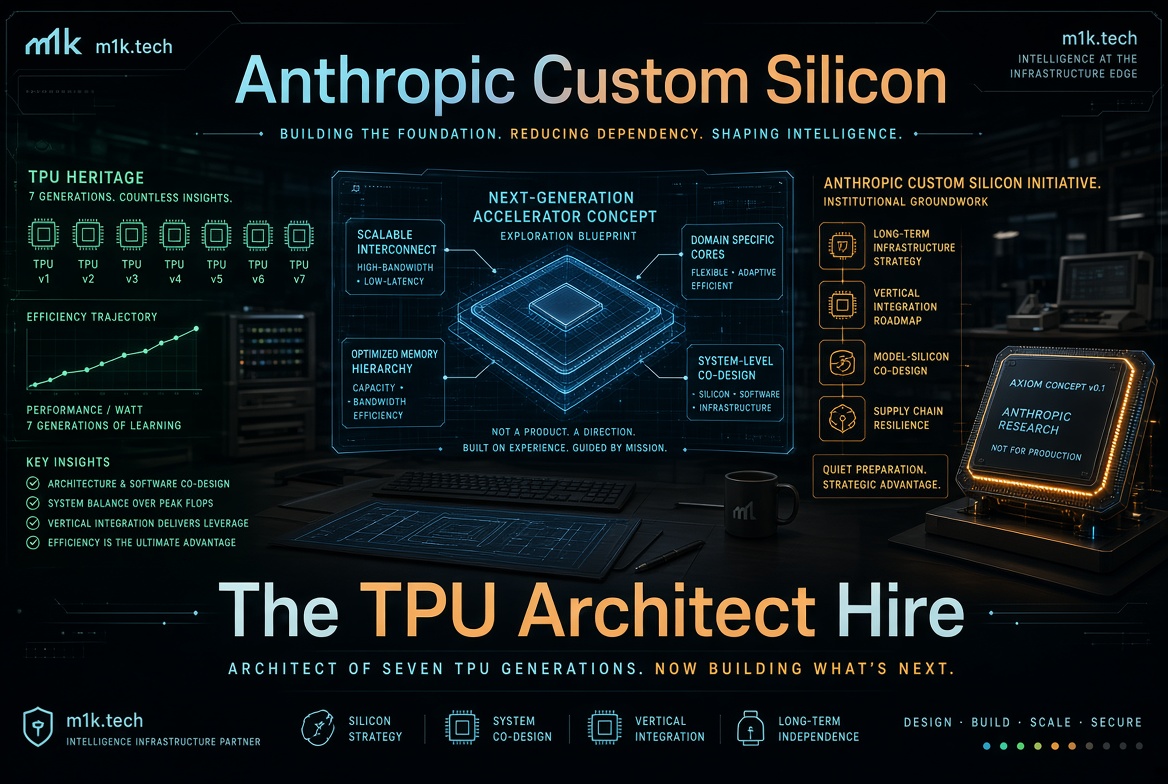
Seven. That’s how many generations of Google’s Tensor Processing Unit Amir Salek shipped before he left in 2022, and it matters more than his job title. Bloomberg reported Friday that Anthropic has hired Salek onto its compute team, reporting to James Bradbury, and the framing Bloomberg used was careful on purpose: Anthropic is “laying the groundwork for its own chips.” Not building one yet. Laying groundwork.
I want to be precise about what’s actually confirmed here, because it’s less than the headlines make it sound and also more interesting than a rumor. There’s no chip, no tape-out, no fab partner, no timeline. What there is: a custom silicon team that already had a job listing out with a salary band running up to $485,000, and now a name attached to it that isn’t a startup chip engineer. Salek founded Google’s custom silicon program from nothing and ran it through seven TPU generations, the accelerator line that’s arguably the most commercially successful non-Nvidia AI chip effort in the industry. After Google, he went to Cerberus Capital Management as a senior managing director, which means Anthropic pulled him out of private equity to go build silicon again. People don’t usually make that trade for a job that’s mostly strategy slides.
What strikes me is how deliberately unglamorous Anthropic’s framing is. No press release, no roadmap teaser, just a hire that leaked through Bloomberg’s usual channels. Compare that to how Anthropic announced the $5 billion AMD deal a few weeks earlier, a full public event built around breaking Nvidia’s grip on frontier training. This is the opposite move made quietly: instead of diversifying who Anthropic buys chips from, it’s building the option to stop buying at all, at least for some slice of the workload. Today the company still runs on a mix of Nvidia GPUs, Google TPU rentals, and Amazon Trainium, and this hire doesn’t change any of that this quarter. It changes who’s in the room deciding whether that mix looks the same in three years.
The thing I don’t buy is the version of this story where Anthropic is quietly plotting to drop Nvidia. Designing a competitive AI accelerator is a multi-year, capital-intensive project with a real failure rate, and Google’s own TPU program took years of Salek’s leadership to become a credible Nvidia alternative rather than an internal science project. One hire, however senior, doesn’t compress that timeline. What it does is signal that Anthropic is treating “we don’t own any of the silicon we depend on” as a problem worth solving with institutional seriousness, not a side project. That’s a different claim than “Anthropic is building a chip,” and it’s the one Bloomberg’s sourcing actually supports.
It also fits a pattern I keep seeing across the frontier labs now. Memory capacity is already the tighter constraint than raw compute for a lot of inference workloads, and Nvidia’s own $500 billion memory commitment to SK Hynix is as much an admission of that as anything Anthropic just did. Every lab that can afford it is trying to own more of the stack that used to be somebody else’s problem, and hiring the person who built Google’s version of that stack is a cheaper, faster way to signal intent than announcing a chip nobody’s confident will ship on schedule anyway.
I’m skipping the fab and process-node speculation entirely here. Nobody’s said where this silicon, if it ever exists, would actually get built, and guessing between TSMC, Samsung, and a chiplet partner is a different post for whenever something real leaks. For now, the honest read is smaller and more interesting than the headline: Anthropic didn’t announce a chip. It hired the one person in the industry who’s actually shipped seven of them, and pointed him at the exact dependency that limits how far the company can scale on someone else’s hardware roadmap.
Sources
- FourWeekMBA, Anthropic hires Amir Salek: what the hire signals about its chip strategy, August 21, 2026
- Crypto Briefing, Ex-Google TPU chief Amir Salek joins Anthropic, August 21, 2026
- Yahoo Finance (Investing.com), Anthropic hires ex-Google chip executive for compute team, August 21, 2026
- m1k.tech, Anthropic’s Custom Silicon Team Is Real, and Its Newest Supplier Is a Company Nvidia Just Funded, August 2026