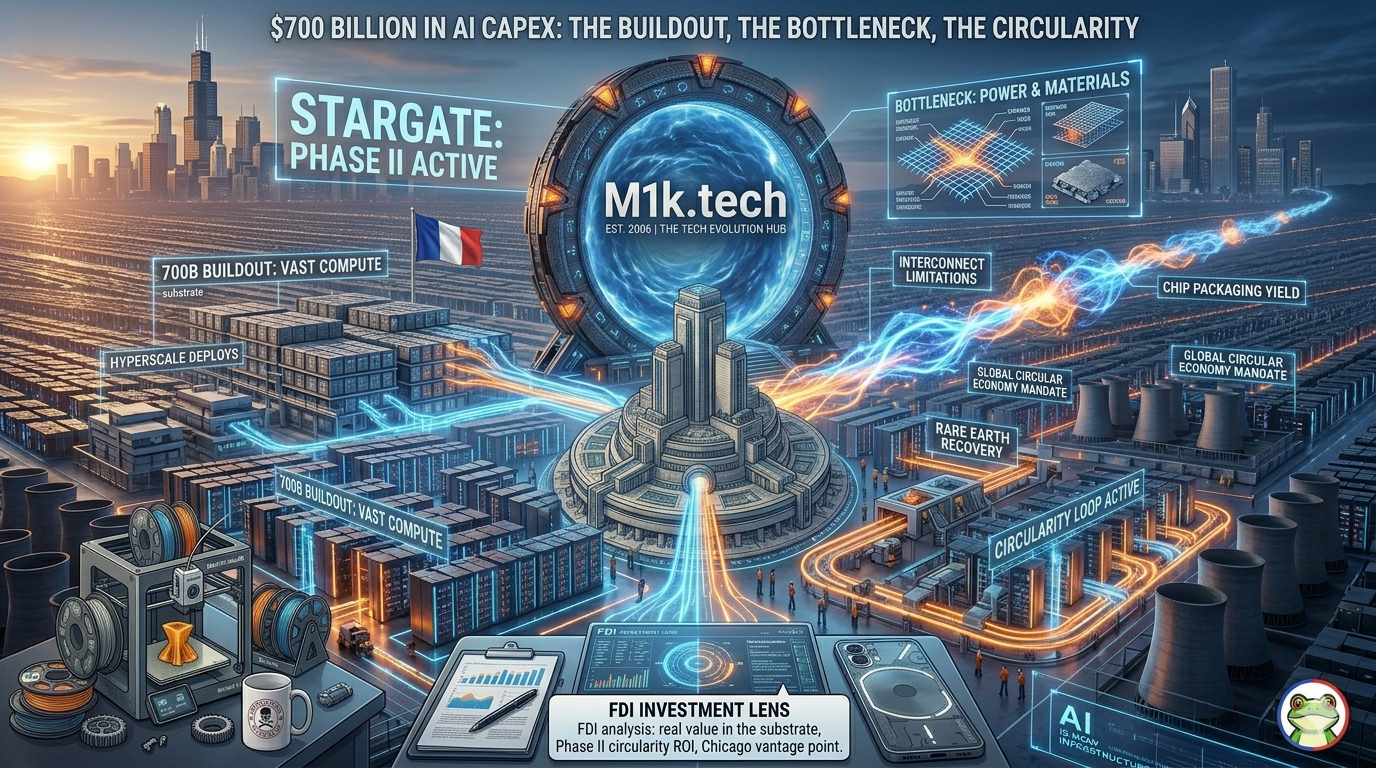
The hyperscaler AI capex for 2026 has reached a figure that genuinely strains belief: the four biggest spenders, Amazon, Alphabet, Meta, and Microsoft, are collectively planning nearly $ 700 billion in capital expenditures this year, nearly double what they spent in 2025. Amazon alone projected 200 billion, Google 175 to 185 billion, Meta 115 to 135 billion, and Microsoft tracking toward similar territory. To put that in perspective, the combined figure exceeds the GDP of all but the top 20 national economies. This is the supply side of everything I have been writing about all year, and it is both staggering and, in one specific way, unnerving.
The money is real, and so is the strain
Start with the obvious: 700 billion dollars in a single year, from five companies, on data centers, chips, and networking. That is not a forecast anyone would have taken seriously three years ago. Today, the hyperscalers treat it as the cost of staying in the game. And they all say the same thing, that they are supply-constrained, not demand-constrained. Microsoft has reportedly sat on about $80 billion in unfulfilled Azure orders because it cannot secure enough electricity to power the GPUs it already owns. Read that twice. The bottleneck is no longer chips or money. It is power.
The spending is starting to bite, too. Reaching these numbers means a real drop in free cash flow, with Amazon’s projected to turn negative this year. Some of the capex bump isn’t even more compute; it is just inflation: Microsoft said roughly 25 billion of its 2026 capex is due to component price increases. When the most cash-rich companies on earth start feeling the squeeze and measuring inflation in billions of dollars of chip prices, you know the scale has tipped into something historically unusual.
The circularity that should make you nervous
Here is the part I cannot stop thinking about, and it is the honest counterweight to all the excitement. A lot of this money flows in circles. NVIDIA sells GPUs, and a big chunk of that 700 billion lands in NVIDIA’s coffers. But Nvidia is also an investor in the buildout: it has put money into the very AI companies that then buy its chips. NVIDIA announced an arrangement with Elon Musk’s xAI, and OpenAI struck a GPU-for-stock deal with AMD. If that sounds circular, it is, because it is. NVIDIA’s GPUs are valuable partly because they are scarce, and by trading them directly into an ever-inflating data center scheme, the company helps keep them that way.
This is what separates healthy demand from a self-reinforcing loop. When the chip seller funds the chip buyer who books the chip seller’s revenue, the numbers can look enormous and real while resting partly on each other. I am not saying it is fake; the underlying demand for compute genuinely exists. I am saying the financial plumbing has gotten circular enough that the topline figures deserve a hard squint. C’est exactly the kind of structure that looks brilliant on the way up and dangerous on the way down.
Where the picks and shovels actually go
Underneath the circular financing, real things still get built. Meta’s Hyperion site in Louisiana, a 2,250-acre project estimated at around $ 10 billion, is designed to deliver roughly 5 gigawatts of compute, with an arrangement involving a local nuclear plant to handle the load. A smaller Ohio site, Prometheus, is expected to go online in 2026, powered by natural gas. Musk’s xAI built its own hybrid data center and power plant in South Memphis. The through-line, again, is power: everyone is now building or buying generation alongside the compute, because the grid cannot keep up. This is the same story I traced from Stargate in January through Anthropic and Microsoft becoming landlords and the record 61 billion dollars in data center deals, now expressed as raw annual capex.
So, what are my 2 cents after a year of watching this? The buildout is real, the demand is real, and the power constraint is the real thing of all. But the financing has gotten leveraged and circular in ways that should keep everyone honest. Seven hundred billion dollars a year is either the foundation of the next computing era or the setup for the most expensive correction in tech history, and the truth is, we will not know which for a while. What I am certain of is that the action has moved from the model demos to the data center floor, the power plant, and the balance sheet. That is where this story lives now, and that is where I will keep watching it.
And it keeps moving fast. Since then, the same buildout has shown up as Nvidia’s sovereign-AI roadshow through Korea and in the less glamorous corners of the supply chain, like Amazon’s deal with Corning. The picks-and-shovels story is far from over.