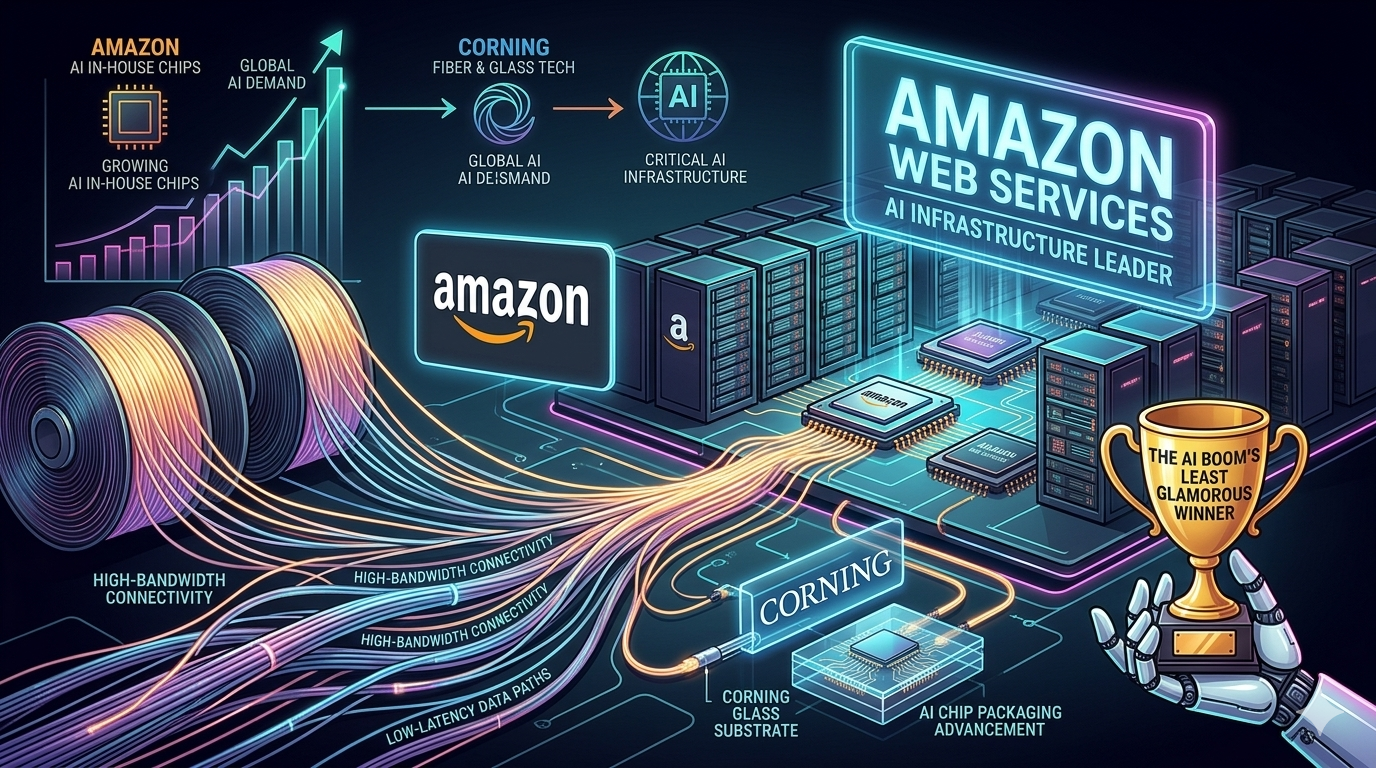
The Amazon Corning deal announced June 8 is the kind of AI story that never makes the front page, and that is exactly why it is worth your attention. Everyone watches the chips. The real tell that this boom is structural, not just hype, is that a 175-year-old glass company just signed its third multi-billion-dollar AI deal of the year, because none of those data centers work without the fiber tying them together. Amazon is paying Corning billions for optical fiber, cable, and connectivity to power and connect its rapidly expanding US AI data centers. No exact figure was disclosed, but for scale, Corning’s comparable Meta deal in January was worth up to 6 billion dollars.
The picks and shovels of the AI gold rush
Here is the thing people miss when they only watch Nvidia. A data center full of the most powerful chips on earth is useless if those chips cannot talk to each other fast enough. The connections between data centers, and between the racks and chips inside them, run on optical fiber. That fiber is the nervous system. And as AI training clusters get bigger and denser, the demand for that interconnect is exploding right alongside the demand for compute. Corning makes that fiber, and it has quietly become one of the most essential, least glamorous suppliers in the entire AI stack.
The market has noticed. Corning’s stock has more than doubled in 2026 and is up almost sixfold since the end of 2023, and it jumped close to 10 percent on the Amazon news. This is the company’s third AI megadeal of the year, after Meta and Nvidia. When a 175-year-old glassmaker becomes a momentum stock because of artificial intelligence, that tells you the buildout is reaching deep into parts of the supply chain nobody was thinking about two years ago. This is the kind of signal I trust more than another revenue-light IPO. Factories and fiber are harder to fake than a valuation.
The part my day job cares about: this is reshoring
The framing of this deal is American manufacturing, top to bottom, and that is the angle I find most interesting. Amazon is investing directly into expanding Corning’s facilities in North Carolina. The deal is expected to create 1,000 new advanced manufacturing jobs at those sites, plus hundreds of additional construction jobs to build the expansion out. Corning’s CEO Wendell Weeks called it a milestone for Corning and for American manufacturing, and for once that is not just press-release filler. This is real capital going into real domestic plants to make a physical product on US soil.
There is a detail in here worth noting, because it is the part that usually gets ignored. Amazon and Corning are expanding Corning’s Fiber Optic Technician Training Program with Catawba Valley Community College, to train students for careers in fiber optic manufacturing and related technical roles. A community-college pipeline feeding directly into advanced manufacturing jobs is exactly how you build a workforce that can actually staff these factories. In my work watching how companies and capital cross borders, the deals that include a training pipeline are the ones that tend to stick, because they are building the local capacity, not just renting it. That is the difference between an announcement and an ecosystem.
The same supercycle, seen from the supply side
This deal does not exist in isolation. It is the supply-side mirror of everything else happening right now. When Nvidia wires gigawatt-scale clouds into South Korea, somebody has to supply the fiber that connects them. When Alphabet raises 84.75 billion dollars to build data centers faster, a chunk of that capex flows down to suppliers like Corning. And the same onshoring instinct driving the sovereignty terms in Quantinuum’s IPO is visible here too, just expressed as factory jobs instead of board covenants. The compute headlines and the infrastructure headlines are the same story told at different layers of the stack. And the ripple was visible immediately: the Amazon announcement also lifted other optical-networking names, with Coherent up around 6 percent and Lumentum up nearly 4 percent. The market is starting to price optical interconnect as a real AI sub-sector, not an afterthought.
There is a nice irony buried in it too. Corning is famous to most people for Gorilla Glass, the stuff on your phone screen. But consumer electronics demand has been soft, weighing on that part of the business, while the boring fiber-optics unit has become the growth engine. The 175-year-old company’s future is being written less by the glass in your pocket and more by the glass threaded through Amazon’s data centers.
Where I land
If you want to know whether the AI infrastructure boom is real or a bubble, do not just watch the chip designers and the model labs. Watch the suppliers. When a glassmaker is signing its third multi-billion-dollar deal of the year, building new factories, and training a workforce to staff them, that is a supply chain responding to demand it expects to last. Bubbles do not usually build community-college training programs. This one might be frothy at the top, in the valuations, but down here at the fiber-and-factory layer, it looks a lot like a genuine industrial buildout. And it is happening in North Carolina, not offshore, which is the detail that will matter long after the current AI news cycle has moved on.