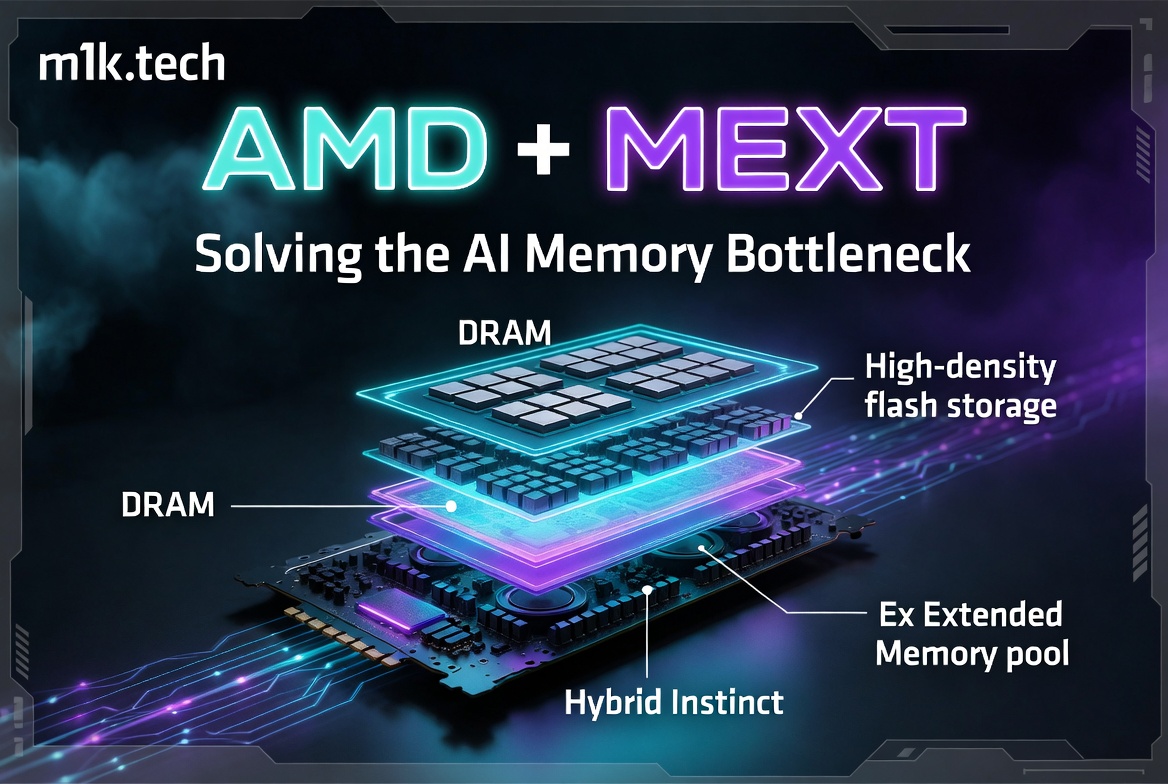
AMD’s June 2026 acquisition of MEXT, a startup whose technology extends DRAM capacity using flash storage, came thirteen days after AMD’s CFO publicly cited unprecedented memory cost inflation as a structural problem. MEXT’s software-based approach claims to deliver two to four times the effective memory capacity at roughly half the per-gigabyte cost of DRAM.
The strategic fit centers on AI inference workloads, which are increasingly constrained by memory capacity rather than compute. As agentic AI systems demand larger, longer-lived working sets, MEXT addresses a cost bottleneck across AMD’s GPU and CPU product lines, complementing existing hardware without requiring new silicon.
“The memory cost increase at this kind of level we have never seen.” AMD CFO Jean Hu said that out loud at the Bank of America Global Technology Conference on June 2, 2026, and the room moved on. Thirteen days later AMD bought MEXT, a startup whose technology makes flash storage behave like DRAM, doubling to quadrupling usable memory capacity while roughly halving per-gigabyte memory cost. The stock jumped about 7% on the news and the market cap cleared $900 billion. Most of the coverage filed it under momentum. That misreads it. This is a cost-of-goods intervention, and the timing is too clean to be accidental.
Run the two possibilities. Either the deal was already in motion when Hu spoke, which turns her conference line into a flare for the investors paying close enough attention to connect it, or AMD went from naming the problem to signing an acquisition in under two weeks. Both readings say this matters more than a one-day pop credits.
DRAM and NAND flash sit at opposite ends of the memory hierarchy, and the gap between them is brutal. DRAM gives you nanosecond latency and high bandwidth at roughly 50 times the cost per bit. Flash is cheap and dense and slow: microseconds for reads, milliseconds for writes, with endurance limits that rule it out for the random high-frequency writes that define working memory. Every serious attempt to bridge that gap has died on latency, endurance, or both.
MEXT works at the software and firmware layer instead of the silicon. It doesn’t make flash faster at the device level. It manages data placement and access patterns so the application sees one unified memory pool, with hot data parked in DRAM and cold-but-active data quietly migrating to flash without the workload noticing. MEXT claims 2-4x effective DRAM expansion at roughly half the memory cost. The concept isn’t novel. What MEXT appears to have cracked is making it hold up at the latency tolerances inference workloads actually demand, and that clause carries the whole acquisition.
Training and inference are different animals. Training is compute-bound: you want the fastest matrix multiplies you can get, and bandwidth beats capacity. Inference at scale is capacity-constrained, because you have to hold model weights, KV-cache state, and context windows in memory at once across many parallel instances. A 70-billion-parameter model in FP16 eats roughly 140 GB for weights alone, before any KV-cache. Run ten parallel instances and you’re staring at 1.4 TB of effective memory demand. Capacity, not compute, is increasingly where inference actually lives. At DRAM prices that’s a cost center that hurts. At flash-extended-DRAM prices it becomes something you can live with.
What makes the fit clean is AMD’s existing hardware. The Instinct line already leans on chiplet design to cram in HBM density. The MI300X packs 192 GB of HBM3 across a unified memory architecture shared between GPU compute dies and CPU dies, about as much HBM as you can physically fit on one package given current interposer area. MEXT doesn’t fight that ceiling. It adds a software layer that stretches the physical memory you already have, stacking on top rather than competing.
The hyperscaler conversation about AI infrastructure has quietly moved from “can we build it” to “can we afford to run it.” That is the data-center bottleneck seen from the cost side. Training a frontier model is a one-time capital event, tens or hundreds of millions of dollars and done. Inference is a running operational cost that grows with every query, every agent step, every API call. Agentic systems that chain tool calls, hit databases, and carry persistent state across multi-step tasks push memory demand per session far past simple prompt-response.
Hu went straight at this in her BofA remarks: “It’s not about answering questions anymore. It’s about orchestration, it’s about database access and a lot of tool execution. And all of those require significant CPU performance.” For memory, that means agentic sessions hold larger working sets for longer. A single-turn chatbot exchange might carry a few thousand tokens of context. An agent grinding through a multi-hour workflow with database access and tool state carries orders of magnitude more. Spread that across thousands of concurrent agents on a hyperscaler fleet and capacity, not compute, becomes the wall that decides how many agents you run per dollar.
That wall is exactly what MEXT goes after. Offer customers a memory subsystem with 2-4x the effective capacity at half the cost and the cost-per-agent-hour falls hard. For hyperscalers staring at AI infrastructure ROI, cost-per-token and cost-per-agent-step weigh as heavily as raw throughput. That’s a procurement argument, and procurement arguments are the ones that close data center deals.
MEXT only makes full sense as the third layer of a stack AMD has been building on purpose, part of the broader modular turn reshaping the AI hardware moat. The MI450 Instinct is the GPU layer, the next-generation accelerator, and AMD has confirmed a deal to deploy up to 6 gigawatts of Instinct GPUs for Meta centered on it. That’s an extraordinary commitment from a single customer, and it plants AMD as a real alternative to NVIDIA for frontier training and inference.
EPYC is the CPU layer, and the agentic shift is what makes it interesting rather than merely solid. AMD’s server CPUs have been the dominant x86 alternative in data centers for years. Training clusters are GPU-dominated, with GPU-to-CPU ratios of 8:1 or higher, so the CPU rides shotgun. Running agents flips that. Orchestration logic, database queries, tool execution, and state management all run on CPUs. AMD’s CFO is openly betting that agentic AI becomes the primary AI workload at scale, which would turn EPYC from a supporting act into a structural AI revenue line. The numbers are already nodding along: CPU revenue grew more than 50% year-over-year in Q1 2026, and guidance points above 70% growth for Q2.
MEXT closes the loop by attacking the cost structure of the memory subsystem both the GPU and CPU tiers depend on, and no other x86 player has all three pieces. Intel has CPUs and discrete GPUs but no AI accelerator at scale and nothing resembling MEXT’s memory layer. NVIDIA owns the AI accelerator market and is pushing into server CPUs with Grace, but it has no flash-as-DRAM technology and no foothold in x86 data center CPUs. Owning all three lets AMD sell full-rack solutions with a single cost and performance story instead of grinding it out chip-by-chip on benchmark sheets. Hyperscalers buying at the rack level care about total cost of ownership, power efficiency, and software integration across the stack, and AMD can finally make that pitch.
None of this is leisurely, and the data center trajectory shows why. The segment did $3.7 billion in 2021. By 2025 it hit $16.6 billion, a 4.5x jump in four years, with forward estimates projecting a two-year revenue CAGR around 48%. At a mid-June 2026 price near $541, the stock trades at roughly 54x next-twelve-months EV/EBITDA.
| Metric | Figure |
|---|---|
| AMD Data Center revenue (2021) | $3.7B |
| AMD Data Center revenue (2025) | $16.6B |
| AMD stock price (mid-June 2026) | ~$541 |
| AMD market cap | >$900B |
| AMD NTM EV/EBITDA | ~54× |
| NVIDIA NTM EV/EBITDA | ~17× |
| Broadcom NTM EV/EBITDA | ~20× |
| Semiconductor peer group avg | ~25× |
| Citi SOTP value of GPU segment alone | $281/share |
| Citi price target (post-upgrade) | $575 |
| Average analyst price target | ~$486 |
| Forward 2-year revenue CAGR (TIKR estimate) | ~48% |
That 54x multiple is the strangest number in the whole story. NVIDIA, which still owns the dominant share of AI accelerator deployments, trades at 17x. AMD’s multiple runs more than three times the semiconductor peer group average of about 25x. Citi’s Atif Malik upgraded AMD to Buy on June 12 with a $575 target, up from $460, and values the GPU segment alone at $281 per share on a sum-of-the-parts basis. The stock is already trading above the roughly $486 analyst consensus.
Holding that multiple requires AMD’s growth to stay exceptional long enough for the earnings base to catch up. The bear case is simpler and meaner: an MI450 ramp that slips, margin compression from memory costs before MEXT scales into production, or NVIDIA breaking into server CPUs through Grace, any one of which deflates the premium fast. MEXT is partly a hedge against the margin scenario. If memory costs stay elevated and AMD can’t pass them through, gross margins compress and the growth story wobbles. MEXT answers that structurally, not as a spec-sheet bullet.
So what is the 7% move missing? Start with the timing, because it’s the part nobody wants to say plainly. Hu’s June 2 remarks weren’t a hand-wave about industry conditions. She named memory cost inflation as unprecedented and tied it straight to AMD’s cost structure. Thirteen days later, a solution. The window is too narrow for coincidence: either the deal was signed when she spoke, handing the investors who connected it a 13-day head start, or AMD’s M&A machine moved at a speed that only happens when the operational problem is real. Both readings say more urgency than the market priced.
There’s also a category error in how people read memory acquisitions. Most chase bandwidth: faster DRAM, next-gen HBM, more pins. MEXT chases cost per effective gigabyte by swapping cheap flash in for expensive DRAM at the software layer. It doesn’t make AMD’s chips faster. It makes AMD’s customers’ deployments cheaper, and in a market where hyperscalers are under the gun to show AI infrastructure ROI, cheaper deployments mean more deployments, which means more AMD silicon racked.
The agentic shift quietly rewrites the GPU/CPU ratio, and that’s where this gets dangerous for NVIDIA. Move the workload mix from GPU-heavy training toward CPU-heavy agentic inference and EPYC stops being a side business. NVIDIA can’t conjure years of x86 server CPU position out of thin air, and MEXT sharpens AMD’s edge precisely on CPU-side memory management for orchestration, the exact workload Hu flagged as the frontier.
The repricing that matters won’t come from a press release. It comes when the MI450 ramps, MEXT ships inside production systems, and cost-per-agent-hour figures start surfacing in hyperscaler earnings calls. The thing I’d actually doubt is the production timeline: a software memory layer that survives a slide deck is not the same as one that holds inference latency across a hyperscaler fleet at scale. The first cost-per-agent-hour number that lands in a transcript tells you whether MEXT shipped or stalled.