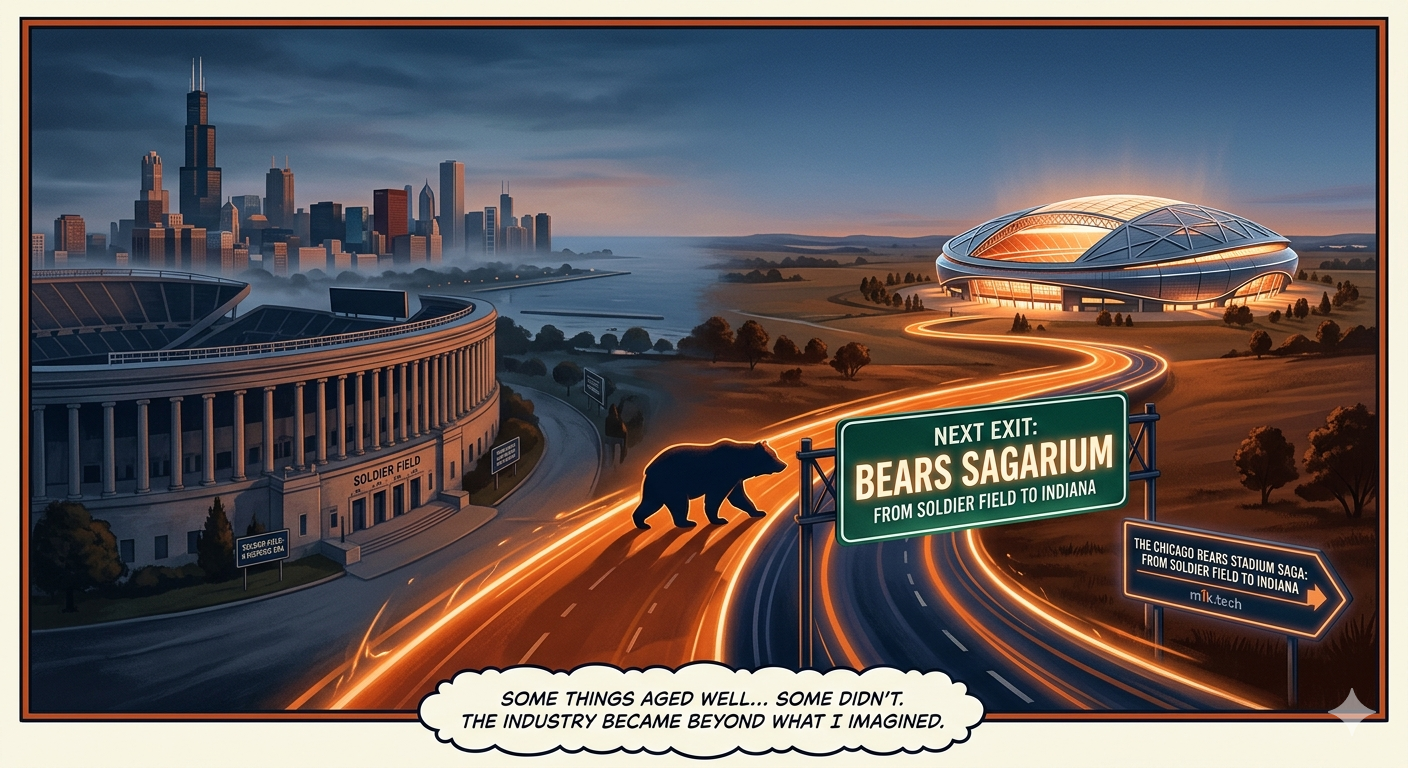
I have watched the Chicago Bears stadium saga drag on for years, and, personally, I never once thought it would end with the word “Indiana” attached to it. Yet here we are in June 2026, and the team’s board of directors has voted to move forward with a stadium in Hammond. Hammond. Across the state line. For a franchise that has been in Chicago since 1921. As a Frenchman who adopted this city, watching this unfold has been something between a soap opera and a slow-motion divorce.
Let me retrace the whole thing, because the drama makes a lot more sense once you see the money underneath it.
The part nobody likes to say out loud
Here is the uncomfortable truth at the center of all of this: the Bears have never owned the building they play in. Founded in 1920 as the Decatur Staleys, they have been in Chicago since 1921, rented Wrigley Field through 1970, and have rented Soldier Field from the Chicago Park District since 1971. The current lease runs to 2033.
Soldier Field is the oldest stadium in the NFL and also the smallest, with around 61,500 seats. The 2003 renovation was supposed to fix everything. Instead, it dropped a glass-and-steel bowl inside the old colonnades, cost the stadium its National Historic Landmark status, and stuck taxpayers with a bill they are still paying. Roughly $590 million of that debt is still outstanding. Let that sink in: Chicago is still paying off the last Bears renovation while arguing about the next stadium.
Why they actually want out
A team makes its real money off the building, not the rent check it writes to somebody else. Naming rights, the club seats, the 130-plus luxury suites, the personal seat licenses fans pay just for the right to buy season tickets, the concerts on the other 350 days a year. At Soldier Field, the Bears capture a fraction of that. They have wanted their own domed, year-round, Super-Bowl-capable building for a long time. Bad weather is romantic on TV. It is terrible for a balance sheet.
This matters for a city that has spent the last few years building a serious economic identity, from a fast-growing AI scene to a deep enterprise and fintech base. Losing the Bears would not break that. It would still sting.
Arlington Heights: the $197 million field of dreams
So in 2021, the Bears made their move and signed for the old Arlington International Racecourse out in the northwest suburbs. The deal closed in February 2023 for $197.2 million, 326 acres that they would actually own. On paper, the problem is solved. In practice, that is exactly where the real fight started.
The property tax war
Cook County is where stadium dreams go to meet the assessor. After the purchase, the Cook County Assessor revalued the site from around $33 million to $197 million, basically the price the Bears had just paid. The team argued the land was vacant and unimproved once they demolished the grandstand, and pushed for a value closer to $60 million. The Board of Review landed at $124.7 million.
After nearly two years of negotiations with the village and three local school districts, everyone signed a deal in December 2024: about $3.6 million per year through 2027, assessed at 10 percent as unimproved land rather than the standard 25 percent commercial rate. The catch, and this matters for what comes next, is that the deal goes void the second the Bears fund a stadium somewhere else.
The lakefront detour
Now rewind a bit, because the Bears did not go straight from Arlington to Indiana. In April 2024, they pulled a U-turn and unveiled a $4.7 billion domed stadium on the Chicago lakefront, right next to Soldier Field on the old Lucas Museum parking lot. Mayor Brandon Johnson stood next to team president Kevin Warren and sold it hard: no new taxes, more open space, Daniel Burnham’s vision, the whole pitch. The ask was about $2.4 billion in public money.
Governor JB Pritzker called it a nonstarter and never budged. Friends of the Parks, the same group that used the lakefront protection ordinance and the public trust doctrine to chase the Lucas Museum out to Los Angeles back in 2016, came out swinging again. The lakefront plan died quietly.
Back to the suburbs, and the real fight: taxes
By 2025, the Bears were back in Arlington Heights, and the framing had changed. Warren started telling season-ticket holders that the team would pay for the stadium itself, with zero state money for construction. Sounds generous until you read the next line: they still wanted about $855 million in public money for the infrastructure around it, roads, sewers, utilities. And they wanted one more thing, the thing that actually decides this entire saga: property tax certainty.
Here is the fiscal heart of it. Build a multi-billion-dollar stadium and entertainment district on that land, and Cook County would eventually assess it like the megaproject it is. Fully developed, the Bears could owe somewhere around $150 million a year in property taxes. No franchise signs up for that. What they want is so-called megaproject legislation that allows them to negotiate a PILOT (payment instead of taxes) with local taxing bodies. Instead of a standard bill that increases with development, you lock in a fixed, discounted payment for 23 to 40 years.
The school districts hate it because a PILOT or a TIF freezes the revenue flowing to them for a generation. The Bears love it because it turns an unpredictable $150 million problem into a known number. That single mechanism, not the pretty renderings, is what this whole fight has been about.
And remember why ownership matters so much. Own the building, and you keep the naming rights, the suites, the PSLs, the non-football events. Lease it, and you split all of that with a landlord. So the question was never really about Chicago versus the suburbs. It was who let the Bears keep the most money, for the longest time, with the least uncertainty.
Indiana runs the play
Which brings us to the team nobody invited to the meeting: Indiana.
While Illinois argued with itself, Indiana just wrote a check. In February 2026, Indiana lawmakers set up a Northwest Indiana Stadium Authority with the power to issue bonds, buy land, and finance construction, and put up to $1 billion in taxpayer-backed financing on the table, structured a lot like the deal that built Lucas Oil Stadium for the Colts. The model is clean: the stadium authority owns the building, the Bears lease it as a tenant with an option to buy it outright later, and the team commits around $2 billion of its own.
The bonds get paid back by a stack of local taxes around the site: a 1 percent food and beverage surcharge in Lake and Porter counties, a 12 percent admissions tax on stadium events in Hammond, a Lake County hotel tax doubling from 5 to 10 percent, plus a professional sports development area that diverts state and local taxes collected inside the zone right back into the project. Governor Mike Braun welcomed the team with a line about building a partnership as strong as the ’85 Bears defense. That is a good line.
The brutal part for Illinois is that Indiana solved the exact problem Illinois could not. Property tax certainty, public infrastructure money, and a clear ownership path. Done, in one bill.
Where this actually stands right now (June 2026)
Illinois had its shot in the spring session. The state Senate actually passed a bipartisan incentive bill in a late-night vote. The House ran out the clock and adjourned on June 1 without taking it up. Three days later, on June 4, the Bears’ board of directors voted to advance the Hammond project. That matters more than it sounds, because it is the first time the board has ever formally voted on a stadium site. The public announcement came on June 5.
Is it a done deal? It depends on who you ask. The Bears’ own statement was three very careful sentences and leaned on words like “advance” and “to be selected,” not “signed.” Kam Buckner, the lead House Democrat on the stadium talks, immediately said the language leaves the door open and that Illinois is still in it. Sources are already floating a second possible Hammond site near Wolf Lake. Arlington Heights’ mayor, for his part, basically conceded, saying the village accepts the direction and will keep serving its residents.
Read that however you want. To me it sounds like a team using a real Indiana offer to squeeze one last deal out of Springfield, except this time the offer is real enough that the bluff might just become the address.
And Soldier Field?
The Chicago Park District is not waiting around. It floated a $630 million plan to turn Soldier Field into a year-round event venue for the day the Bears leave, and an architecture firm pitched a wilder concept with a transparent roof and an entertainment deck built over Lake Shore Drive. Somebody is going to be paying off stadium debt on that lakefront for a long time, football or no football.
I have complicated feelings about all of it. I write about chips and phones on this blog, and about how this region keeps quietly punching above its weight, which is something I believe. The Bears bolting for Indiana would be a gut punch to that story, even when the spreadsheet says it adds up. A billion dollars of someone else’s tax money and a clean ownership structure is hard to argue with when your alternative is a 100-year-old rental and a legislature that cannot get out of its own way.
There is something that hits different about watching a Chicago institution treat the state line like a negotiating tactic. Maybe it works and they stay. Maybe Hammond builds the thing and we all learn to take the South Shore Line to a game. Either way, the next move is Springfield’s, and they have run out of time-outs.