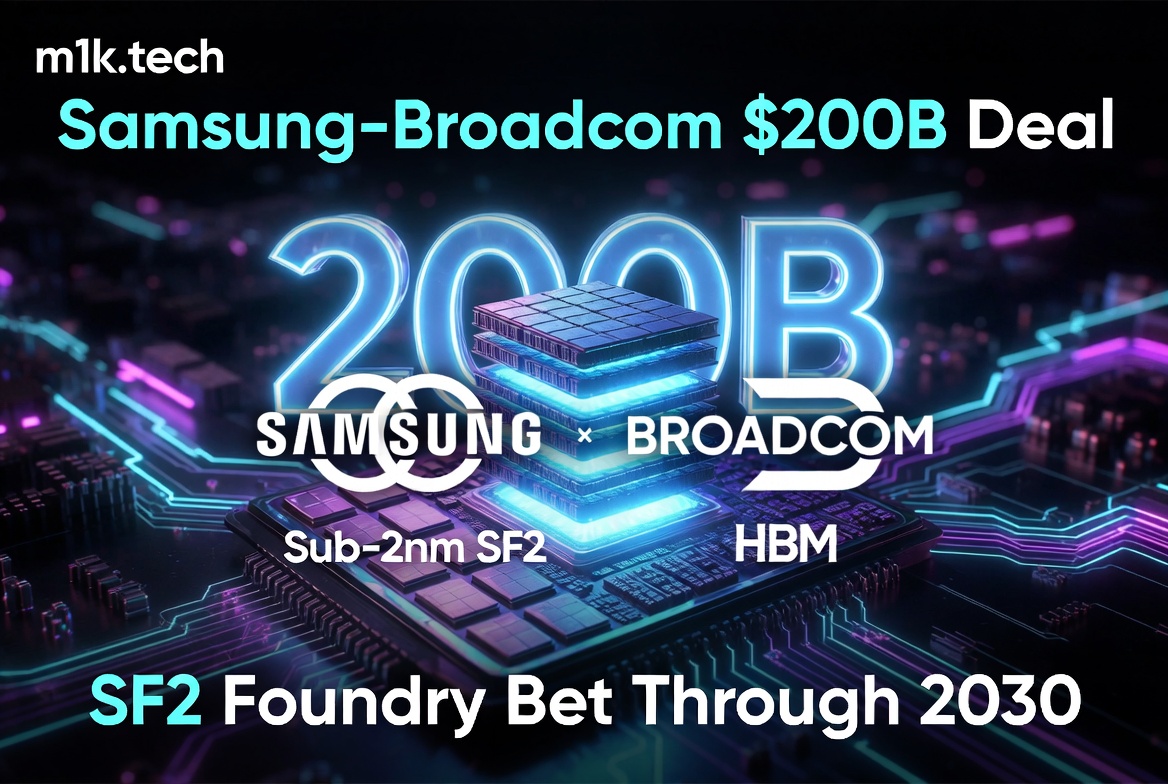
Broadcom just staked $200 billion on Samsung’s foundry future, and this Samsung Broadcom deal validates the turnaround more than any press release could.
The two companies signed a memorandum of understanding on Saturday spanning memory chips, contract chip making, and advanced packaging, with combined value expected to clear $200 billion through 2030. Buried in that framework is the detail that actually matters to me: Broadcom’s next generation of high-speed communications ASICs, the custom chips it designs for a shrinking list of companies willing to pay for them, will be built on Samsung’s sub-2-nanometre process.
I’ve been skeptical of Samsung’s SF2 comeback bid since I wrote about it last October. Announcing a leading-edge node is one thing. Getting a manufacturer as picky as Broadcom to commit hundreds of billions of dollars to it is a different kind of validation, the kind that shows up in fab utilization instead of slide decks.
Context matters here. Broadcom isn’t some anonymous fabless shop chasing volume. It’s the same company that locked in a $30 billion, six year commitment from Apple for custom Fort Collins silicon, and the same one that built OpenAI’s Jalapeño inference chip once the AI lab decided it needed to become its own supplier instead of just Nvidia’s customer. When Broadcom picks a foundry partner for its ASIC roadmap, other custom silicon customers pay attention, because Broadcom’s engineering teams don’t sign checks this size on a hunch.
The memory half of the MOU is where I think the real strategic logic sits, though. Samsung and Broadcom are also lining up next-generation HBM4E and HBM5 collaboration, which lands about a month after Samsung’s chip division head Jun Young Hyun said he’d already discussed the same roadmap directly with Nvidia’s Jensen Huang. Samsung makes memory and logic under one roof in a way TSMC structurally cannot, and if Broadcom’s ASICs need HBM5 co-designed with the same fab that’s etching the logic die, that’s an argument TSMC has to answer with partnerships instead of in-house capability.
None of this closes the gap with TSMC overnight. TSMC just pushed through another wafer price hike this year with no floor in sight, which tells you foundry capacity for anything advanced is scarce enough that customers are absorbing double-digit cost increases rather than walking away. Samsung landing a $200 billion multiyear commitment from a company as disciplined as Broadcom is the first evidence I’ve seen that some of that overflow demand might actually have somewhere else to go.
This didn’t happen in isolation, either. A South Korean presidential adviser told reporters this was one piece of $950 billion in deals unveiled over the same weekend, alongside SK Hynix’s own $750 billion memory supply commitments to US tech companies, at a summit President Lee Jae Myung hosted specifically to court American chip demand. Seoul isn’t shy about who’s writing the checks anymore.
I’m not going to pretend Samsung has solved its yield reputation problem with one MOU. That argument is still open, and the skepticism about whether Samsung can execute at the volumes Broadcom needs is fair. What this deal tells me is narrower and still worth sitting with: the company willing to bet the most money on custom silicon right now just decided Samsung’s advanced node is good enough to build on.
Sources
- CNBC, “Samsung Electronics wins $200 billion Broadcom AI chip partnership, boosting foundry push”, July 25, 2026
- Reuters, “Samsung Elec wins $200 billion Broadcom AI chip partnership, boosting foundry push”, July 25, 2026
- Reuters, “South Korea’s SK Hynix, Samsung Elec sign $950 bln partnership with US big tech”, July 25, 2026