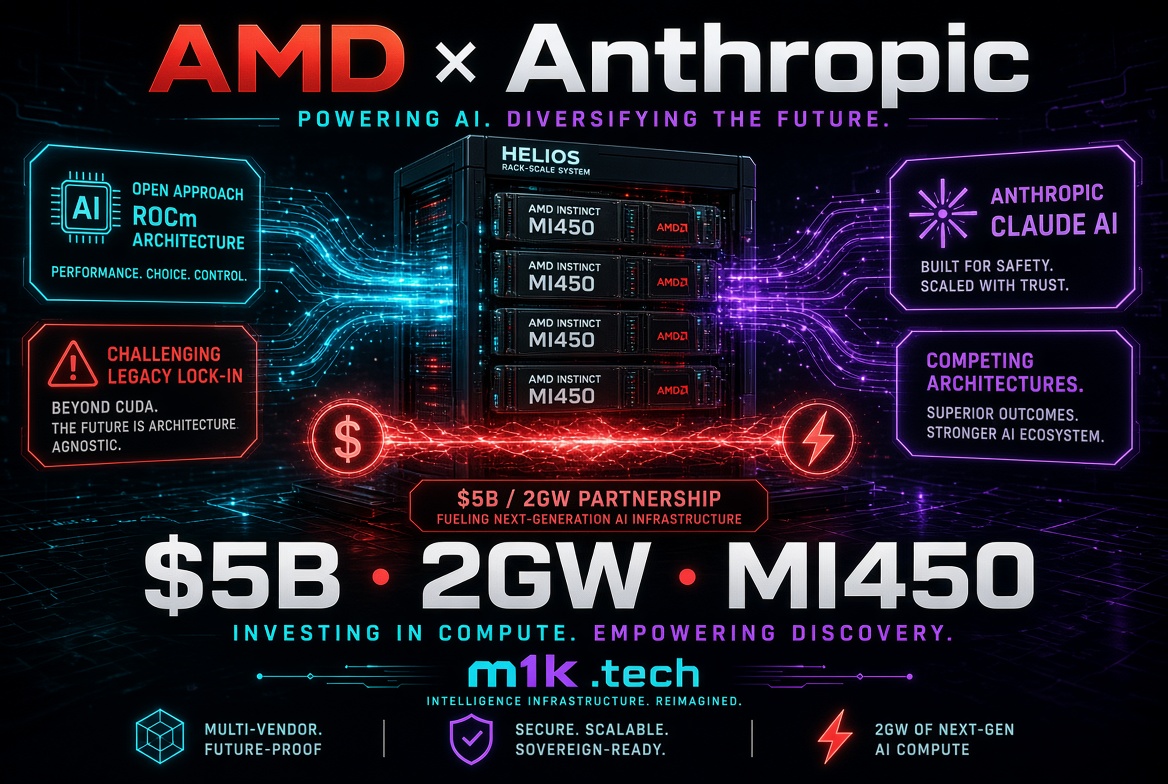
Two gigawatts. That’s the number that jumps out of the AMD and Anthropic partnership announced on July 22, 2026: up to 2 gigawatts of AMD Instinct MI450 Series GPUs deployed in AMD Helios rackscale solutions, the first gigawatt online in H1 2027, wrapped around a $5 billion AMD equity investment in Anthropic. Procurement contracts don’t usually get equity stakes bolted onto them. This one has three interlocking commitments, financial and technical, and taken together they describe something bigger than a purchase order. Two companies are trying to build a structural alternative to NVIDIA, and they’re using each other as the raw material.
Anthropic got here by managing its dependencies rather than escaping them. Amazon led a $4 billion investment starting September 2023, and that money came with AWS Trainium and Inferentia chips baked into the deal. Google added roughly $2 billion and brought TPU access along with it. The capital and compute let Anthropic train and serve Claude at scale, but it left a problem anyone paying attention could see coming: Anthropic’s two biggest compute suppliers are also its two most direct rivals. Amazon runs Titan on Bedrock. Google runs Gemini. Anthropic was renting its nervous system from the competition, and diversifying supply stopped being a preference somewhere along the way and became a survival condition.
AMD spent those same years with hardware that kept outrunning its own software. The MI300X shipped in late 2023 with 192 GB of HBM3 in the original configuration, enough memory to embarrass NVIDIA’s H100 on certain inference workloads and hard to wave away on large-model serving. Microsoft and Meta started qualifying it as a real alternative. The MI325X arrived in late 2024 with incremental gains, and the MI350 Series in 2025 jumped to CDNA 4 with HBM3E pushing toward 288 GB per accelerator. The hardware gap narrowed with every generation. ROCm never kept pace. AMD’s answer to CUDA had a long track record of promising more than it shipped into production, and hyperscalers stuck with NVIDIA not because of silicon but because CUDA is where the world’s ML engineers actually live: the libraries, the compiler toolchain, ten years of optimization sunk into it. This partnership is AMD’s most serious swing yet at that software wall, and Anthropic is about the most credible partner it could have recruited to swing with.
Topping AMD’s CDNA 5 generation, the MI450 follows the CDNA 4 that debuted in the MI350. AMD hasn’t published full specs yet, but the direction of the whole Instinct line is not subtle. Memory capacity and bandwidth have been AMD’s sharpest competitive edge; the MI350X’s ~288 GB of HBM3E already clears what NVIDIA’s Blackwell B200 offers in standard configurations, and the MI450 is expected to push both further. Interconnect is the other axis that matters. Infinity Fabric has been evolving toward the tight GPU-to-GPU communication that large-model parallelism demands, and at 2 GW the fabric linking nodes inside a Helios rack starts to weigh as heavily as the compute on each chip.
Helios is where AMD stops selling parts and starts selling systems. It’s a rack-scale platform that integrates Instinct GPUs, EPYC CPUs, networking, power, and cooling at the rack level instead of leaving the customer to bolt separately purchased components together. The obvious yardstick is NVIDIA’s GB200 NVL72, which packs 72 Blackwell GPUs and 36 Grace CPUs into a single rack with NVLink delivering 1.8 TB/s of GPU-to-GPU bandwidth. That approach won over hyperscalers because it moves the integration headache from the buyer to the vendor. Helios is AMD conceding the point that winning on individual accelerator specs no longer closes deals; the system has to compete as a system.
Most announcements never operate anywhere near the scale that 2 GW implies. A modern flagship AI data center campus might target 100 to 500 megawatts of IT load. Two gigawatts means either one extraordinary facility or, far more likely, a phased buildout across several sites and several years. For context, the entire US grid adds roughly 30 to 40 GW of new generation capacity a year across every source there is. A single commercial AI partnership committing to 2 GW is operating at utility scale, with everything that drags in: power procurement, grid interconnection queues, cooling, geographic spread. Starting the first gigawatt in H1 2027 tells you AMD and Anthropic have already done real site selection and power contracting. This isn’t an aspiration painted on a slide, it’s a plan with land under it. At the TDPs typical of high-density GPU racks, 1 GW works out to tens of thousands of nodes, and even conservative math lands somewhere between 50,000 and 100,000 accelerators in the first phase alone.
The three pillars of the deal don’t carry equal weight, and pretending they do would miss the point. AMD adopting Claude across its engineering and product teams is the simplest: a real enterprise software commitment that hands Anthropic a large, sophisticated customer and gives AMD’s engineers AI help tuned to their workflows. Useful, not seismic.
The MI450-in-Helios deployment at 2 GW is the infrastructure and money core. Stack the $5 billion equity investment on top and AMD becomes a stakeholder in Anthropic’s outcomes rather than a vendor angling for reorders. That equity is the piece that changes behavior, because it ties AMD’s incentives to Claude’s performance in a way no procurement contract ever manages. AMD now has money riding on Claude staying competitive, which means AMD has money riding on MI450 and ROCm being good enough to run Claude well.
The third pillar is the novel and shakiest one: using Claude to optimize workloads for Instinct GPUs and accelerate ROCm development. This is AI-assisted hardware-software co-design running in production, not sitting in a research paper. Work through the mechanism and it becomes a compounding loop. Anthropic’s engineers, grinding to run Claude efficiently on MI450, surface ROCm bottlenecks, the kernel gaps and compiler inefficiencies and missing library support. Claude helps diagnose them, writes optimized kernels, speeds up ROCm components. AMD’s software team, now leaning on Claude themselves, iterates faster. The hardware runs Claude better, and Claude gets sharper at hardware optimization from doing the work. Each turn welds AMD’s silicon and Anthropic’s models a little tighter.
The logic holds. The execution risk is just as real. ROCm has a documented history of the distance between what the docs claim and what production delivers. Anthropic’s engineers are among the best ML practitioners alive, and they’re also shipping frontier models under brutal competitive pressure, so if ROCm friction starts eating cycles that belong to model development, the co-development work is exactly the kind of thing that quietly slides down the priority list behind the next Claude release. Watch for whether Anthropic publishes ROCm benchmarks or engineering posts about MI450 performance. A year into the deployment, silence there would tell you plenty.
NVIDIA’s position in AI infrastructure is roughly 70 to 80 percent a software problem and 20 to 30 percent hardware. CUDA has been in continuous development since 2006. cuDNN, cuBLAS, NCCL, and the rest of the library ecosystem are decades of optimization work fused into every major ML framework. PyTorch’s first-class target is CUDA. Most ML engineers have never written a ROCm kernel and see no reason to start when CUDA already works. AMD has closed real ground here. The HIP layer translates CUDA code to run on AMD hardware, and PyTorch’s ROCm support is far better than it was in 2023. But “works” and “works as well as CUDA” are separate claims, and the gap has always been widest exactly where frontier training lives: collective communication ops, mixed-precision kernels, and the long tail of custom CUDA extensions that big labs write for their own architectures.
Anthropic sits in a group of maybe five organizations on earth, next to Google DeepMind, Meta AI, Microsoft Research, and OpenAI, whose public endorsement of a non-CUDA stack would move the broader ML community. Put Anthropic’s engineers on MI450 with ROCm, running Claude training and inference, publishing competitive numbers, and the math changes for every AI startup and enterprise team that’s been defaulting to NVIDIA out of inertia rather than evaluation. The proof-of-concept value reaches well past Anthropic’s own footprint.
NVIDIA has answered credible threats before with faster hardware and deeper software investment in tandem. The GB200 NVL72 and Blackwell broadly are its current reply to AMD’s memory advantage, and NVLink’s bandwidth still sits ahead of what Infinity Fabric delivers at rack scale today. The moat, though, always rested partly on the assumption that no frontier lab would invest seriously in an alternative. That assumption is now, explicitly, false.
The equity money also creates conflicts that will surface more the longer it sits there. AMD sells GPUs to OpenAI through Azure, to Meta, to other Anthropic competitors. Anthropic now counts AMD as a financial stakeholder alongside Amazon and Google, both AI rivals in their own right. All three of Anthropic’s largest strategic investors carry independent commercial interests that may pull against Anthropic’s. AMD’s roadmap calls could start looking like they’re colored by one particular equity stake: who gets early MI450 access, which optimizations get prioritized. And Anthropic’s choices about where to run workloads now carry financial weight for a chip vendor, not just a cloud.
The Amazon precedent is the tell. That deal wired Trainium and Inferentia into Anthropic’s stack and made Amazon a major investor, and it hasn’t stopped Anthropic from chasing other compute relationships, but it’s kept a live question hanging over whether Anthropic’s deployment decisions are fully independent of its backers. The AMD deal thickens that question. Anthropic is now financially tangled with its main CPU/GPU vendor, its main cloud provider, and one of that provider’s biggest competitors, all at once.
Export controls drag geopolitics into the buildout. The MI450 falls under US semiconductor export rules that have tightened steadily since 2022 and take specific aim at high-performance AI accelerators. Where the infrastructure physically lands, whether the US, EU, Middle East, or elsewhere, gets constrained by those rules, and given the scale of the commitment and the sensitivity of frontier capabilities, both companies will face pressure to show the whole thing lines up with export control requirements.
For the market, the first thing to move is the “NVIDIA or nothing” story that has run enterprise AI procurement for years. Buyers have watched hyperscalers qualify AMD hardware for a while now without ever seeing a frontier lab put a multi-gigawatt, multi-year bet behind it. That reference point just changed. When a procurement team at a bank or a telecom weighs NVIDIA against AMD, the fact that Anthropic, one of the two or three most credible labs going, has committed 2 GW to AMD is a data point with real mass.
For AMD’s own business, the $5 billion carries as much signal as the compute. It says AMD treats AI infrastructure as a core strategic business rather than a GPU line riding the boom, and it buys AMD a direct financial stake in one of the most commercially promising labs around, exposure to the application layer on top of the infrastructure layer. Zoom out and the deal argues that the compute market is big enough to sustain more than one serious hardware ecosystem. Single-vendor dependence on NVIDIA has been a systemic risk for the whole industry, not because NVIDIA looks likely to stumble but because concentration hands one company pricing power, creates supply chokepoints, and leaves a single point of failure under an increasingly critical stack. A credible AMD alternative, proven out by Anthropic at scale, takes some air out of that risk.
Inference is where the economics that matter most to end users live. If MI450 hits competitive cost-per-token against Blackwell, Claude’s API pricing gets room to turn into a weapon. Inference is where labs actually make money, and it travels better than training: less custom kernel work, more sensitivity to memory capacity and bandwidth than to raw FLOPs, which is precisely the terrain where AMD has been strongest. The MI450’s expected memory configuration could make it better at serving large context windows, one of Claude’s signature features. That advantage wouldn’t stay contained to Anthropic either. Mistral, Cohere, and the next crop of frontier labs will be reading Anthropic’s ROCm experience closely, and published evidence that MI450 with ROCm holds its own on training and inference lowers the perceived risk for every lab still parked on the fence.
Which is why I’d bet the whole analysis on that engineering blog. AMD can ship the silicon, wire the racks, and cash Anthropic’s compute commitment, and none of it cracks the CUDA moat until Anthropic’s engineers put their name on numbers showing ROCm on MI450 keeps up. If those numbers never get published, take the hint.