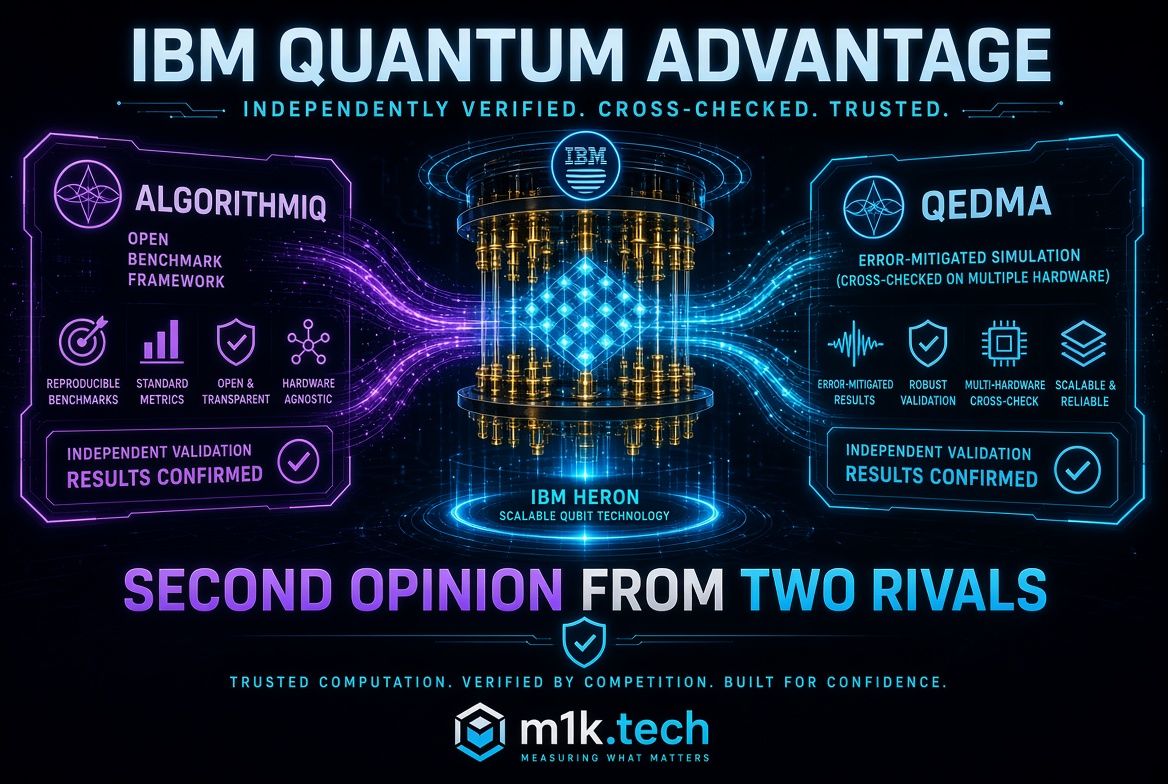
Quantum computing has a trust problem that has nothing to do with qubits misbehaving. It’s this: once a quantum processor produces a result no classical computer can check, how does anyone know the answer is right? That question has quietly undercut almost every “quantum advantage” claim of the last several years, because the usual proof was circular. Run the quantum machine, then run a classical simulation to confirm it, and the moment someone writes a cleverer classical algorithm, the advantage evaporates. Google’s 2019 claim went through exactly that cycle. IBM spent this week trying to close the loophole for good, and it did it twice, with two different partners, using two different methods, on the same day.
The first result came from Algorithmiq, a Milan-based quantum software company. Its team, led by senior scientist Sergey Filippov under CSO Guillermo García-Pérez, built a simulation of heterogeneous quantum matter, the kind of irregular, interface-heavy structure you find in real catalysts and battery electrolytes, and ran it on an IBM Quantum Heron processor. The point wasn’t just running the simulation. It was proposing a framework for trusting the output when no classical machine can verify it directly, and then backing that framework up by publishing an open benchmark so outside researchers can try to beat it classically. Eight months after the original result went up on the Quantum Advantage Tracker, nobody has.
The second result, from the Israeli error-mitigation company Qedma, took a more brute-force route to the same conclusion. Qedma’s QESEM software ran a two-dimensional Floquet Ising simulation on IBM hardware at up to 74 qubits, a scale where classical methods (tested in collaboration with RIKEN and BlueQubit) simply stopped keeping up. What makes this one harder to wave away is the cross-check: the same physics was independently reproduced on Quantinuum’s trapped-ion hardware, a direct competitor’s machine, and it matched. That’s the detail I trust more than either company’s press quote. A result that survives being rerun on somebody else’s hardware, using a completely different qubit technology, is a different animal from a benchmark a company runs on its own machine and calls historic.
I’ll admit the timing bugs me a little. IBM published both of these the same week its quantum division crossed a billion dollars in cumulative revenue, which I wrote about a few days ago, and coordinated PR pushes around investor-friendly milestones are not exactly rare in this industry. New Scientist ran a piece basically the same week arguing that fully fault-tolerant quantum computing might always be five years away, and I don’t think that skepticism is wrong just because IBM had a good week. Quantum advantage claims have burned enough credibility that “two vendors, two methods, one hard-to-fake cross-validation” is a meaningfully higher bar than what usually gets called a milestone, but it’s still not the same as a quantum computer solving a problem nobody cares whether it’s real or not.
What convinces me isn’t the advantage claim itself, it’s that Algorithmiq open-sourced its best classical attack instead of just asserting victory. That’s the opposite of how most of these announcements work, and it’s the kind of move that survives scrutiny instead of needing a press cycle to outrun it. Illinois has been betting real money that this field matures on a useful timeline, and pieces like this are the evidence I weigh, not the revenue milestone. I still don’t know whether “quantum advantage” as a phrase survives the next two years without getting redefined again. Ask me after somebody tries to break Algorithmiq’s benchmark and fails a second time.
Sources
IBM Newsroom, “IBM and Algorithmiq Demonstrate Quantum Advantage, Establishing a Framework for Trusted Quantum Computation Beyond Classical Verification”, July 30, 2026.
Yahoo Tech, “IBM and Qedma Report Quantum Computing Milestone Beyond Classical Supercomputer Capabilities”, July 30, 2026.
New Scientist, “Why full-fledged quantum computers might always be five years away”, July 31, 2026.