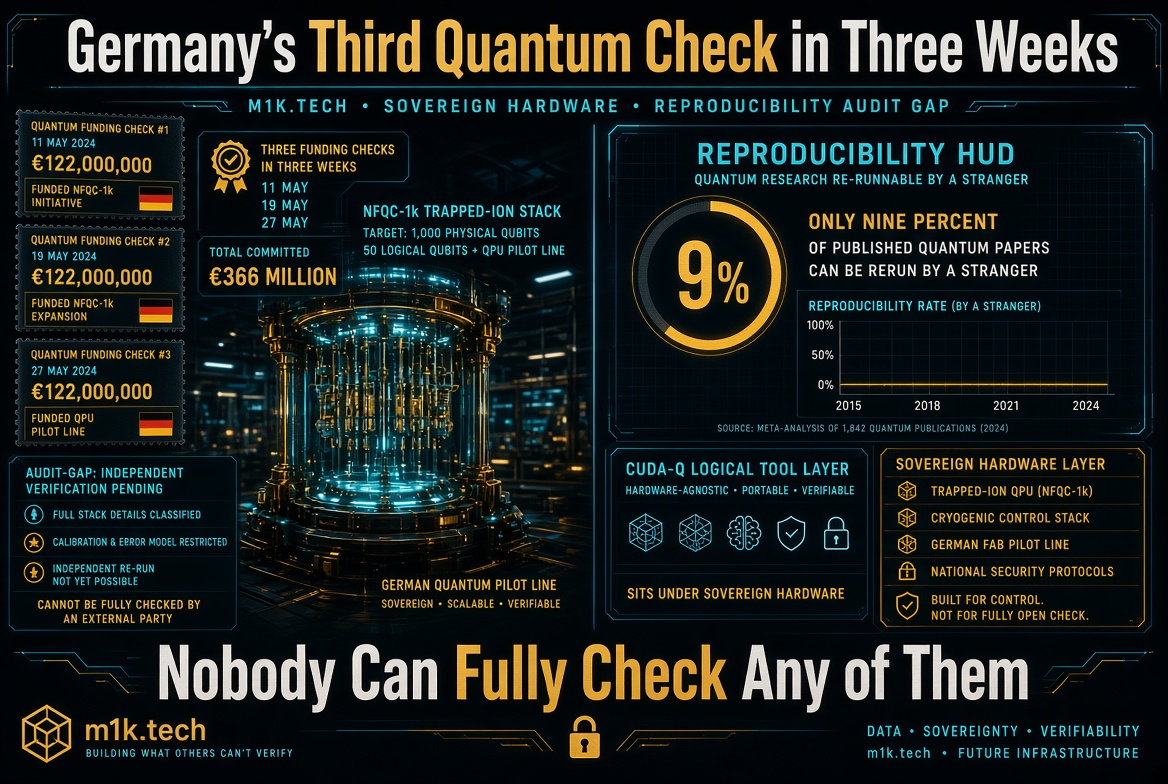
Germany’s Federal Ministry of Research, Technology and Space handed out some of this year’s biggest quantum funding this week, and it isn’t betting on a single horse. On Tuesday, the ministry selected a seven-member consortium led by QUDORA Technologies for a €122 million project called NFQC-1k: a trapped-ion quantum computer targeting 1,000 physical qubits and roughly 50 logical ones, plus a QPU pilot line to actually manufacture the hardware rather than just prototype it once. The consortium reads like a checklist of who does what in German quantum research: QUDORA supplies the systems integration, TU Braunschweig and Leibniz University Hannover bring the physics, the Physikalisch-Technische Bundesanstalt handles metrology, NXP Germany brings semiconductor packaging experience, Forschungszentrum Jülich supplies its existing quantum infrastructure, and AQT Germany rounds out the ion-trap expertise.
What makes this worth a post rather than a line in a digest is the timing. This is the third major German or Danish quantum-hardware commitment inside about three weeks. Jülich turned on its own ion trap quantum computer, JION, on September 3, and Copenhagen broke ground on a quantum chip foundry a day later, backed by €25 million and €35 million in German state and EU money on one side and $62 million in Novo Nordisk Foundation money on the other. NFQC-1k is a fresh, separate €122 million, and it’s explicitly framed as one slice of a roughly €640 million “Quantum Computing Competition” under Germany’s High-Tech Agenda, which has set itself the goal of two European fault-tolerant quantum computers by 2030. Three funding announcements, three different qubit technologies, one government, three weeks. That is not indecision. It’s the same instinct Illinois had when it let PsiQuantum, IBM, Diraq, and Infleqtion all set up shop on the same 440 acres outside Chicago instead of picking a single approach: nobody yet knows which qubit architecture wins, so the hedge is to fund several at once and let the technology sort itself out.
The American version of the same instinct looks different on paper but rhymes underneath. The Department of Energy’s Quantum Genesis Q program is offering up to $215 million to any private company that can build a machine with at least 100 logical qubits, which is a prize structure rather than a consortium grant: DOE doesn’t pick the team; it picks the finish line and lets whoever gets there first collect. Germany’s NFQC-1k is the opposite instinct, funding a named consortium to hit a specific physical-to-logical qubit ratio on a specific technology. Both approaches are trying to buy the same thing, a credible national claim to fault-tolerant hardware before 2030, and neither one actually solves the problem that’s been sitting underneath this entire field all year.
That problem now has a number attached to it, and it’s an ugly one. A study out of the Technical University of Applied Sciences Regensburg found that only about nine percent of published quantum computing papers can actually be reproduced by an outside researcher, once you account for how many papers even include runnable code and how many of those actually execute when someone tries. Nobody involved in that study was trying to embarrass the field from outside it. It came from inside quantum research, and the number is worse than the same team found running the same check four or five years earlier. Pour €122 million into a consortium chasing 50 logical qubits, and the eventual press release announcing success will land in exactly the environment that study describes: a claim from the people who built the machine, checked mostly by the people who built the machine, in a field where nine times out of ten a stranger can’t rerun the numbers.
There’s a second complication that has nothing to do with qubit count and everything to do with who ends up owning the tooling underneath all of this hardware. NVIDIA spent September cutting Fermilab’s fault-tolerant design cycle from five months to three weeks using CUDA-Q Logical, open-source software that Sandia, Infleqtion, IQM, and Quantum Motion have all already adopted across superconducting, neutral atom, and other qubit types entirely. That list includes some of the same names Europe is counting on to build sovereign hardware. You can fund a trapped-ion machine built entirely on German soil with German money and German physicists, and still end up running the co-design workflow that decides how many physical qubits it needs through a tool that exists because an American company open-sourced it. That’s the exact pattern that gave NVIDIA’s original CUDA its grip on classical AI computing, and it doesn’t care whose government wrote the check for the hardware sitting on top of it.
None of this means NFQC-1k is a bad bet. A trapped-ion demonstrator with a real pilot line for manufacturing, not just another one-off lab machine, is a legitimate step past where Jülich’s JION sits today, which has a handful of working qubits and a roadmap to ten by mid-2027. But the country that ends up mattering most in this race won’t be whichever one wrote the biggest check this month. It’ll be whichever one first gets a logical-qubit claim verified by someone with no reason to be generous about it, the way IBM’s own quantum-advantage claim only started meaning something once two rival companies independently reproduced it. Until then, €122 million buys Germany a seat at a table where almost nobody can fully check anyone else’s homework, including, eventually, its own.
Sources
- QUDORA Technologies, German government selects QUDORA-led consortium for €122 million project NFQC-1k, September 23, 2026