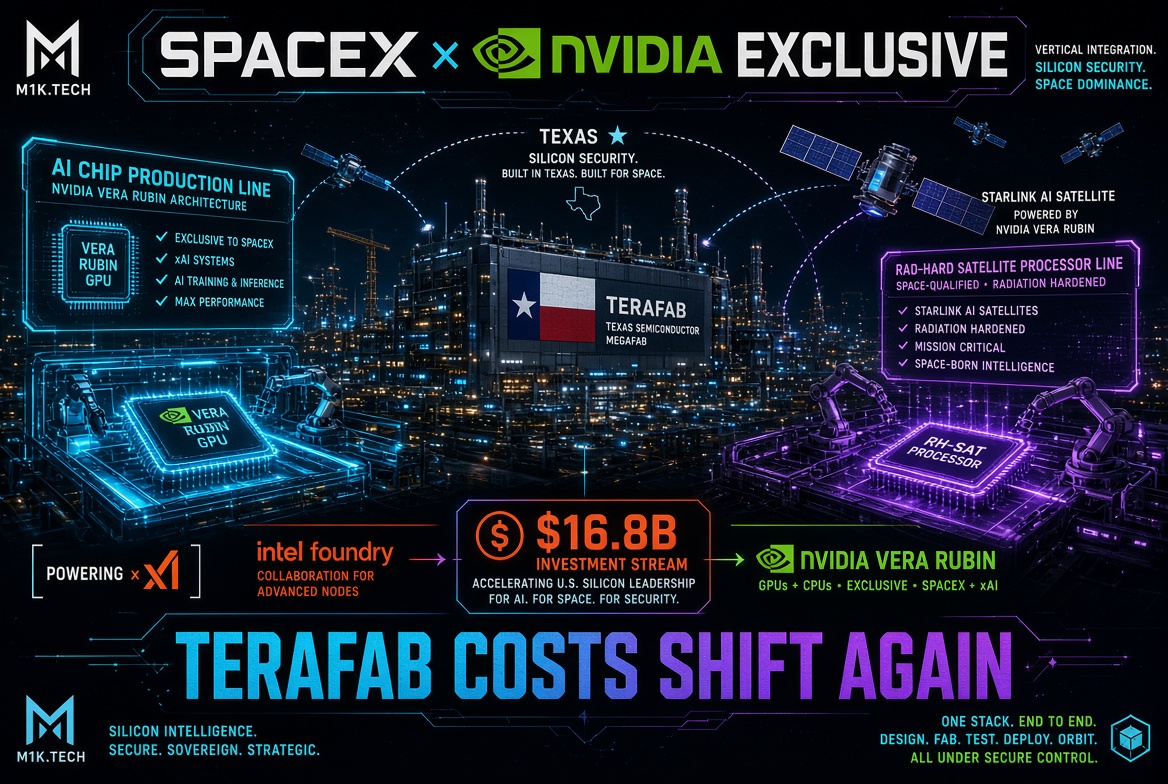
Elon Musk said the quiet part out loud on SpaceX’s second earnings call as a public company: “We think the Vera Rubin architecture is the best architecture, we’re exclusive to Nvidia.” Not preferred supplier. Not primary partner. Exclusive, on the record, for the chip family that’s about to run Starmind AI1, the first satellite in an orbital AI compute constellation SpaceX and Nvidia announced hours before the call started. Each satellite carries Rubin GPUs and Vera CPUs. Nvidia traded above $219 within the hour on a 3.5 percent pop, worth about $180 billion in market cap moved by one sentence from a customer’s earnings call.
I keep turning that sentence over because it isn’t really a marketing decision, it’s a confession. Multi-vendor sourcing exists for one reason: to preserve leverage over the biggest line in your budget. SpaceX gave that up in public, on its biggest line, with no discount disclosed and no second source named. Revenue came in at $7.81 billion, up 92 percent year over year and about 13 percent ahead of estimates, with the loss narrowing to $541 million. Then came the number that actually mattered: $18.37 billion in capex, $15.83 billion of it dumped straight into AI infrastructure, 39 percent past what analysts had modeled. A rocket company spent roughly twice its quarterly revenue on computing hardware in three months and wouldn’t say what it plans to spend for the rest of the year. Shares popped 9.4 percent during the session and gave back about 7 percent after hours once traders had time to actually read that line.
Two days later, Texas governor Greg Abbott confirmed the other half of the story: Terafab, the “vertically integrated semiconductor megafactory” Musk has been teasing since spring, finally has a legal home in Grimes County, roughly 90 miles northwest of Houston. First-phase investment: $16.8 billion. Which is a strange number to land on, because SpaceX’s own regulatory filing put the first-phase figure at $55 billion just three months earlier, and the number before that was $25 billion, and the one before that was $20 billion. Four price tags in five months isn’t unusual for a project this size while it’s still being engineered, but it’s worth sitting with for a second before anyone declares victory.
The part I find more interesting than the money is who’s actually building this thing. SpaceX’s own May S-1 described Terafab in the flattest legal language possible: “a general framework for the future development,” no financial terms, no binding commitments from any party, and a risk-factors section noting that neither Tesla nor Intel is obligated to stick around. An analyst at Yole put it more bluntly to EE Times: Terafab reads less like Musk’s chip plant and more like an Intel fab expansion with Tesla, SpaceX, and xAI signed on as anchor customers. That framing matters a lot more than the press release does. Intel has the process engineers and yield experience this actually requires, and its foundry business lost $10.3 billion in 2025 with no high-volume anchor customer to show for it. Terafab hands it one, wrapped in someone else’s press cycle.
The technical bet is two dedicated fabs on Intel’s 14A node rather than one shared line: one for the AI5 and AI6 chips running Tesla’s FSD stack, Optimus, and Cybercab, the other for D3, a radiation-hardened processor meant for SpaceX’s satellite fleet, which already runs more than 6,000 active Starlink units. Musk calls it “linear, adjacent movement of the FOUP,” engineer-speak for keeping one product per building so wafers never have to detour. It’s a clean idea on paper. It’s also boxed in by a hard date: Intel’s 14A design kit isn’t shipping to external customers until October, per Ming-Chi Kuo, which means real chip design can’t start before Q4 2026 against a first-silicon target of late 2027. That’s not a lot of runway, and Tesla already knows what a slipped node costs, since its Samsung-built AI6 supply out of Taylor, Texas already moved from mid-2027 to late 2027 after a delayed prototype run.
None of this reads as a scam or vaporware to me, and I don’t think that’s the interesting conclusion here anyway. What’s actually happening is a company staring down 2 gigawatts of compute by the end of this year and 10 by the end of next, deciding that owning a piece of the supply chain everyone else is fighting over is cheaper than continuing to compete for it. That’s the same logic behind every chiplet and modular packaging bet the industry has made this year, just run by someone with rockets instead of a fab lease. And it’s happening at the exact moment Nvidia is quietly trimming memory specs on next-generation Rubin Ultra, stepping down from a 12-Hi HBM4e configuration to 8-Hi at 192GB, well below the 288GB on regular Rubin, because DRAM is expected to stay short through 2027 and the taller memory stacks aren’t yielding. A company doesn’t build its own fab and hand its GPU budget to a single vendor because business is easy. It does that when there simply isn’t enough silicon to go around at any price, and I think that’s the actual headline buried under four different cost estimates and one very good quote from an earnings call.
Nvidia reports its own fiscal Q2 results on August 26, guided to roughly $91 billion. Watch whether it says anything about memory availability. That’s the number that tells you if this was Musk getting ahead of a shortage or just getting louder about one everyone already knew was coming.
Sources
- Forbes, “SpaceX Goes Exclusive With Nvidia, Putting Rubin GPUs In Orbit”, August 7, 2026
- Tech Times, “SpaceX Confirms Terafab in Texas; Own Filing Shows $38B Gap in First-Phase Figures”, August 7, 2026
- Governor Greg Abbott’s office, “Governor Abbott Announces SpaceX Expansion in Grimes County”
- EE Times, “Intel Enters Pact With Tesla and SpaceX for Terafab”
- TrendForce, coverage of Nvidia Rubin Ultra memory configuration changes, August 4, 2026