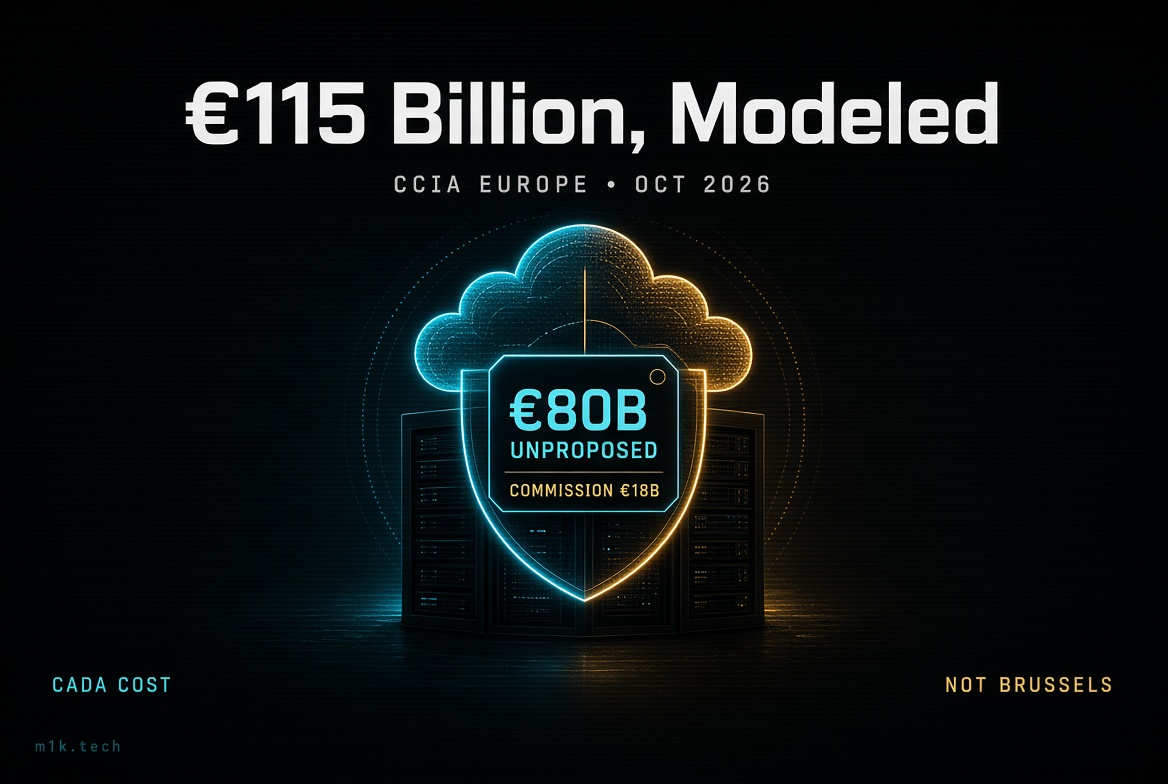
Of the €115 billion in the headline number, €80 billion is a bill Brussels hasn’t sent. It only exists if the Commission stretches sovereignty requirements to cover 25 percent of cloud workloads in essential private-sector industries, which is a modeling assumption made by the people paying for the model.
Those people are CCIA Europe, the lobby group whose members include Amazon, Google and Meta. It commissioned the European Center for International Political Economy to cost the Commission’s proposed Cloud and AI Development Act (CADA), and the answer is €115 billion over ten years against the Commission’s own upper estimate of €18 billion. ECIPE puts direct public-sector costs at €33.3 billion; the rest lands on private companies in banking, healthcare, energy and transport, if Article 31 is used the way CCIA fears it could be.
The mechanism is believable, which is what makes the study hard to dismiss. Moving a workload off a hyperscaler is not a copy job. ECIPE says code rewriting and re-architecting make up 69 percent of its estimated cost, and anyone who has watched a company untangle itself from one provider’s proprietary services knows the number is not crazy in shape. The Luxembourg figure, €1,711 per worker over the decade, is the kind of line that will get quoted in a working group whether or not the underlying scenario ever happens. Denmark, Austria and Finland all come in around €864 to €905 per worker, with Ireland at €856, which is a little funny given where several of these companies keep their European headquarters.
I don’t know what CADA should cost. Policy economics is not my lane, and a gap of more than sixfold between two cost estimates tells me mostly that nobody has agreed on what gets counted. What I can say is that AWS is simultaneously spending real money on a European Sovereign Cloud it will cut off from the global backbone on October 24, while its trade association tells governments that sovereignty rules based on corporate origin are the wrong tool. Both can be true. Sovereignty as a product is fine; sovereignty as a legal requirement that favors European providers is the thing being priced as a catastrophe.
CCIA wants to limit requirements to sensitive workloads and replace origin-based tests with what it calls risk-based technical safeguards. I’d read that as the real ask, and the study is the lever. When AWS became NATO’s default classified cloud, the argument that Europe can’t function without US hyperscalers got a very concrete exhibit. This study turns that argument into a spreadsheet.
It also lands on ground I’ve covered before. Europe has a long record of announcing sovereignty and then buying American, which is where sovereignty as a panel topic came from, and AXA’s Copilot rollout was a quieter version of the same retreat. A €115 billion headline makes retreat easier to justify to a finance minister. It doesn’t make the number right.
Sources
The Register, US tech giants warn Europe that ditching US tech giants could cost €115B, October 14, 2026