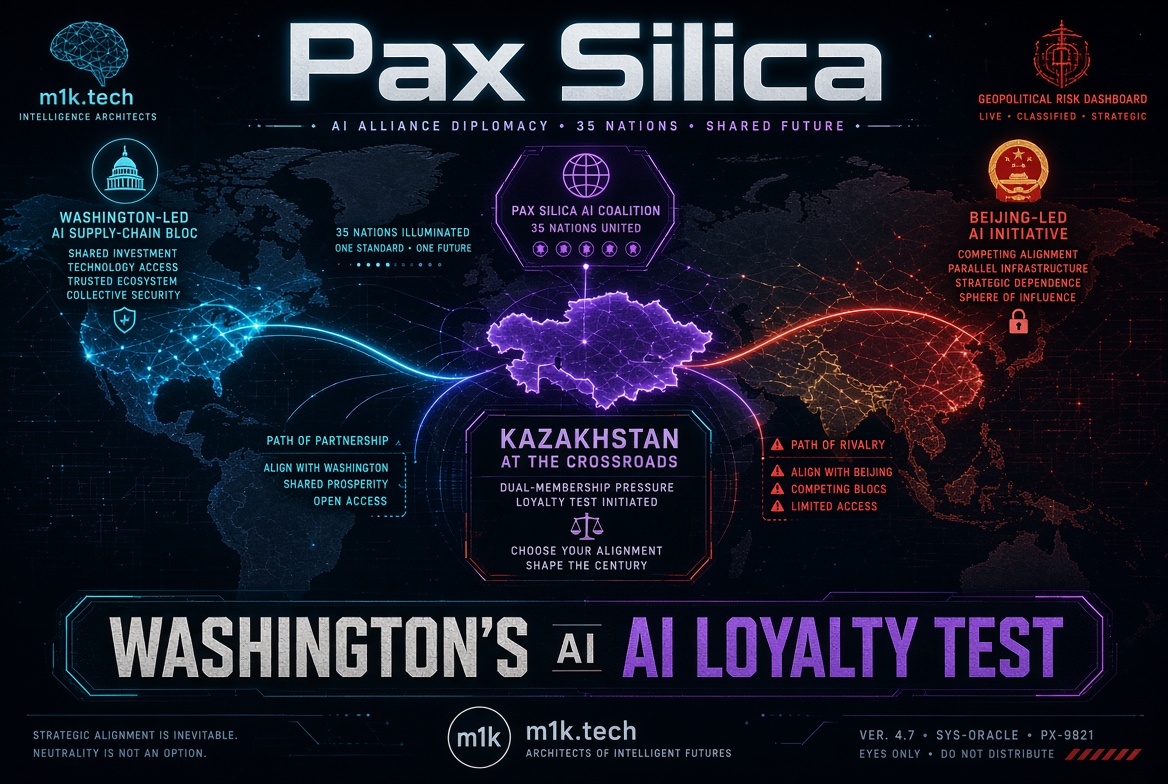
“To be part of everything is to be part of nothing.” That line sits inside a draft State Department letter Reuters got hold of this week, addressed to the 35 countries that signed Washington’s “AI Opportunity Statement” back in June. Strip away the diplomatic phrasing and the message is blunt: pick a side in the AI race, ours or Beijing’s, and if you’re currently hedging between both, stop.
I’ve spent a lot of this year watching the export-control regime get built one licensing category at a time, the kind of thing that shows up as a 30-day permit window on an H100 shipment to a transshipment hub in Malaysia and nowhere near a headline. This letter is a different kind of instrument. It’s not a chip rule or a tariff schedule. It’s an attempt to turn a voluntary framework into a loyalty test, aimed at governments that probably signed the AI Opportunity Statement the way you sign a conference guestbook, without expecting anyone to hold them to it later.
Pax Silica launched last year as Washington’s vehicle for locking down AI supply chains: models, semiconductors, and the critical minerals that feed both. Roughly two dozen countries have joined, including close allies like Japan, Australia, and South Korea. In June, the State Department touted Kazakhstan as the first Central Asian member, a genuine coup given the country’s rare earth and uranium reserves. Then in July, Kazakhstan also joined Xi Jinping’s rival initiative, the World Artificial Intelligence Cooperation Organization, becoming the only country sitting in both blocs at once. Reuters’ sourcing says that fact alone set off alarm bells in Washington and prompted this letter.
The mechanics are odd, because the letter itself doesn’t name China. It doesn’t have to. “It cannot be held alongside membership in duplicative initiatives whose expectations conflict with our own” only makes sense if you already know which initiative it’s talking about, and everyone reading it will. An unnamed State Department official put it more plainly to Reuters: you can’t credibly claim to be a trusted partner in one technology ecosystem while signing up for a Chinese initiative built to compete with it.
What actually surprised me isn’t the sentiment, which has been the subtext of every export control announcement since the first Nvidia chip restriction. It’s the format. A membership subscription you can be asked to cancel is a much more legible piece of leverage than a chip license, because it doesn’t require Commerce to litigate the end use of every shipment. Sign the wrong declaration and, per the letter’s own framing, you’ve disqualified yourself from “shared investment opportunities in AI-related projects” that Pax Silica members get access to. That’s a cleaner lever than anything in the export control toolkit I’ve written about this year, and also a much blunter one, which is exactly why I don’t think it survives contact with the EU bloc unchanged.
Here’s my problem with the “pick a side” framing as policy rather than as diplomatic theater. Europe has spent this entire year demonstrating that sovereignty and dependency are two settings on the same dial that companies adjust based on what’s cheapest that quarter. AXA built its own controlled AI environment specifically to avoid this exact bind, then rolled Microsoft 365 Copilot out across the company anyway once the productivity case got strong enough. Mistral, the company France built as its sovereignty answer, took a billion euros from Microsoft to get there. If flagship European companies can’t hold a consistent line inside their own borders, I have no idea what “choose deliberately” is supposed to mean for a government trying to keep both a domestic AI industry and an American cloud contract alive at the same time.
And Washington’s own credibility on the “trusted partner” side of this bargain isn’t spotless either. The US government ordered Anthropic to kill Fable 5 and Mythos 5 access worldwide with essentially no warning, a reminder to every ally that access to the American AI ecosystem is revocable by decree, not contract. Asking countries to bet their entire AI posture on a coalition whose senior partner has already demonstrated it will cut the cord unilaterally is a harder sell than the letter’s drafters seem to appreciate. Meanwhile, the actual product gap that’s supposed to make this an easy choice keeps narrowing on its own. DeepSeek’s V4-Flash is running roughly a hundred times cheaper than Claude for comparable work, and no amount of alliance paperwork changes what a finance ministry’s procurement spreadsheet says about that.
I’m not going to model the critical-minerals leverage angle here; Kazakhstan’s rare earth reserves and the broader mineral chokepoint fight deserve their own post, and I’d just be guessing at numbers I don’t have. My simpler read: this letter reads like it was written for a world where AI capability is scarce enough that access is worth this kind of loyalty oath. China’s embassy called the whole thing an attempt to politicize trade and technology, and for once I think the framing, if not the outrage, is basically accurate. Whether Kazakhstan actually drops one membership or just keeps hedging until somebody forces the issue, I don’t know. Reuters couldn’t even confirm when the letter goes out.
Sources
- Reuters, EXCLUSIVE: US to tell partners they must pick sides in AI race with China, August 14, 2026
- CNBC (via Reuters), U.S. to tell allies they must pick sides in AI race with China, August 15, 2026
- State Department, AI Opportunity Statement (June 2026 signatories list, referenced via Reuters/CNBC reporting)