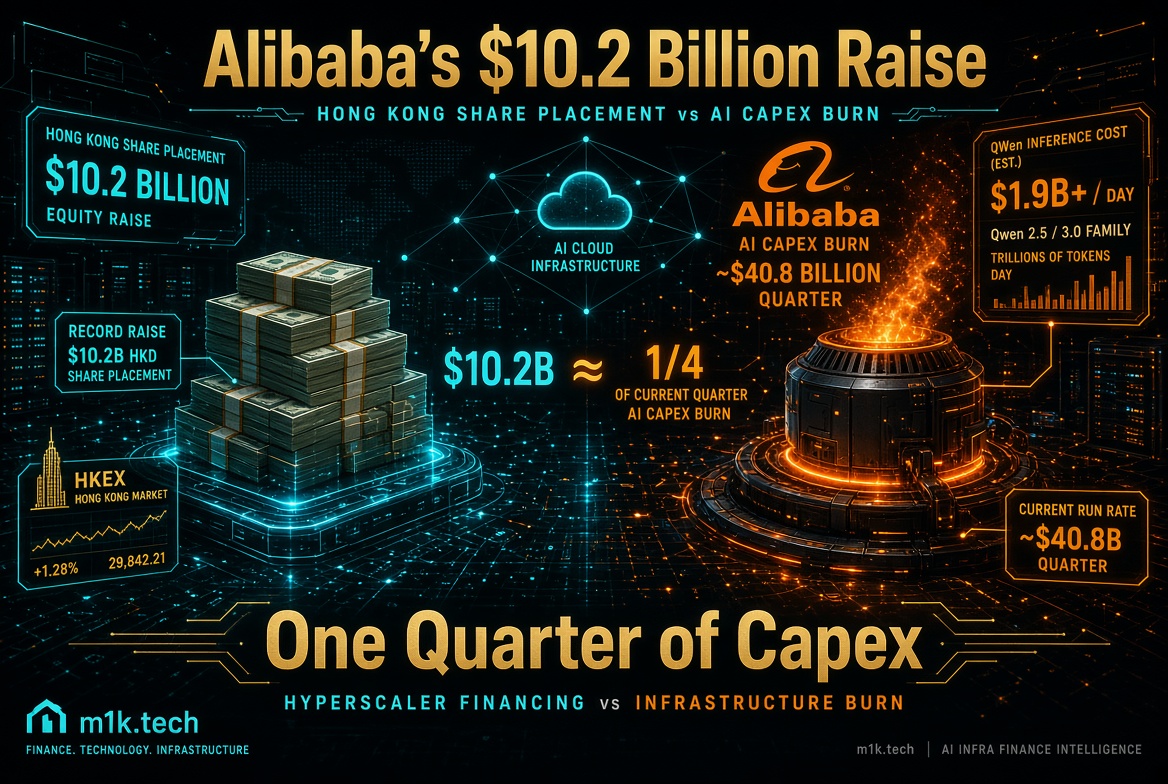
Alibaba had RMB 474.5 billion in unrestricted cash and liquid investments on 30 June, roughly $66 billion. Three days later, Alibaba priced a share placement worth HK$80 billion, or $10.2 billion. Companies with $66 billion in the bank don’t raise money because they are short of it, so the interesting question isn’t why Alibaba wanted the cash. It is what the arithmetic looks like on the other side.
Here is the number that reframed the whole story for me. HK$80 billion converts to roughly RMB73 billion. Alibaba’s capital expenditure in the June quarter was RMB67.7 billion. The largest primary follow-on offering in the history of the Hong Kong exchange, oversubscribed roughly threefold inside an hour, third-largest follow-on anywhere in the world this year behind Alphabet and Intel, covers about one quarter and change of what this company is currently spending on compute. That is the actual scale of AI infrastructure in 2026, and it is why I find the ‘record raise’ framing slightly beside the point.
The mechanics nobody bothered to explain
The placement priced 710 million new ordinary shares at HK$112.70, closing 26 August, structured under Regulation S to non-US persons in offshore transactions. That last part matters more than it reads. The world’s third-largest follow-on this year was legally closed to American investors, which is a quiet reminder of how far the two capital markets have drifted apart. Sovereign wealth funds took the slack, along with global long-only money.
A discount discrepancy is floating around the coverage that is worth clearing up, because it confused me for a good ten minutes. Reuters saw a term sheet describing a 3.6% discount. CNBC reported an 8.4% discount. Both are correct. The 3.6% is measured against Friday’s close on the US-traded line, which Bloomberg confirmed, while the Hong Kong shares closed Friday at HK$123. When Hong Kong opened Monday, the local line fell as much as 10% to HK$110.10 and settled around the placement price, as expected: the HK quote had to walk down to meet a price struck against the ADR. Anyone reading the 8.5% Monday drop as a verdict on the strategy is reading arbitrage as sentiment.
Dilution is real, roughly 3.7% against the share count, and Charles Wang at Shenzhen Dragon Pacific put the bear case plainly enough when he told Reuters that investors generally dislike capex even when the investment pays off later. Fine. But a book covered three times over inside sixty minutes is not a market rejecting the plan.
What the June quarter actually said
Revenue came in at RMB268.95 billion, up 9%, just above the LSEG consensus. Net income fell 75% to RMB10.44 billion, and the reasons aren’t purely AI: a provision for a EUR550 million European Commission Digital Services Act fine sits in there, plus RMB4.46 billion of goodwill impairment. Operating margin went from 14% to 6%. Non-GAAP net income was down 38%, which is the number I would watch if I owned this.
The cloud side is where the case lives. AI Cloud and Compute Services revenue hit RMB48.44 billion, up 45%, its fastest in more than five years, with adjusted EBITA up 133% to RMB5.63 billion and segment EBITA margin at 12%. AI-related product revenue was RMB12.38 billion, a twelfth consecutive quarter of triple-digit growth, now around 35% of Alibaba Cloud’s external revenue. Eddie Wu is guiding to RMB100 billion of external cloud revenue by 2030 at a 20% gross margin, and Alibaba brought its stated payback on AI investment forward from three years to two and a half.
Against that, free cash flow was an outflow of RMB44.67 billion, versus an RMB18.82 billion outflow a year earlier. The AI Labs and Applications segment, which carries Qwen and QwenWork, lost RMB13.86 billion on an adjusted EBITA basis against RMB3.22 billion a year ago, and Alibaba attributes the widening to inference costs on the consumer Qwen app. Serving free tokens to consumers is expensive, and this is the first quarter where I can see the size of that bill cleanly.
Now run the plan against the run rate. The RMB380 billion three-year commitment announced in February 2025 had roughly RMB190 billion deployed as of June. At RMB67.7 billion a quarter, the remainder is gone in under three quarters, well before the three-year window closes in early 2028. The RMB380 billion figure is already a historical artifact. The placement is not a top-up on that plan; it is the admission that the plan was too small, and I think that is the real disclosure buried in a routine announcement about full stack AI capabilities.
Where the money leaks
Alibaba was unusually specific about why capex rose 75%: uneven timing of customer purchases, more CPU compute capacity, and higher prices across a broad range of chip components. That third one deserves more attention than it got. A meaningful slice of this spending increase is buying the same silicon at a worse price, not buying more silicon. TSMC’s price surge has no floor under it and memory scarcity is the layer where Nvidia has been quietly building its moat, and both of those land directly on the bill of materials for a Chinese hyperscaler that cannot simply order whatever it wants.
Which raises the obvious constraint. What does $10.2 billion buy a company that cannot legally take delivery of Nvidia’s best parts? Some of it is domestic silicon, and Alibaba’s own filing describes orchestration software managing heterogeneous chip clusters including its own proprietary chips, which is a careful sentence doing a lot of work. Some of it is the rented offshore compute that export controls do not actually reach, which is a legal structure rather than a loophole and which Alibaba is named in. I am deliberately not going into the T-Head and PPU substitution question here, because the domestic-accelerator story deserves its own post and I would rather do it properly than bolt three paragraphs onto this one.
Europe is not being outspent; it is being out-committed
This is where the comparison gets uncomfortable, and where I think the widely repeated ‘half of what the EU committed’ line has quietly gone stale.
The EUR20 billion InvestAI gigafactory figure von der Leyen announced in Paris in February 2025 is no longer the number. When the actual call for tenders opened on 30 July, the structure was up to EUR10 billion of combined EU and national public support against at least EUR20 billion sought from private investors. Brussels’ own share of that public money is around EUR5 billion, matched by member states, and under the current Multiannual Financial Framework the Commission can commit approximately EUR1 billion. The other EUR4 billion depends on a budget cycle beginning in 2028 that is still being fought over. Council Regulation 2026/150 caps the Union contribution at 17% of each facility’s computing capex, which is not a funding shortfall; it is a legal ceiling on public subsidy written into the framework on purpose.
So the honest comparison is this: one Chinese company placed, in a single afternoon, roughly the entire public envelope for all seven European gigafactories combined, and about ten times what the European Commission can currently sign for. Bids close 12 November, awards land in early 2027, and the first sites are targeted for mid-2028. Alibaba’s money closes on 26 August 2026 and gets spent this quarter. I wrote in July that seven gigafactories at EUR30 billion was an answer to a EUR700 billion problem, and nothing since has made that look pessimistic. The 77 expressions of interest across 60 sites in 16 member states were never the constraint. Timing and legal authority were, and they still are.
Against America, the number is small
Flip the comparison, and Alibaba looks modest. Microsoft, Amazon, Alphabet, and Meta are expected to spend around $725 billion to $760 billion in capex in 2026. Alibaba’s entire multi-year RMB380 billion program, about $53 billion when announced, is less than one quarter of Amazon’s annual budget on its own. The record-shattering Hong Kong placement equals roughly five days of combined American hyperscaler spending.
The structural difference is more interesting than the totals. American AI infrastructure is being financed with debt and increasingly exotic private credit. Nvidia arranging half a trillion dollars of financing for its own customers is the extreme version, but the pattern runs through SPVs, twenty-year leases and record data center debt issuance across the whole sector. Alibaba did the opposite and sold equity, which is the most expensive capital available and the only kind that comes with no covenants, no maturity wall and no refinancing risk if payback slips from two and a half years to four. Given that Chinese tech has spent five years learning that access to offshore dollar debt is a political variable rather than a financial one, paying up for permanent capital looks less like a bad trade and more like a company that has read the room.
Tencent, for what it is worth, ran capex up 65% quarter-on-quarter to RMB52.8 billion in the same period. The Chinese buildout is not an Alibaba idiosyncrasy.
What I keep circling back to
The monetization story is real and I have been wrong to be as skeptical of it as I was earlier this year. Twelve straight quarters of triple-digit AI product growth, 38.1% of China’s AI cloud market per Omdia, cloud EBITA up 133%, and open weights that actually shipped after I doubted they would. That is a business, not a narrative.
What I cannot square is the direction of the two lines. Payback is getting shorter, from three years to two and a half, while free cash flow is going the other way at RMB44.67 billion a quarter, and the consumer inference bill is quadrupling. Both of those can be true if demand is genuinely outrunning supply. They can also both be true if you subsidize consumption to buy market share and call the subsidy an investment. Nothing in the June quarter distinguishes between those two, and the placement does not either. It just buys another quarter to find out.
Ask me again after the December quarter, when the RMB380 billion is spent, and Alibaba has to name a new number.
Sources
- Alibaba Group, Form 6-K, pricing of the HK$80 billion placing, 23 Aug 2026: sec.gov
- Alibaba Group, Form 6-K, June Quarter 2026 results, 20 Aug 2026: sec.gov
- Alibaba Group, Form 6-K, RMB380 billion AI and cloud commitment, Feb 2025: sec.gov
- Reuters, Alibaba launches $10 billion Hong Kong share placement to fund AI spending, 23 Aug 2026: finance.yahoo.com
- Bloomberg, Alibaba Raises $10 Billion for AI in Record Hong Kong Share Sale, 23 Aug 2026: bloomberg.com
- CNBC, Alibaba plunges after announcing $10.2 billion share placement to fund AI push, 24 Aug 2026: cnbc.com
- CNBC, Alibaba cloud revenue rises 45% even as AI spending weighs on profit, 20 Aug 2026: cnbc.com
- European Commission, EU launches AI Gigafactories call, 30 Jul 2026: digital-strategy.ec.europa.eu
- Euronews, EU opens call for seven gigafactories to train next-generation AI technologies, 30 Jul 2026: euronews.com