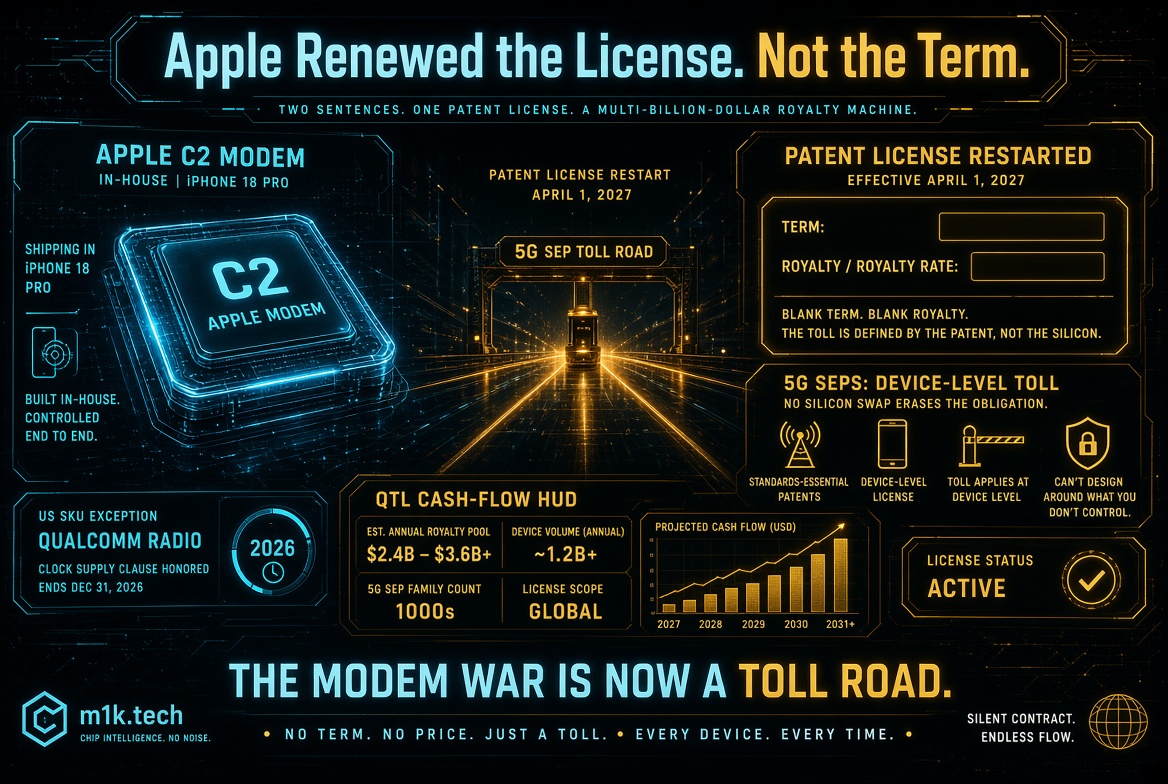
Qualcomm announced the renewal of its global patent license agreement with Apple on Thursday, the last day of Snapdragon Summit, in a release so short it could have been a text message. The new agreement takes effect April 1, 2027, the day after the current one expires. It carries no term length and no royalty figure, and it never once mentions a modem. John Han, who runs Qualcomm’s licensing business, supplied the only quote, saying Qualcomm was pleased to extend the Apple license agreement. That was the whole thing.
The market’s first reaction was a shrug that tipped negative. Qualcomm shares slipped about one and a half percent on the day while analysts picked at what the release left out, then recovered that and more on Friday once people decided a signed license beats an unsigned one. Bernstein’s Stacy Rasgon put his finger on the part that bothers me too: when the two companies settled in 2019, Qualcomm spelled out a six-year term with an option to extend. This time there is no number at all, and companies that sign long, rich renewals usually can’t wait to tell you.
I have a personal stake in this one. In July, when I wrote about Qualcomm’s royalty machine, I argued that the real cliff for QTL was never Apple’s in-house modem. It was the March 2027 renegotiation, when Apple would sit down to re-price a license covering patents it now practices in its own silicon, represented by the same lawyers who sued the first time. That cliff just got paved over six months early, with no lawsuit and no leak, and I did not see a quiet ending coming. The 2017 version of this story played out in courtrooms on several continents. The 2026 version fit in two sentences during a chip conference in Maui.
Two contracts on two clocks
Most coverage blurs Apple and Qualcomm into one relationship, and the renewal only makes sense once you pull the pieces apart. The patent license dates to the April 2019 settlement that ended the war: Apple paid a one-time sum reported at roughly $4.5 billion, took a six-year license with an extension option, and that is how the paperwork reached March 31, 2027. It covers Qualcomm’s standard-essential patents on cellular technology, the ones any phone that speaks 4G or 5G practices no matter whose silicon does the talking.
The chip deal is a different animal on a different calendar. In September 2023, Qualcomm announced it would supply Snapdragon 5G Modem-RF systems for Apple’s 2024, 2025 and 2026 phone launches. Thursday’s release renews the license and says nothing whatsoever about supply, and that silence is the chip story.
The iPhone 18 Pro already told it. Apple’s C2 modem, unveiled on September 9, ships in the iPhone 18 Pro, in the folding iPhone Duo, and in the iPhone 18 Pro Max everywhere except the United States. C2 adds US millimeter-wave support that C1 and C1X never had, and Apple claims meaningfully faster uploads than C1X while drawing 15 percent less energy. The lone holdout is the US Pro Max, where Apple’s spec page simply omits the C2 line, and the teardowns point to Qualcomm’s Snapdragon X80, the same radio that sat in last year’s iPhone 17 family. International Pro Max units run C2, and C2 does US mmWave now, so this is not a size, thermal, or band limitation. The explanation I find most convincing, and the one John Gruber landed on, is contractual: Apple needed Qualcomm modems somewhere in the 2026 lineup to honor the 2023 commitment, and one regional SKU was the cheapest place to put them.
Which means the 2026 iPhones are very likely the last ones that contractually have to carry a Qualcomm modem at all. Qualcomm has been bracing for this in public. On the fiscal third-quarter call in July, CFO Akash Palkhiwala said the decline in product revenue from Apple would accelerate starting in the fiscal fourth quarter, which closes this week. Nobody on either side is pretending the silicon relationship has a future. The license is what’s left, and the license is what just got renewed.
Why Apple can drop the chip but not the check
This is the part people keep getting wrong about Apple’s modem program, including a fair number of analysts who should know better. Building your own modem gets you out of buying Qualcomm silicon. It does not get you out of the 3GPP standard. The C2 still has to attach to a 5G network the way the standard says, negotiate carrier aggregation the way the standard says, and hand off between cells the way the standard says, and Qualcomm holds a deep pile of patents declared essential to exactly those procedures. Every mmWave band Apple just added to C2 makes that dependency slightly bigger, not smaller. The rumored NR-NTN satellite support in C2, if it shows up in software later, would add another layer of standard to license.
The royalty itself is calculated on the device, not the chip. Qualcomm’s historical rate sits in a band of a few percent of the phone’s wholesale price, applied against a capped device value somewhere around $400 after a decade of regulators leaning on the company. The cap is the detail that matters here: an iPhone 18 Pro Max at $1,299 pays on the capped value, not the full price, so Apple’s per-unit royalty is bounded no matter how expensive its phones get. It is also completely indifferent to whether the modem inside says C2 or X80. Apple’s modem program saves Apple the chip margin. It saves exactly nothing on the license.
Apple is not negotiating empty-handed, and I think this is where the undisclosed terms come from. When Apple bought Intel’s smartphone modem business in 2019 for about $1 billion, it took roughly 17,000 wireless patents. Seven years of C-series engineering on top of that means Apple now owns its own cellular IP, and a license negotiation between two patent holders tends to become a cross-license with a net payment rather than a straight toll. I would bet the number Apple pays from April 2027 is lower per unit than the 2019 number. I can’t prove it, and neither company will help, but it is the simplest explanation for a licensor that stayed quiet about a contract with its most valuable licensee.
The reason Apple signed rather than fought is also practical. Patents still produce injunctions in the right court. In the last round, a Munich ruling over a Qualcomm power-management patent, not even a standard-essential one, knocked older iPhones out of Apple’s German stores for a stretch. Standard-essential patents carry more obligations for the holder, but they have produced injunctions in Germany too, and Apple can’t ship a worldwide C-series lineup with that risk hanging over every market where Qualcomm could file. A renewal effective the day the old license lapses buys Apple the thing it needs most for the C3 and whatever follows it: no gap, no litigation, no retail shelves going dark in Germany.
The money
QTL booked $1.28 billion in fiscal Q3, down 3 percent from a year earlier, and Qualcomm guided the current quarter to between $1.2 and $1.4 billion at a 68 to 72 percent pre-tax margin. That margin is the reason this renewal matters more than its dollar weight. The chip business supplies most of Qualcomm’s revenue; licensing supplies a wildly disproportionate share of its profit, and the whole thing runs roughly flat at a little over $5.5 billion a year, with renewals in one corner offsetting expirations and lapses in another. Huawei’s license lapsed and Huawei dropped out of the numbers. Samsung is locked through 2030 after its extension a few years ago. With Apple now signed past March 2027, the two largest premium-phone licensees on the planet are both under contract, and that is a stability story, not a growth story.
Wall Street split along exactly that line. Baird framed the renewal as proof of how foundational Qualcomm’s IP is to smartphones; Wolfe Research called it neutral. Both are right. The renewal removes the scariest scenario: a 2027 lapse with Apple withholding payments during a fight, as happened for almost two years last time. It does nothing for QTL’s trajectory, which remains welded to global handset volumes that stopped growing years ago. The stock is still down roughly 20 percent this year on the modem transition, and a license renewal was never going to undo a customer walking out of the chip business.
That’s why the rest of Qualcomm’s September matters more than this release. The $60 billion Amazon deal, and the stock warrants Qualcomm handed over to land it, is the growth story. QTL is the cash flow that funds it. I laid out that dependency in the Qualcomm strategy map in August, and Thursday’s news reinforces it: the licensing business survives Apple’s modem, keeps throwing off high-margin cash, and keeps paying for the escape into data centers, PCs and cars.
Why announce it in Maui
The timing looks deliberate to me. Qualcomm spent three days in Maui selling itself as the silicon behind every agent on every device, with Google, Microsoft, Xiaomi and a parade of startups on stage. The one question every analyst in the room had in their back pocket was the Apple overhang, and Qualcomm answered it on the final day, while the sell side was still on the island and before the fiscal Q4 call where it would have been asked anyway. That is good investor-relations choreography. It turns an awkward earnings-call exchange into a headline you control, and it lets the rest of the Summit coverage run without a footnote.
Apple’s go-to-market is quieter and, in its own way, more telling. Apple’s iPhone 18 Pro page sells the C2 as a feature, with AI-powered improvements to cellular quality and a battery-life argument. On the US Pro Max column, where a Qualcomm part does the work, the modem line is simply absent. Apple has never marketed a supplier, but it has also never gone out of its way to leave a spec field blank. The company is building a brand around its own modem, and a license renewal that nobody discusses is perfectly consistent with that. Apple gets to keep telling customers the radio is Apple’s, while quietly paying for the right to make it work on the network.
There is also a partnership pattern here worth naming. Apple has fought most of the big cellular licensors over the past decade and eventually signed with all of them. It renewed with Nokia on a long-term basis in 2023, and it settled with Ericsson at the end of 2022 after a round of lawsuits. The price is what gets fought over, never whether a license exists. This time the fight either happened entirely in private or didn’t happen, and I lean toward the former, because a company that just shipped mmWave in its own modem has no reason to accept 2019 terms without trying.
I’m leaving the other direction of Qualcomm’s royalty life out of this, the part where it’s the one paying Arm, since the Nuvia fight has its own post and its own appeal still running. The irony of Qualcomm lecturing anyone about license fees after that one isn’t lost on me.
What I want is one number: the term. Qualcomm reports fiscal Q4 in early November, and someone will ask. If the answer comes back as a vague “multi-year” with no digit attached, I’ll read that as short, and short means the cliff I wrote about in July didn’t disappear, it just moved to a date we can’t see. My bet is a term shorter than six years at a lower per-unit rate than 2019, accepted by Qualcomm because a quiet renewal at a haircut beats another two years of German injunction hearings and withheld payments. The modem war ended in 2019. What started on Thursday is a toll road, and neither company will tell us the ticket price.
Sources
- BigGo Finance: Apple and Qualcomm renew patent license as chip supply shifts toward pure licensing (Rasgon comments, 2023 supply deal, Palkhiwala July remarks)
- Zacks via Yahoo Finance: Qualcomm renews Apple patent deal, QTL Q3 revenue and Q4 guidance
- MacRumors: Apple says iPhone 18 Pro Max sold in the US differs in one way
- AppleInsider: Teardown confirms US iPhone 18 Pro Max lacks Apple’s C2 modem
- Mobile Internet Resource Center: iPhone Duo and 18 Pro debut C2, Pro Max US stays on X80
- Daring Fireball: why only US iPhone 18 Pro Max models use Qualcomm modems
- Quiver Quantitative: Qualcomm shares rise as Apple license renewal adds to Summit momentum
- Eastern Herald: Qualcomm renews Apple patent license amid modem transition