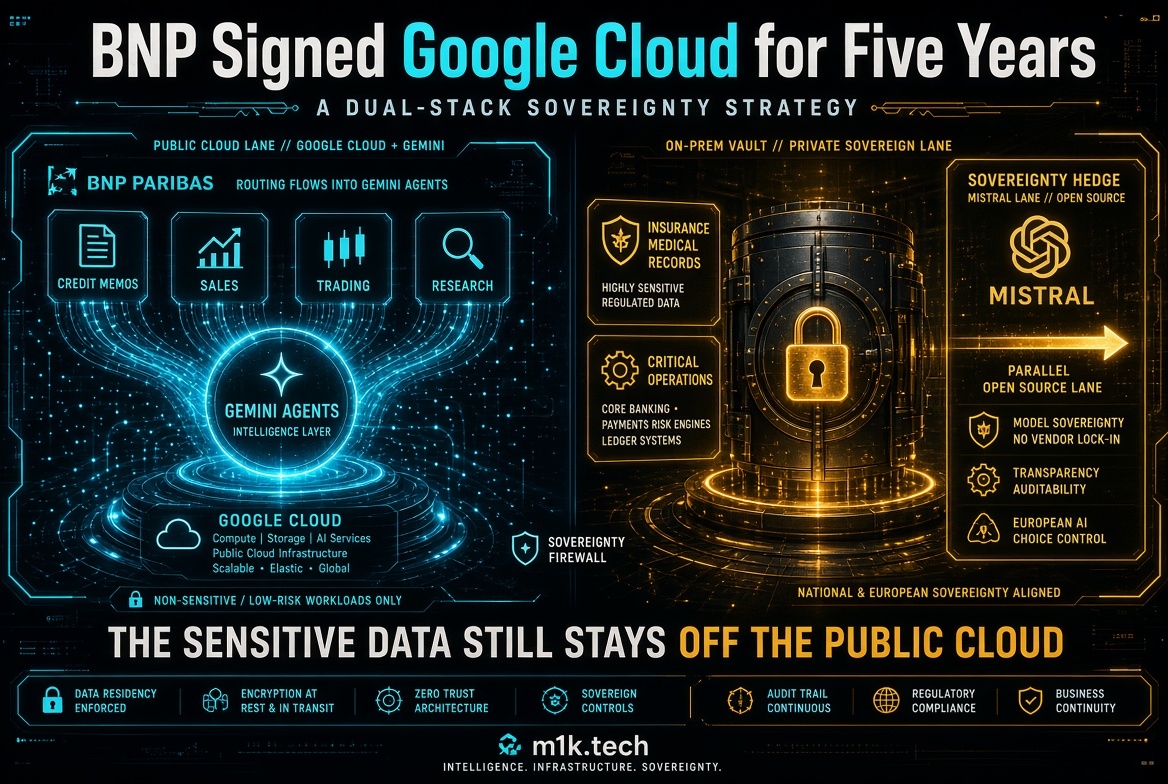
Marc Camus joined reporters Thursday to announce that BNP Paribas had signed a five-year cloud and AI partnership with Google Cloud, then spent most of the call telling everyone what the deal doesn’t cover.
That’s not how these announcements usually go. Vendors want the clean win-cycle: the multi-year headline, the CEO quote, the stock ticker mention. BNP delivered that part too. Google Cloud CEO Thomas Kurian called agentic AI “a critical shift in how global financial institutions streamline operations, assess risk, and serve their clients,” and BNP’s own Chief AI Officer for Corporate & Institutional Banking, Charles Holive, backed him up on cue. But underneath the press-release choreography, Camus spent his half of the call drawing a map of exactly where Google’s access stops.
The agreement gives BNP access to Gemini Enterprise and Gemini models on top of Google’s cloud infrastructure, starting with the bank’s Corporate & Institutional Banking arm. The plan is to fold Gemini into LLM@CIB, BNP’s existing internal generative AI assistant, and push agentic AI into credit memos, trading support, research and structuring. Fairly standard enterprise-AI territory, the kind every large bank is racing to bolt onto its workflow this year.
What isn’t standard is what Camus said next. “The fact that we signed this agreement with Google doesn’t mean that we will get rid of our on-premises infrastructure,” he told reporters. Medical information held by BNP’s insurance operations is staying off public cloud entirely, full stop, he said, and the bank plans to keep running open-source models alongside its existing partnership with French AI company Mistral, splitting workloads by sensitivity rather than consolidating around a single vendor. Google confirmed its side of that arrangement too: BNP keeps ownership of its data, none of it trains or tunes Google’s models, and any agent touching BNP’s systems is authenticated, scoped down to only the resources it needs, and monitored.
I’ve watched this exact shape repeat across European finance all year, and it stopped surprising me somewhere around Coles ending its Palantir contract while still refusing to say the word surveillance out loud. Sign with the American hyperscaler, get the capability, then spend the announcement narrating the part that isn’t moving. What’s different about BNP is that it isn’t walking anything back. It’s building the exit into the contract on day one, sorting sensitive from non-sensitive before a regulator or a headline forces the question for it.
That’s a more honest position than most of the sovereign-AI marketing I’ve read this year, and also a pricier one to run. Keeping Mistral, an open-source stack, and Gemini alive in parallel means real ongoing overhead: separate integration work, separate security reviews, an extra vendor relationship BNP now has to maintain indefinitely instead of collapsing everything into a single throat to choke. Christine Lagarde has spent months arguing that Europe’s compute gap makes full independence from US infrastructure basically impossible on any near-term timeline, and BNP’s structure reads like a bank that did that math and decided against arguing with it. You don’t get sovereignty out of an arrangement like this. You get insurance. Different thing, and still worth paying for.
It also tracks with how Mistral itself has been repositioning lately, less as a pure European alternative to the US labs and more as the layer that keeps a customer able to switch providers without rebuilding everything from scratch. BNP isn’t picking Mistral over Google, or the other way round. It’s paying to keep both doors open and betting that the option is worth more than whatever efficiency it loses by refusing to consolidate.
None of this stops a future headline about a misconfigured Gemini agent pulling data it shouldn’t have. Authentication and scoping promises sound airtight in a press release and get tested for real the first time an agent has a bad day in production. AWS made almost identical sovereignty promises to Airbus and Scaleway earlier this month, and the gap between the pitch and the actual product showed up within weeks.
Sources
- Reuters, BNP Paribas to keep sensitive data off public cloud despite Google deal, September 24, 2026
- BNP Paribas Group, BNP Paribas and Google Cloud Announce New Partnership on Agentic AI and Cloud Innovation, September 24, 2026
- PR Newswire / Google Cloud, BNP Paribas and Google Cloud Announce New Partnership on Agentic AI and Cloud Innovation, September 24, 2026