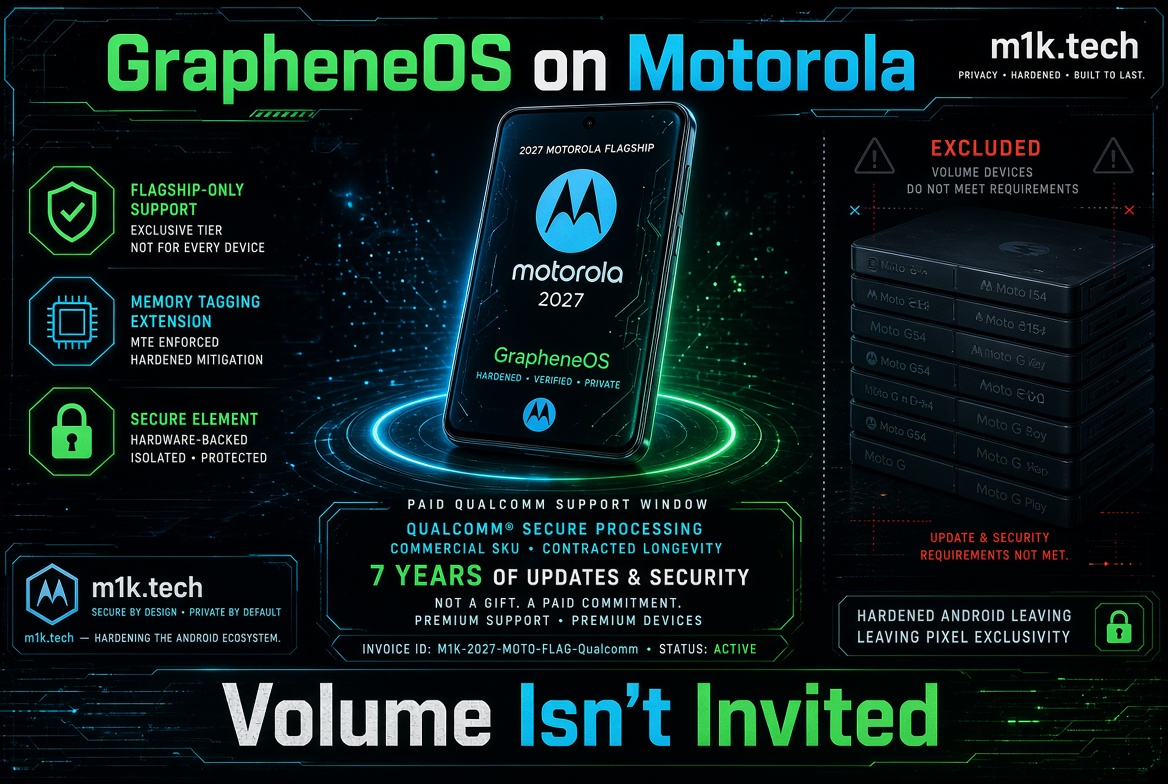
Motorola shipped 3.6 million phones in the United States in the first quarter of 2026, and roughly seventy percent of those were Moto G handsets. Not one of them will ever run GrapheneOS. The first GrapheneOS Motorola phone lands in 2027, the project confirmed on 21 August, and it will be a flagship carrying “higher-end hardware than Pixels at a higher price.” A follow-up thread two days later filled in the rest, and the more detail arrives, the clearer it gets that the interesting part of this story is not the phone. It’s the invoice.
Here is the line that everyone skimmed past: “We’ll also need Motorola to start paying them for longer updates below flagships.” Them is Qualcomm. GrapheneOS is saying, publicly, that the reason a $299 Moto G cannot meet its standards isn’t that the silicon is incapable in some abstract way. It’s that the length of the software support window on a Snapdragon platform is a commercial term Motorola negotiates and pays for, tier by tier, and Motorola currently does not buy it for the cheap stuff.
I’ve been writing about Qualcomm’s licensing structure for two years, and this is the cleanest public confirmation I’ve seen that update longevity is priced, not granted.
The support window is a SKU
When Google promises seven years of updates on a Pixel, it can do that partly because it designs Tensor and owns the relationship with its own silicon team. When Samsung matched that promise, it did the same thing with Exynos on one side and bought an unusually long window from Qualcomm on the other. Everyone else negotiates.
Qualcomm sells a platform with a defined support lifetime attached: kernel maintenance, driver updates, firmware fixes, security patch delivery for the modem, the DSP, and the GPU blob. Extending that lifetime means Qualcomm keeps engineers on an old part longer, which costs Qualcomm money, so it shows up in the contract. Flagships absorb it because the margin is there. A Moto G sold at prepaid pricing in a US carrier channel doesn’t have room in the bill of materials for four extra years of someone else’s payroll, especially now, with memory prices doing what they’re doing to every Android BOM below the premium tier.
That is the real gate on GrapheneOS’s low end, and it’s a business gate wearing a technical costume. The technical gate exists too, and it’s more specific than the coverage suggested. GrapheneOS says the Snapdragon 8 Elite Gen 5 introduced MTE but that the implementation is broken on the non-Elite parts, the chips sitting one rung down in the stack. Anyone who has looked closely at how Qualcomm builds its second tier already knows those are not the same silicon with a lower clock; the cheaper 8-series parts I went through on the OnePlus 15R are separate designs with separate compromises. Memory tagging landing broken on them is exactly what happens when a feature is validated on the halo part and inherited downward without the same scrutiny.
So Motorola’s 2026 flagships, the Signature, the Razr Fold, and the Razr Ultra, are described by GrapheneOS as very close to qualifying and still short: no MTE, insufficient secure element integration. The 2027 parts fix it. Qualcomm engineers are apparently on the hook to help debug MTE across the kernel and userspace once devices exist, which is not a sentence I expected to read about a company that shipped Snapdragon 8 Gen 3 without memory tagging at all while MediaTek had already done it.
What memory tagging is actually worth
MTE assigns a 4-bit tag to every 16-byte granule of memory and stores a matching tag in the unused top bits of the pointer that addresses it. Every load and store gets checked. Mismatch, fault. That catches use-after-free and buffer overflow at the hardware level, at runtime, in shipping software, with overhead low enough to leave on.
Four bits means sixteen possible tags, so a random collision slips through roughly one time in sixteen. It’s probabilistic, not absolute, and GrapheneOS has said as much publicly while arguing that the tag width is a bigger practical weakness than the side-channel issues people like to bring up. What makes it matter is coverage: GrapheneOS wires MTE into hardened_malloc and turns it on for the kernel and nearly the whole base OS by default, plus opt-in for third-party apps, which is a wider deployment than stock Android does with the same hardware. Memory corruption is still the bulk of the remote exploit chain on mobile. Closing most of that class in hardware, everywhere, is the single largest thing separating a hardened Android from a themed one.
Pixels have had it since the Pixel 8 in 2023. It took Qualcomm two more years to ship it on a flagship and it still isn’t right below that line.
Where this leaves Google
Google has spent years getting a free security halo from a project it doesn’t fund, doesn’t control, and occasionally annoys. That ends in 2027, and Google appears to have helped it end.
GrapheneOS says Pixels became substantially harder to support after AOSP 16 removed the official Pixel device support code, and that maintaining Motorola hardware and pushing it through major Android upgrades will be meaningfully easier once it ships. Read that again in commercial terms: the reference platform for the most respected hardened Android build got worse to work with because the vendor stopped publishing the parts that made it easy, and the project responded by acquiring a second vendor who assigns actual engineers. Motorola is putting dedicated staff on the porting and maintenance work. GrapheneOS is no longer doing this alone, and Google’s own release engineering pushed it there.
The chip comparison is blunter still. GrapheneOS now describes Tensor as a sidegrade or a downgrade against flagship Snapdragon on several axes: CPU, GPU, and the on-die isolation of the cellular, Wi-Fi, Bluetooth, and GNSS blocks. Where Google still wins is Titan. The M2 and now the M3 are custom security chips built to resist someone holding your phone, and GrapheneOS is explicit that matching them on physical attack resistance is hard. Its actual claim is narrower and more interesting than the headlines: a 2027 Motorola flagship can plausibly beat a Pixel against remote attacks while losing to it against physical ones. That is a real, defensible split, and it happens to line up with what I argued when Google put post-quantum signatures in the Pixel 11’s boot ROM: the Titan story has always been about device lifetime and authenticity at the hardware root, not about the threat model the press releases imply.
Which means Google’s answer here is the one asset it can’t lose. It should probably say so out loud instead of quietly deleting device support code from AOSP.
Nobody is paying anybody
This is where the commercial logic goes sideways in a way I find refreshing.
GrapheneOS is a Canadian non-profit with something on the order of 400,000 active users, funded entirely by donations, most of them in cryptocurrency, paying around ten people full-time. No license, no enterprise tier, no paid support SKU, no telemetry to sell. Jack Dorsey’s StartSmall put in a million dollars in 2021, OpenSats another million in 2023, Vitalik Buterin some ETH along the way, and the rest is small recurring contributions. That is the entire business.
And when Motorola showed up, the project says it declined money and asked for engineering resources instead.
That decision is smarter than it looks. Cash creates a dependency with a renewal date and a negotiating counterparty; seconded engineers create a fixed reduction in the project’s largest cost line: human time spent on device bring-up and maintenance. Combine it with the AOSP 16 problem and the deal reads less like an expansion and more like a hedge. GrapheneOS spent a decade with a single hardware supplier that made its life harder with every release. It just acquired a second one who pays its own engineers to do the port. In pure sustainability terms, that is worth more than a grant.
Motorola’s side is murkier, and the part that doesn’t fit is distribution. GrapheneOS says the sales mechanism hasn’t been decided, and that it prefers buyers to purchase ordinary retail units and flash the OS themselves through the web installer. If that’s how it ships, Motorola books a hardware sale and nothing else: no attach revenue, no services tail, no subscription. Lenovo does not run a phone business on Halo.
So the money has to come from enterprise, and the announcement’s framing supports that. The MWC partnership landed inside Motorola’s business-solutions messaging, next to ThinkShield. Government, legal, healthcare, journalism, and the security-conscious end of corporate IT will pay a premium per seat for a device with a hardened OS, seven years of updates, and a verifiable boot chain, and they buy in fleets. That is a real market with real margin, and it’s the only one where a phone deliberately priced above a Pixel makes sense. Motorola also gets to bring GrapheneOS-derived concepts into its regular Android builds, which is free security marketing across a lineup that badly wants a reason to be taken seriously above $600. It has been circling that opening since OnePlus vacated the premium foldable space.
The volume problem
Now the uncomfortable arithmetic. Motorola is a genuine volume brand: about 5% of global shipments, eighth worldwide, third in the US, the only vendor in Omdia’s US top five to grow in Q1 2026, up 18% year over year while the market fell. It has nearly doubled its share in India in two years, and it grew in Europe while Apple and Samsung didn’t. Compared to Google, which moved roughly 800,000 Pixels in the US that same quarter and sits near 1% globally, Motorola looks like a massive upgrade in reach.
Except the reach is in the wrong tier. Moto G was seventy percent of that US quarter. The Signature, the flagship most likely to spawn the first GrapheneOS Motorola device, isn’t even sold in the US. Strip out everything the project just excluded and the addressable base is a slice of a slice, launching into a market IDC expects to contract nearly 14% this year on memory costs alone, at a price deliberately set above a Pixel.
Four hundred thousand users is a rounding error today. It will still be a rounding error in 2028. That’s fine. It was never the point, and if you want the version of this argument aimed at people who care more about what leaves the device than what runs on it, I’ve covered what de-Googling an Android phone actually costs you.
I’m not going to get into what bootloader unlocking does to hardware attestation and the banking apps that check it, because that deserves its own post and the answer is unresolved for a device sold at retail and flashed by the buyer.
What I keep coming back to is the sentence below about paying Qualcomm for longer updates on non-flagships. Every argument about Android’s update problem for the last decade has been framed as OEM laziness or carrier obstruction. Here is a security project with no commercial stake saying plainly that on the cheap end it’s a procurement decision, and that the fix is Motorola writing a bigger cheque to San Diego. If that’s true, and I think it is, then the entire moral framing of Android longevity has been wrong. It isn’t that nobody cares. It’s that somebody quoted a price and the answer was no.
Sources
- GrapheneOS on Mastodon: initial devices, flagship pricing, Qualcomm support windows
- GrapheneOS on Mastodon: full Motorola roadmap thread
- 9to5Google: Motorola GrapheneOS phone will be higher end than Pixel in 2027
- 9to5Google: GrapheneOS support coming to Razr Fold and Razr Ultra
- Notebookcheck: GrapheneOS reveals full Motorola plans, 7-year updates, Razr support
- 9to5Google: Omdia US smartphone shipment data, Q1 2026
- IDC Worldwide Quarterly Mobile Phone Tracker
- Android NDK: Arm Memory Tagging Extension
- GrapheneOS donations page