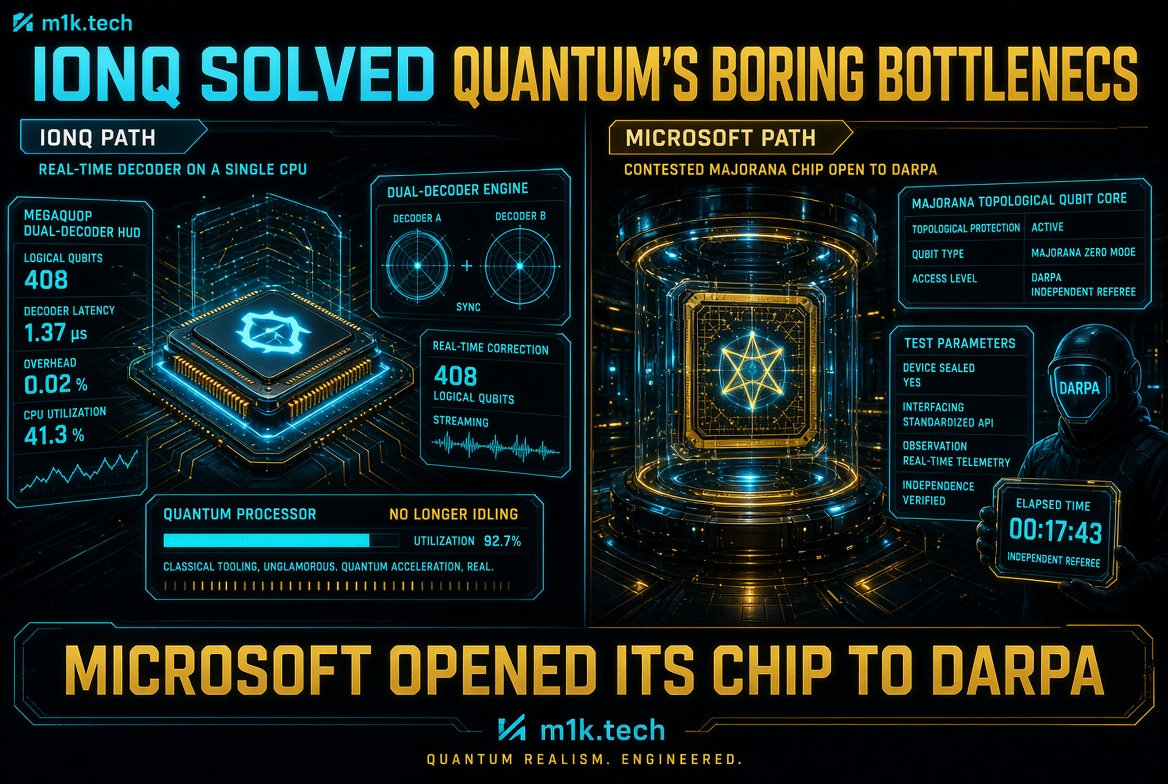
IonQ put out a press release on Tuesday about the least glamorous problem in quantum computing, and it’s the one I actually wanted an answer to. Every qubit, no matter how it’s built, drifts and errors constantly, which means a fault-tolerant machine needs a classical computer watching it in real time, catching mistakes and correcting them before they cascade. That classical decoder has quietly been one of the field’s worst bottlenecks: throw enough logical qubits at it and the decoder falls behind, and the quantum processor has to sit there idling while the math catches up. IonQ says it built a decoder that doesn’t fall behind, and it did it on a single off-the-shelf CPU, not custom silicon.
The numbers, from a paper posted to arXiv, are specific enough that I believe them: a dual-decoder architecture validated across benchmark circuits simulating up to 408 logical qubits spread over 88 memory blocks and magic factories, executing more than 31.5 million individual quantum operations at what the team calls the “MegaQuOp” scale. Under standard operating noise, the decoder added as little as 0.02 percent overhead to the total computation time. “The fact that our decoder runs on a single CPU provides a practical path to commercial-scale fault-tolerant quantum computing,” said Nicolas Delfosse, the paper’s co-author and IonQ’s quantum research lead, and for once I think the press-release quote undersells the result rather than oversells it. A commodity processor handling this workload means the cost of scaling fault tolerance stops being a custom-hardware problem and starts being an ordinary computing problem, which is a much cheaper problem to have.
Microsoft spent the same day opening a building, and the contrast between the two stories is what kept me reading past the press release. The company cut the ribbon on a 15,000-square-foot quantum research center inside the University of Maryland’s Discovery District, and the headline detail isn’t the square footage; it’s who gets a key. DARPA now has on-site, independent access to one of Microsoft’s topological quantum systems, built around the company’s Majorana 2 chip, as part of the agency’s Underexplored Systems for Utility-Scale Quantum Computing program. That program sits inside DARPA’s broader Quantum Benchmarking Initiative, which exists to answer one blunt question by 2033: can any of these competing approaches actually build something commercially useful, or are we all still guessing?
I don’t think Microsoft handed DARPA the keys to its most contested hardware out of generosity. Topological qubits, the whole premise Majorana is built on, are supposed to be inherently more resistant to the exact kind of noise IonQ just spent its press release solving for with software, and Microsoft’s claims about them have drawn more outside scrutiny than almost anything else in the field over the past two years. Quantum computing has a documented reproducibility problem, and Microsoft has been closer to the center of that argument than most vendors would like. By letting a federal agency run independent tests in a building funded partly through Governor Wes Moore’s Capital of Quantum Initiative, Microsoft is accepting a referee it didn’t design, on a claim it’s made for years without one. Microsoft is one of several companies that made it to the utility-scale program’s final stage, alongside evaluation work running through the Air Force Research Laboratory, Johns Hopkins’ Applied Physics Lab, and national labs at Los Alamos, Oak Ridge, Lawrence Berkeley, and Lawrence Livermore, so this isn’t a one-off audit. It’s a standing arrangement, and the Maryland center just gave it a physical address.
What strikes me about putting these two stories next to each other is that they represent two different ways the fault-tolerance argument gets settled. IonQ’s decoder is a result you can check yourself: run the benchmark, count the stretch time, done. Microsoft’s Majorana chip is a claim that can only be settled by someone else running it who has no reason to be generous, which is exactly what DARPA access is for. NVIDIA spent September cutting Fermilab’s own quantum design cycle from five months to three weeks with a software layer, which is the same pattern again: the unglamorous classical tooling around a quantum system is turning out to matter as much as the qubits themselves, maybe more, and it’s the part vendors are least incentivized to talk about at a keynote.
None of this settles whether topological qubits are the right long-term bet, and I’m not going to pretend a single building opening answers that. IBM’s own quantum-advantage claims only got taken seriously once two rival companies independently reproduced them, and that’s the bar Microsoft just volunteered to be held to, on its own hardware, in its own new building, with a federal agency holding the stopwatch. I’d rather watch that than another keynote slide with a qubit count on it.
Sources
- The Quantum Insider, IonQ Demonstrates Industry’s First End-to-End Real-Time Quantum Error Decoder, September 22, 2026
- The Quantum Insider, Microsoft Gives DARPA Access to Majorana System, Opens Maryland Quantum Research Center, September 22, 2026
- arXiv, Real-time decoder for a MegaQuOp quantum computer using a single CPU, September 2026