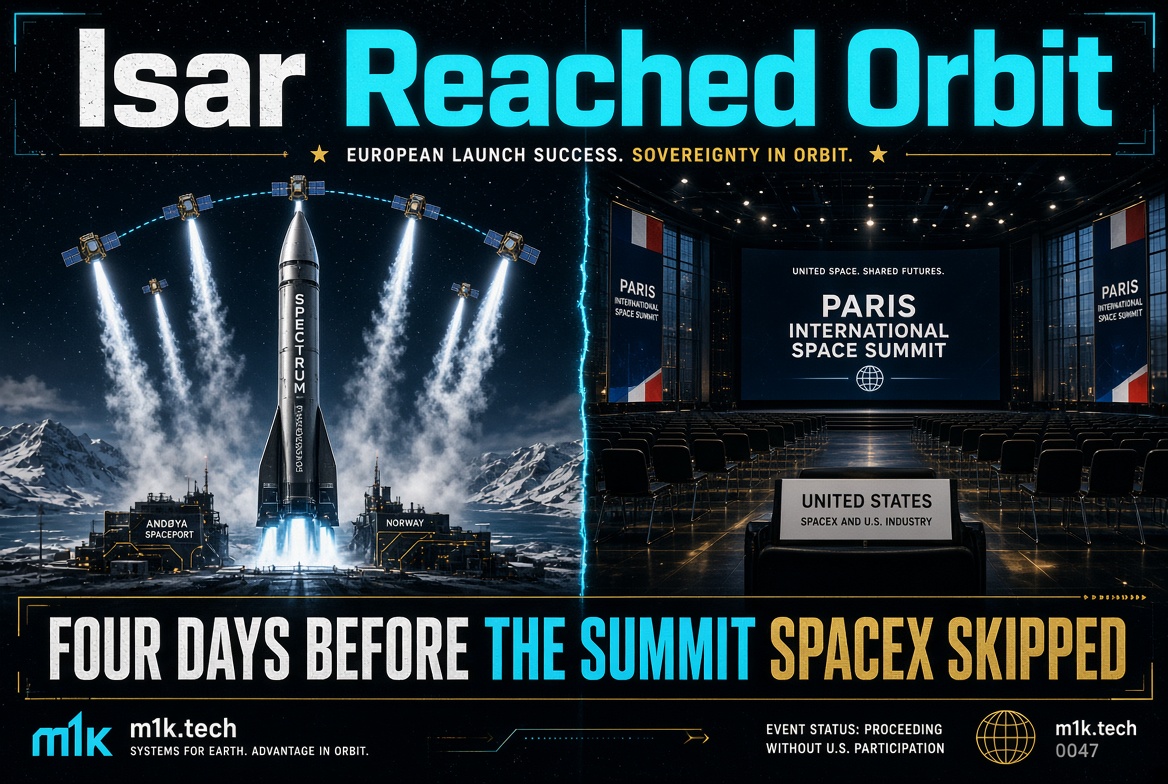
Saturday night, Isar Aerospace’s Spectrum rocket lifted off from a spaceport in Arctic Norway, reached orbit, and dropped off five small satellites and a technology experiment, the first time a privately built European rocket has managed that from European soil. Eighteen months ago, the same rocket exploded about forty seconds after its first launch from the same pad. Nobody died, Isar kept the data, and Saturday was the payoff.
The timing is what makes this interesting, not just nice. Four days before Isar reached orbit, SpaceX, Blue Origin, Stoke Space, and the orbital data center startup Starcloud told French organizers they would not be showing up to the International Space Summit in Paris, the one Macron and von der Leyen are still scheduled to headline September 9 and 10 in front of roughly 120 delegations. Nobody in Washington issued a formal order. An official from the White House’s Office of Science and Technology Policy got on a call with US aerospace executives about a week earlier, told them France organized the summit without consulting the US, accused Paris of anti-competitive practices, and suggested the whole panel structure was built to sideline American interests. The companies read that clearly enough without it being in writing, and pulled out.
What Washington is actually protecting is the ability to keep writing the rules for orbit itself, specifically the governance of low Earth orbit crowding from mega constellations like Starlink, one of the summit’s four stated priorities. The two companies most exposed to whatever rules 120 countries might agree on without American input happen to be the same two that just walked, and I don’t think that’s a coincidence worth spelling out any further.
Isar reaching orbit the same week doesn’t change the numbers Europe is actually working with. By the company’s own count, the US launched 198 rockets last year against Europe’s eight, and Isar is aiming for something like 40 a year once Spectrum is producing at scale, still a fraction of what SpaceX alone puts up in a normal month. But it’s the difference between Europe’s sovereignty argument being a slide in a keynote and being a rocket sitting in orbit with a working payload attached. I’ve watched Pasqal IPO on Nasdaq instead of selling France’s quantum champion to whoever offered the most, and I’ve watched Denmark build a sovereign AI control layer where the actual sovereignty lives in the router, not the model underneath it, and the pattern across all of it is the same: European sovereignty keeps showing up as infrastructure quietly finished while everyone was still arguing about whether it was possible, not as the panel announcing it.
German Chancellor Friedrich Merz visited Isar’s launch site back in March, which reads differently now than it did then. Supporting European autonomy is easy when autonomy is still theoretical. It means something else the week the company you showed up for reaches orbit, right as the country whose autonomy you were talking about gets told, informally but unmistakably, to stay out of a room.
I’m skeptical this changes the actual leverage math anytime soon. Eight launches to 198 isn’t a gap Isar closes just by hitting its own targets, and Isar’s second launch site is going up in Canada, which isn’t exactly a declaration of European self-sufficiency either. The Mistral and Microsoft sovereignty paradox I wrote about last month applies just as well here: wanting sovereign infrastructure and needing the incumbent’s help to build it aren’t mutually exclusive; they’re just uncomfortable to say out loud at the same summit.
Still, orbit is orbit. On Wednesday, no European commercial rocket succeeded. Sunday there is one, and the country that just tried to keep 120 delegations from setting rules without it will have to explain why staying at the table got harder exactly when it needed to look easy.
Sources
- DW, German company successfully launches rocket to space, September 6, 2026
- SpaceNews, Isar Aerospace reaches orbit on second Spectrum launch, September 5, 2026
- Tech Times, White House Pushed SpaceX and Blue Origin Out of Paris Summit to Protect Starlink, September 4, 2026
- The Next Web, Isar Aerospace reaches orbit on its second flight, a first for a European commercial launcher, September 6, 2026