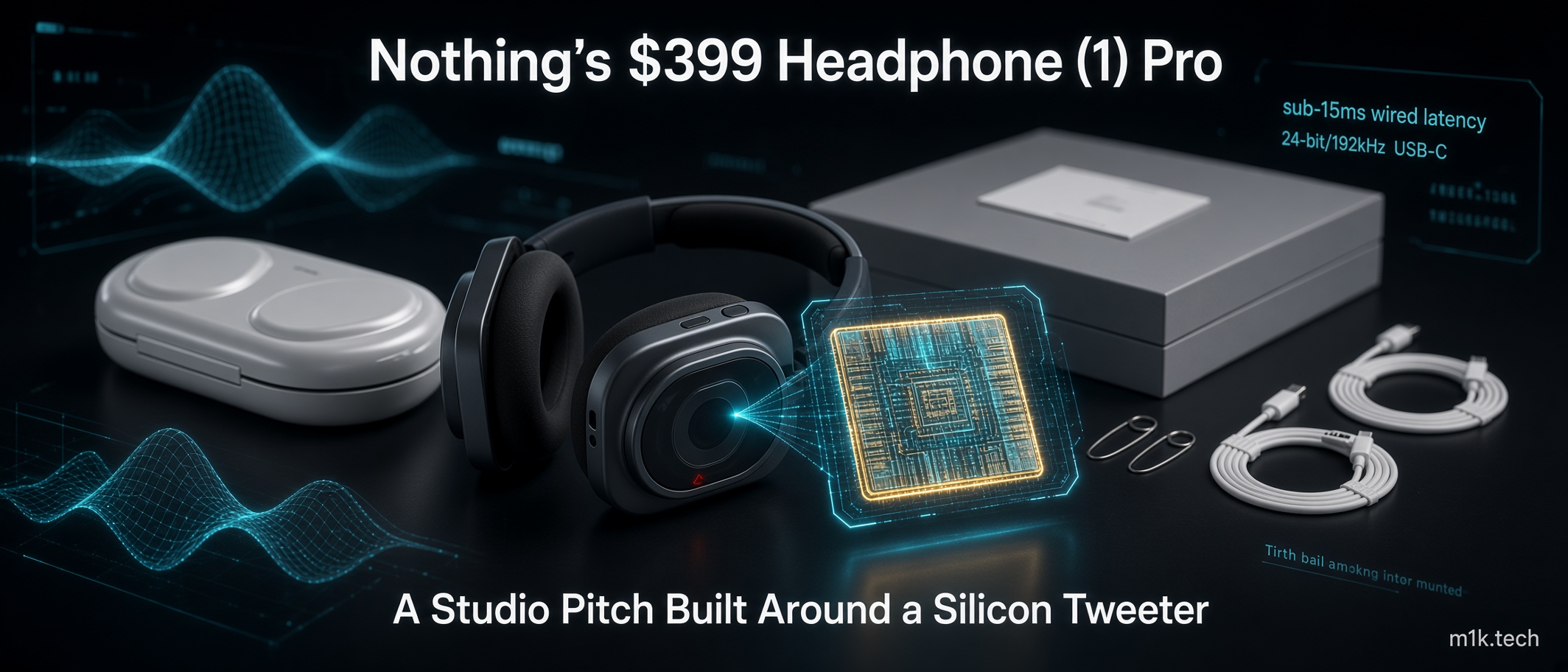
The treble driver inside the Nothing Headphone (1) Pro measures 3.2 × 6.0 × 1.15mm, and that one line is the most interesting thing on a spec sheet otherwise stuffed with studio talk. Those are, to the hundredth of a millimeter, the dimensions of the xMEMS Cowell, the solid-state silicon microspeaker xMEMS started shipping in 2024. Nothing never names the part anywhere
Cowell was the first speaker built on xMEMS’s second-generation M2 architecture, 56 milligrams of etched silicon, and until now it has mostly lived in earbuds, like the SoundPEATS Capsule3 Pro+ that turned up in my under-$100 earbud comparison. The over-ear idea isn’t new either: xMEMS and Merry Electronics demoed a two-way over-ear reference design at CES 2025 with Cowell working as a mid-tweeter next to a dynamic woofer. Nothing took that template and made it three-way. A 40mm dynamic driver covers 20Hz to 10kHz, a 13 × 8mm “precision” dynamic driver with a PEN diaphragm takes 5kHz to 15kHz, and the xMEMS unit handles 10kHz to 40kHz. Those bands overlap by several kilohertz on both seams, which tells you the crossover lives in DSP rather than in passive components, and it’s why Nothing X now lets you adjust the drivers individually. The tuning is the product here, far more than the glass.
Tiny nerd complaint while I’m in the spec table. Nothing’s marketing copy calls the tweeter’s diaphragm silicon, “95 times stiffer than plastic,” and the technical specs on its own product page list the material as “Silicone.” I’m fairly sure the second is a typo, since a MEMS speaker is etched from a wafer, not molded from rubber, and it bugs me more than it should that a company this obsessed with materials got that word wrong.
The bass driver got real work too. Nothing claims 15% more punch and 26% more sensitivity than the Headphone (1)’s single driver, thanks to a new dual-magnet system, with a PET dome carrying an electroplated metal-ceramic coating on a PEEK and PU surround. I can’t verify the percentages; they’re Nothing’s lab numbers against Nothing’s previous product.
KEF is out, a recording studio is in
Last year’s Headphone (1) launched at $299 with KEF’s name on the tuning. The Pro drops KEF entirely and brings in Metropolis Studios in London, and swapping a speaker company for a recording studio is the whole pitch in one move. The headline hardware is a physical Flat EQ switch on the inside of the left earcup that strips out coloration and processing in one flick. Metropolis also tuned a “Studio B” spatial mode meant to mimic the diffusion of its own mixing room, along with five EQ profiles for British genres (Neo-Jazz, Rock, UK Rap and Grime, Electronica, Bass) that live in the EQ Library in Nothing X.
Nobody mixes a record over Bluetooth, and the features an engineer would actually care about are wired. USB-C feeds an onboard DAC at up to 24-bit/192kHz, the 3.5mm jack takes analog at up to 24-bit/96kHz, and the one that matters most is hiding in a footnote on Nothing’s spec page: under 15ms of latency over AUX with Flat EQ on. Over Bluetooth, the best Nothing quotes is 120ms, and only paired with a Nothing phone in Game Mode. That sub-15ms wired figure is the actual pro feature. It sits in a disclaimer while the launch film stars V from BTS.
Early reviews split on what “flat” even means. Adam Doud at SlashGear flipped the switch and heard a midrange-forward signature without much bass, which is roughly what a mastering engineer means by neutral and roughly what a basshead means by broken. Another reviewer found that engaging Flat EQ quietly disables Transparency mode, leaving only ANC on or off, an odd thing to discover after you’ve paid. And the 40kHz ceiling is marketing math; as SoundGuys points out, human hearing tops out around 20kHz on a good day. My own ears gave up on anything near that a long time ago. What the xMEMS buys you, if it buys anything, is transient speed in the treble you can hear, the attack on a hi-hat or a plucked string.
Forty-six decibels, if your head cooperates
Noise cancellation climbs to a claimed 46dB from 42dB on the Headphone (1), and the microphone count goes from six to ten: three feed-forward and two feedback mics per side, backed by a new 8mm silicone baffle wall around the driver. Nothing’s own footnote calls 46dB “the theoretical maximum limit,” which is refreshingly blunt for a spec sheet.
SoundGuys put it on a test head and measured 78.2% passive isolation and 87.4% total attenuation with ANC running, which are strong numbers with a real catch attached. Their reviewer found the seal hard to get right and easy to lose, whether from chewing, talking, glasses arms, or long hair. The softer cushions (Nothing says 50% softer than the Headphone (1)) help comfort and cost some isolation, and more than one reviewer landed on “very good, still a step behind Sony and Bose.” Wind is where the ten-mic array seems to earn its keep: Doud rode a scooter at 22mph with ANC on and said the wind noise simply vanished, which is impressive and also something you should never, ever do.
The equalizer I complained about is fixed
Back in July I pulled apart the Nothing X app, and what bothered me most was the Headphone (1)’s parametric EQ: a real eight-band engine in the firmware, with the frequency ranges fenced off in the app so it behaved like a graphic EQ in costume. On the Pro, you can finally set your own center frequency for each filter. That’s how a parametric EQ is supposed to work. Add per-driver control and the Personal Sound hearing test, and this is the change that makes me want a pair more than the Panda Glass ever could.
Controls stay physical, which I love. The roller handles volume and play/pause, the paddle does tracks and calls, the Button fires ChatGPT or the camera shutter, and the new switch sits where your fingers find it without looking. Doud called it his favorite control layout on any headphone he’s reviewed, though he’s annoyed that most of it can’t be remapped. Bluetooth 6.1 brings Auracast broadcast, so the headphones can transmit whatever you’re hearing to other Auracast headphones nearby, a trick I’d only seen on pricier JBL cans. Dual connection is there too, though SoundGuys notes it swaps between two sources rather than doing true simultaneous multipoint.
A case heavier than the headphones
Battery life went backward. The 1,060mAh cell is rated for 30 hours with ANC on over AAC and 28 over LDAC, or 68 hours with ANC off. The Headphone (1) was rated for 35 hours with ANC, and SoundGuys actually ran one to 42 hours 53 minutes, while the $199 Headphone (a) claims 75. Nothing hasn’t explained the drop. My first suspect is the xMEMS itself: piezoelectric MEMS speakers are capacitive loads that want a dedicated higher-voltage amplifier a dynamic driver doesn’t need, and the Pro is also feeding ten mics and head tracking. That’s my guess, not Nothing’s explanation. Five minutes on a cable buys four hours without ANC or two with it, and a full charge takes two hours.
The case now. It’s a hardshell that swallows the earcups while the headband sticks out as a handle, and Nothing’s own spec sheet puts it at 383.5g, heavier than the 327g headphones it carries. There are strap loops but no strap, and no slot for either of the cables that do come in the box: a USB-C lead and a 3.5mm cable, plus a quick start guide. That’s the whole unboxing. Nothing clearly set out to beat Apple’s AirPods Max case, and it barely managed it. One UK reviewer called the case a potential deal-breaker, and I get it; a folding frame and a soft pouch would have been lighter and more honest about how people carry headphones. Now, release a new one with compartments and customization options; make it like a real pouch, and you can discard all the others, and you’ll get a banger! Or just release the STL and let’s go 3D printing one that matches your style and vice. This a miss opportunity, IMO.
The rest of the build is the upgrade people will actually see. Each cup is aluminum machined from a single block; the arms are a titanium alloy. Nothing says it’s 45% lighter than the Headphone (1)’s, and a 9H Panda Glass window sits over the drivers, drop-tested from 1.8m. Total weight lands at 327g, only 2g under the Headphone (1). The headband is 10% wider with 12% thicker padding; the pads pull off for cleaning, and IP52 covers dripping water, not rain. To be honest, Nothing headphones are the only ones making my ears sweaty… I’m not sure whether it’s the foam density or the material quality, but I’m curious: with all these changes, what would the results be for me?
| Headphone (1) Pro | Headphone (1) | Headphone (a) | |
|---|---|---|---|
| Launch price | $399 | $299 | $199 |
| Launched | Sept 2026 | July 2025 | March 2026 |
| Drivers | 40mm dynamic + 13 × 8mm dynamic + xMEMS | 40mm dynamic | 40mm dynamic |
| Tuning | Metropolis Studios | KEF | Nothing |
| ANC (claimed) | up to 46dB | up to 42dB | n/a |
| ANC mics | 10 | 6 | 4 |
| Battery, ANC on (AAC) | 30h | 35h | 75h |
| Battery, ANC off (AAC) | 68h | 80h | 135h |
| Weight | 327g | 329g | 310g |
At $399 the Pro walks into the most crowded shelf in audio. Sennheiser’s Momentum 5 Wireless has sat at $399.99 since June with a rated 57 hours of ANC playback, a user-replaceable 700mAh battery, aptX Lossless and eight ANC mics. That’s the one I’d cross-shop first, because it nearly doubles Nothing’s ANC battery and lets you swap the cell in three years instead of binning the whole headphone. Nothing’s edge there is the wired DAC and Auracast, plus the tweeter if you buy the pitch, none of which you’ll think about on a Tuesday commute when the battery icon turns red.
Bose’s QuietComfort Ultra (2nd Gen) still lists at $449, though Bose had it at $379 on its own store in August, and Sony’s WH-1000XM6 hovers around $448 on Amazon. Reviewers keep putting both a notch ahead of Nothing on cancellation, and neither offers a 24-bit/192kHz wired path or a free-center PEQ. Further down, Bose’s new QuietComfort Headphones (2nd Gen) launched at $359 in August and have already dipped to $319.
JBL’s Tour One M3, at $449.95, is the only rival I know of that matches the Auracast transmitter trick. Sonos, meanwhile, is selling something else entirely with the Ace Ultra, betting on its platform more than its drivers.
The competitor I’d worry about if I ran Nothing’s audio team isn’t Bose. It’s the Headphone (a), which already showed up at $165 in August sales. Doud reached the same conclusion and called the $199 model the better overall value, and it’s the exact pattern I flagged in my Ear (3a) review two weeks ago: Nothing builds a flagship, then ships a value model good enough to eat it. The Pro’s answer is mostly things the average buyer will never touch, starting with a wired path under 15ms that almost nobody will plug in. For producers and video editors, that’s the point, and nothing else at $399 bundles it with a real parametric EQ and a MEMS tweeter. For everyone else, the tiered ladder Nothing spent two years building is quietly working against its own top rung.
I’m not getting into the V campaign or the call-quality mics here; the first is a marketing story, the second deserves a proper test. And I don’t have the unit, so I will need to scout over the internet any 3rd-party reviews that talk about it.
If you don’t produce, edit, or care what’s sitting behind that glass, buy the Headphone (a) and keep the $200.
As I said, I haven’t had the Pro on my own head yet, and if I do, the xMEMS question is will be the second one I’ll check too: whether solid-state treble in an over-ear is a real shift or a spec-sheet trophy.