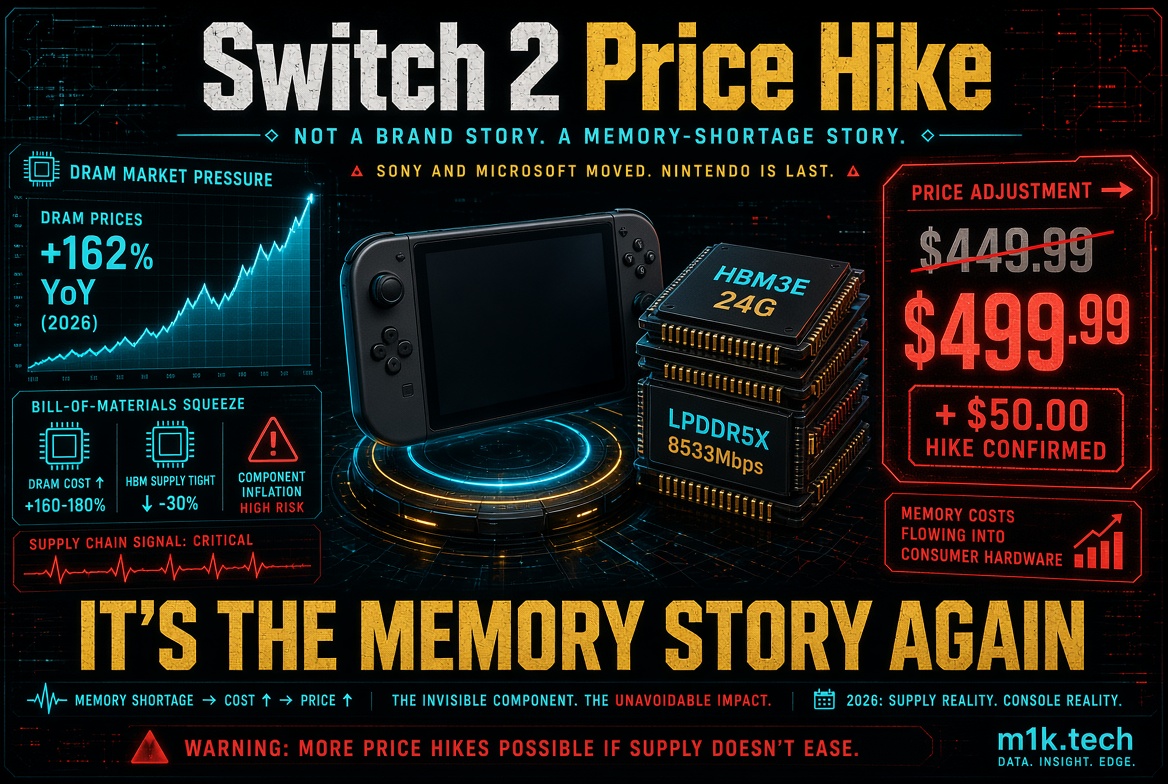
Starting September 1, the Switch 2 price increase takes the console from $449.99 to $499.99, and Nintendo is the last of the big three to move. Sony raised prices on the PS5 line back in March, blaming what it called continued pressure on the global economic landscape. Microsoft flagged its own Xbox Series X and S increases back in June, and by the time the exact European numbers landed in August, Series X and S buyers there were looking at a jump of more than a third, even as the US increase settled at a flatter $100 to $150 depending on the model. Nintendo held out the longest, and IGN’s own framing said as much before reporting the hike: an “admirable job” of keeping the price down amid rising component prices, right up until it wasn’t admirable anymore, it was just delayed.
I don’t think this is really a Nintendo story. Every bundle that let you pick a game vanished from retailers ahead of the hike, and Nintendo is rolling out two new bundles after the increase, Mario Kart World at $549.99 in late September and Switch Sports Resort at $529.99 alongside the game’s October 22 launch, that quietly reset what “the price of a Switch 2” even means going forward. That’s a company managing a price increase the way you’d expect: gradually, with new SKUs absorbing the sticker shock instead of one flat announcement.
What actually interests me is the timing against everything else I’ve been tracking this year. DRAM prices spiked hard enough by August that I wrote about Halo Studios layoffs landing the same week as the price spike, arguing gaming’s cost structure and gaming’s memory costs had become the same story. Samsung passed the same squeeze straight to phone buyers a month earlier, tacking $100 onto every foldable at Unpacked, in a rare case where the company selling you the memory is also the one paying for it. Nintendo took longer to pass the cost through than either of those, probably because a console launched at a fixed price a year ago has less room to quietly reprice components than a phone refreshed every twelve months, but the mechanism reads the same: memory got more expensive everywhere at once, and everyone downstream is taking their turn passing it on.
None of that makes $500 for a hybrid console outrageous on its own, Sony and Microsoft both moved first and by more. What bugs me is watching three companies that compete on almost nothing else this year land on the same twelve months for a price hike anyway, because none of them control the input that’s forcing it. I called this the console war back in May, and the framing still holds except now all three sides are losing the same fight. If you were holding off on the console I called exactly the sequel Nintendo needed a year ago, this week is your last shot at $449.99, and if you’re buying refurbished instead, that’s the one lever still working in your favor.
Sources
- IGN, PSA: Nintendo Switch 2 Gets a $50 Price Increase on Tuesday, August 30, 2026
- IGN, ‘Final Nail in the Coffin’: Xbox Price Rises Revealed, Leaving Fans Stunned as Series X/S Spike By More Than a Third in Europe, August 2026
- PlayStation.Blog, New price changes for PS5, PS5 Pro and PlayStation Portal, Remote Player, March 27, 2026