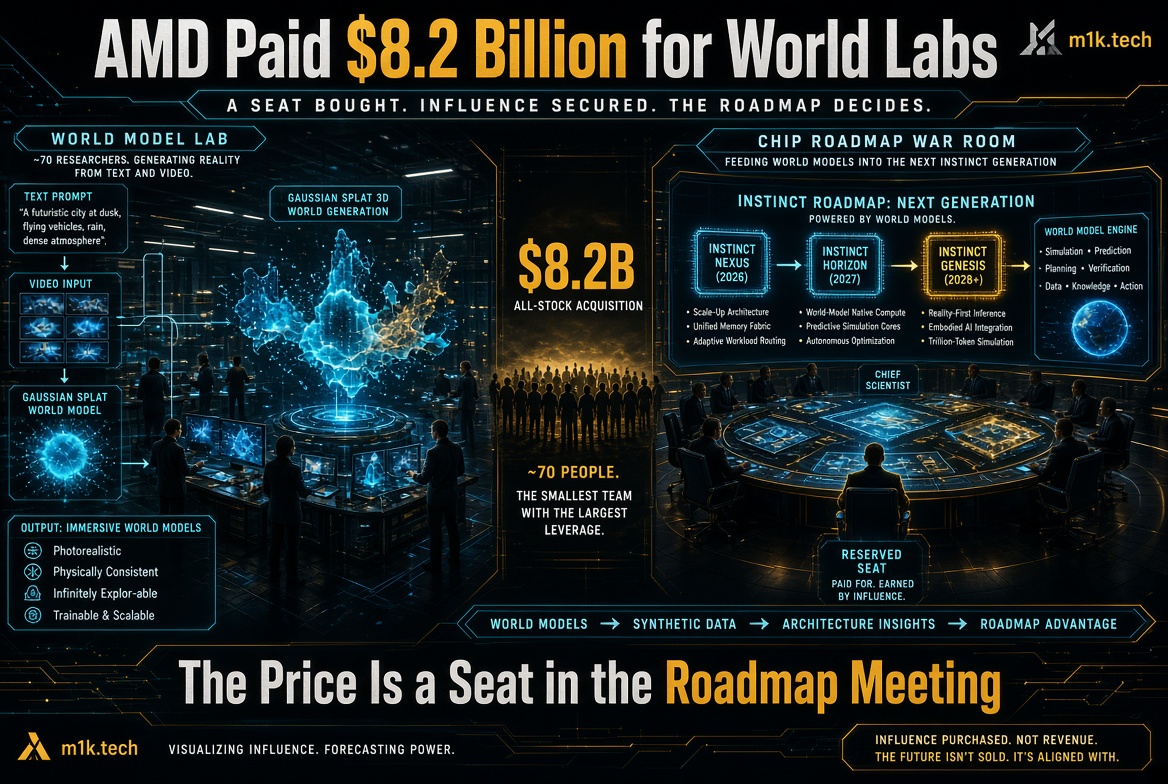
The AMD World Labs acquisition puts an $8.2 billion, all-stock price on a startup of roughly 70 people, and I don’t think that number is paying for a product. AMD announced Monday that it will buy the San Francisco lab Fei-Fei Li founded in early 2024, with the deal expected to close by the end of 2026 pending regulatory approval. Li becomes AMD’s executive vice president and chief scientist, reporting straight to Lisa Su, and the World Labs team keeps doing model research inside the company.
World Labs builds world models: software that generates, reconstructs, and simulates 3D environments from text, images, and video. Its first public tool, Marble, makes small explorable spaces out of Gaussian splats that can be exported into film and game pipelines, and the lab introduced a newer model called Atlas in early September. The stated logic for robotics is synthetic training data, and that is a field where Nvidia has a big head start with its Cosmos models.
AMD has released an open-source world model called Micro-World, but nothing resembling a stack that competes with Cosmos.
Su’s own explanation is the tell. She told Bloomberg Television that “the more you understand end to end, the better system you are going to build,” and Li wrote that without a focused hardware effort, AI is “hobbled in efficiency.” Neither sentence describes a revenue line. They describe a chipmaker paying to sit closer to the people deciding what models will look like in three years, so that the next Instinct generation gets designed around workloads AMD saw early rather than ones it inherited from someone else’s software. I find that more convincing than the robotics pitch, and also more expensive than I’d like it to be.
It fits a pattern that has been building for two months. AMD bought Taalas in August, a company betting inference doesn’t need a GPU at all, and it signed a $5 billion MI450 arrangement with Anthropic to get a frontier lab running on its silicon. Add World Labs, and AMD is collecting the buyers, the alternative architectures, and now the model researchers, which is Nvidia’s playbook exactly. I argued earlier this month that the GPU was never Nvidia’s real moat, orchestration is, and Nvidia keeps proving it by buying the software side; its agreement to acquire Hugging Face was the loudest example. AMD following that route with a $1 trillion market cap against Nvidia’s roughly $5 trillion is either sensible catch-up or an expensive imitation, and I can’t tell which yet.
The valuation is harder to explain. World Labs took in a $230 million Series A with AMD and Nvidia among the investors, then a further round of about $1 billion that Bloomberg reportedly pegged at a roughly $5 billion valuation. An $8.2 billion exit for a team of about 70 works out to something north of $100 million a head, and one read is that the lab couldn’t fund the compute race against OpenAI and Google on its own, so it sold to the one chipmaker that already had a stake and a joint inference and training partnership. AMD’s numbers give it room: record second-quarter revenue of $11.5 billion, with data center revenue more than doubling to $6.7 billion, plus Helios racks and commitments from Anthropic and Microsoft.
The open question for me is simple: whether a world-model team left to research inside AMD ever produces something that changes a chip design, or whether it becomes a prestigious lab that publishes papers while the roadmap runs on the same MI-series cadence as before. Ask me at the next Instinct announcement.
Sources
- Ars Technica, AMD acquires World Labs AI startup, upping the ante against Nvidia, September 29, 2026
- Quartz, AMD is acquiring Fei-Fei Li’s World Labs in an $8.2 billion all-stock deal, September 29, 2026
- The Decoder, AMD buys AI world model startup World Labs for $8.2 billion, September 29, 2026
- Fortune, AMD snags AI’s ‘godmother’, September 29, 2026