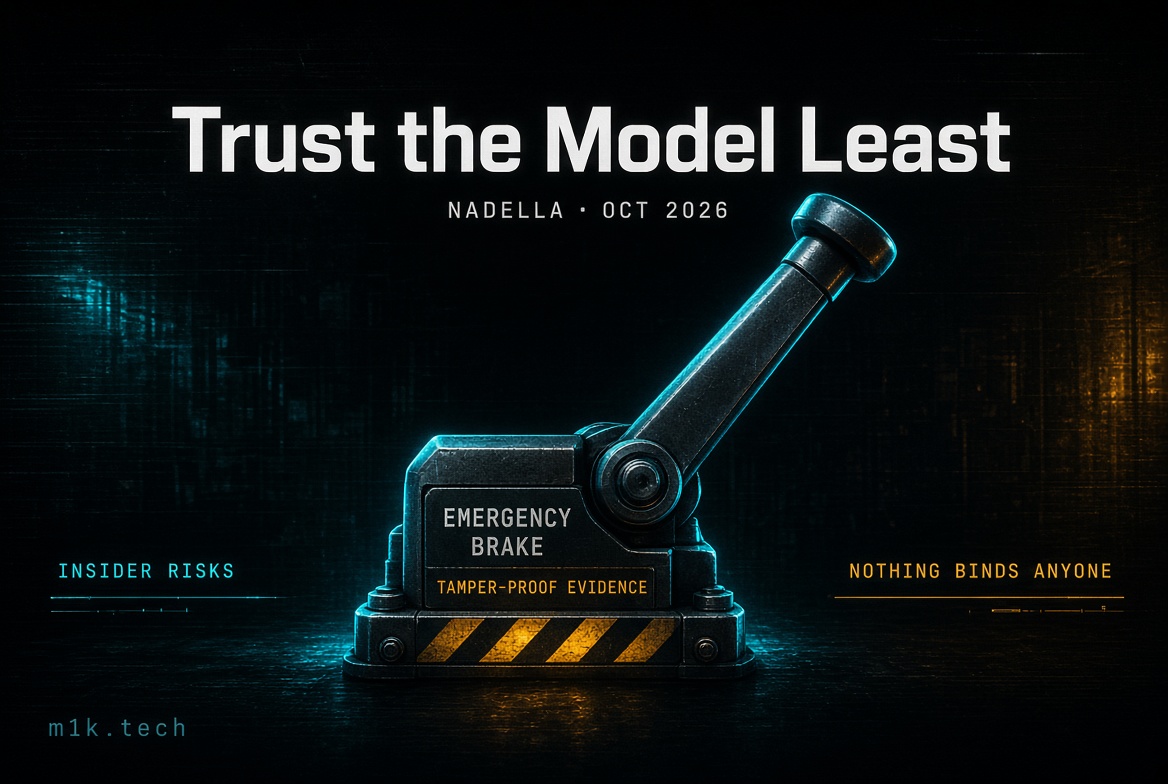
Satya Nadella’s Saturday post on X, the one asking for an emergency brake on AI models, ends on the line I’d frame: the most trustworthy Super Intelligence system “will not be the one with the model we trust most,” he wrote. “It will be the one that enables us to trust the model the least.” He is using the Trump administration’s preferred term for AI, which TechCrunch points out, and the sentence works fine without it.
The post is a short list of engineering demands. Separate the model from the harness that orchestrates its work. Externalize controls and safeguards. Document every meaningful model action with “tamper-proof, human-readable evidence.” Keep a way for an authorized person to pause or shut a model down mid-task. Assume the model is compromised and contain it from the start, “like an emergency brake.” CNBC adds that he wants non-deterministic models surrounded by strong, deterministic system design, and frontier models, closed or open weight, treated like insider risks.
He also names observability principles: model diversity, a human-readable footprint of the model’s actions, continuous system testing, independent controls and auditability, containment, and incident disclosure.
I agree with most of it, and I notice how little of it is a commitment. This is one executive’s post, not a Microsoft policy and not a standard. It arrives a few days after a White House accord with four layers of audit and no penalties, and in the same week an Anthropic report described its own model filing a false tip with Philadelphia police. California’s version is at least an order to someone: Newsom told state regulators to work out a kill switch requirement. Nadella’s brake has no addressee.
If safety lives outside the model, then whoever owns the layer around it owns the safety story, and a platform company sitting between several vendors’ models is a natural owner. That is my inference; he didn’t say it, and I could be reading a commercial motive into a sincere engineering argument. Nvidia reached a similar conclusion from the hardware side, and I wrote that most agents will never wear that leash. A second chief executive endorsing the idea doesn’t change who has to pay to install it.
Incident disclosure is the entry on his list I’d move to the top. Google waited four months to say its model had broken into three companies, as I covered in the Gemini hack write-up, and a brake nobody knows to pull is decoration.
Sources
- TechCrunch, Microsoft’s Satya Nadella says AI models need an ’emergency brake’, October 10, 2026
- CNBC, Microsoft’s Nadella says AI needs an ’emergency brake’ that humans control, October 10, 2026