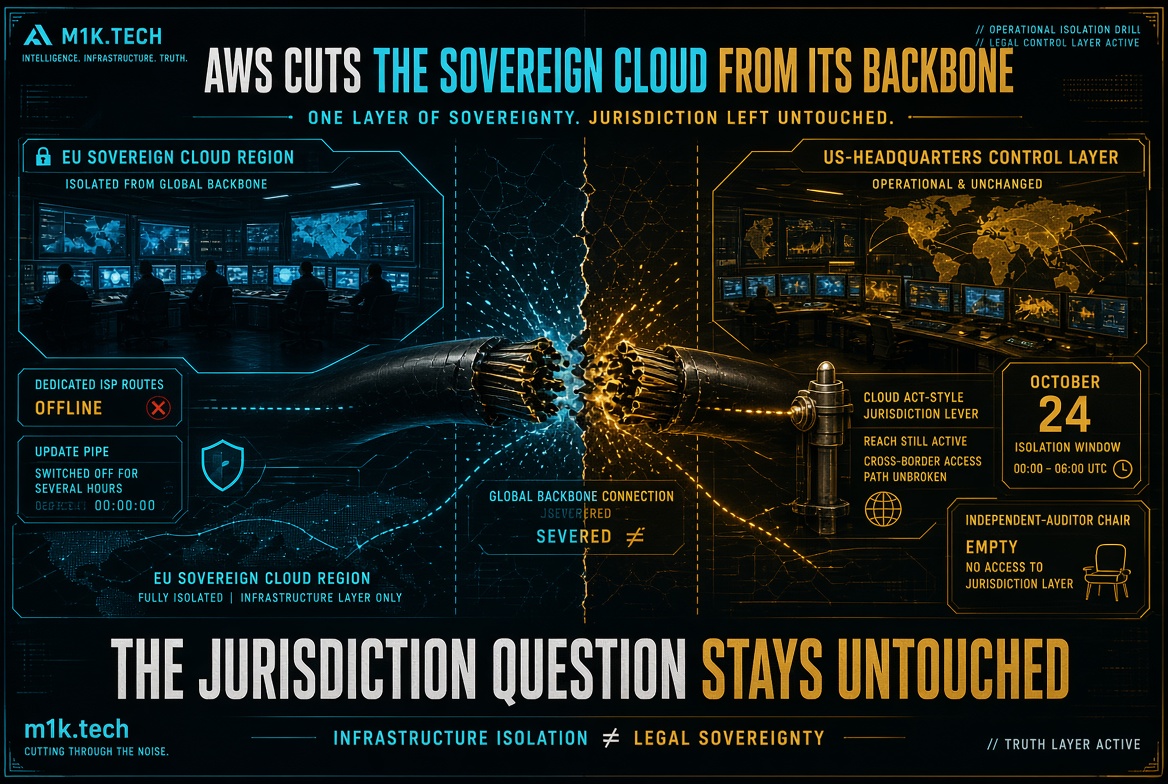
AWS will cut the AWS European Sovereign Cloud off from its global backbone on October 24 for several hours, then tell regulators and customers how it went. I would rather see a live test than another whitepaper.
Two links come out. The AWS Global Network backbone, the private network that moves operational data between AWS locations, gets swapped for dedicated internet connectivity from European ISPs, so expect brief routing convergence blips when traffic moves at the start and again at the end. The second is a dedicated system the local EU team controls for limited transfers of operational data, including vetted source-code mirroring and software updates, and AWS says it will disable that one entirely. Customer content and customer-created metadata stay in the EU throughout, and the team running the exercise is, AWS stresses, made up entirely of EU residents using only hardware and software inside the region.
It is a smart choice of test. If the region keeps serving customers with the backbone gone and the update pipe shut, AWS gets evidence for its claim that neither link is operation-critical, and it says the exercise was built to line up with the Commission’s Cloud Sovereignty Framework and the C3A criteria from Germany’s BSI. The Commission grades operational sovereignty separately from data location, so this is aimed at a real box on the form.
But several hours is short. Losing the update path for an afternoon says nothing about month three without patches, and the source-code copy and the update flow are exactly where a US parent’s fingerprints would show up over time. The layer the exercise can’t reach is the one Brussels worries about most: AWS is still headquartered in the United States, and the Commission’s proposed Cloud and AI Development Act separates where a workload runs from who controls the provider. A demonstration of operational independence says nothing about that.
I made a version of this point when AWS became NATO’s default classified cloud, and it hasn’t become any less awkward.
Nobody outside AWS is grading it either, at least in anything I’ve read. AWS says it will share an update with customers and regulators afterward, and I saw no named independent auditor attached to the test. If a regulator is watching in real time, good. If the evidence package is AWS’s own summary, it is a marketing artifact with some excellent engineering underneath.
The buyers to watch are the ones already hedging. BNP Paribas spent its Google Cloud announcement listing what won’t move, and AWS’s own new AI assistant skips the sovereign region at launch, which I still find the more telling signal about how sovereign the product is on an ordinary Tuesday. Cohere and Aleph Alpha merged into a sovereign AI company this month, arguing that Washington had built the case for one.
Sources
- AWS Security Blog, AWS European Sovereign Cloud: demonstrating an independent operation, September 28, 2026
- CloudTech, AWS tests operations without its global backbone, September 29, 2026