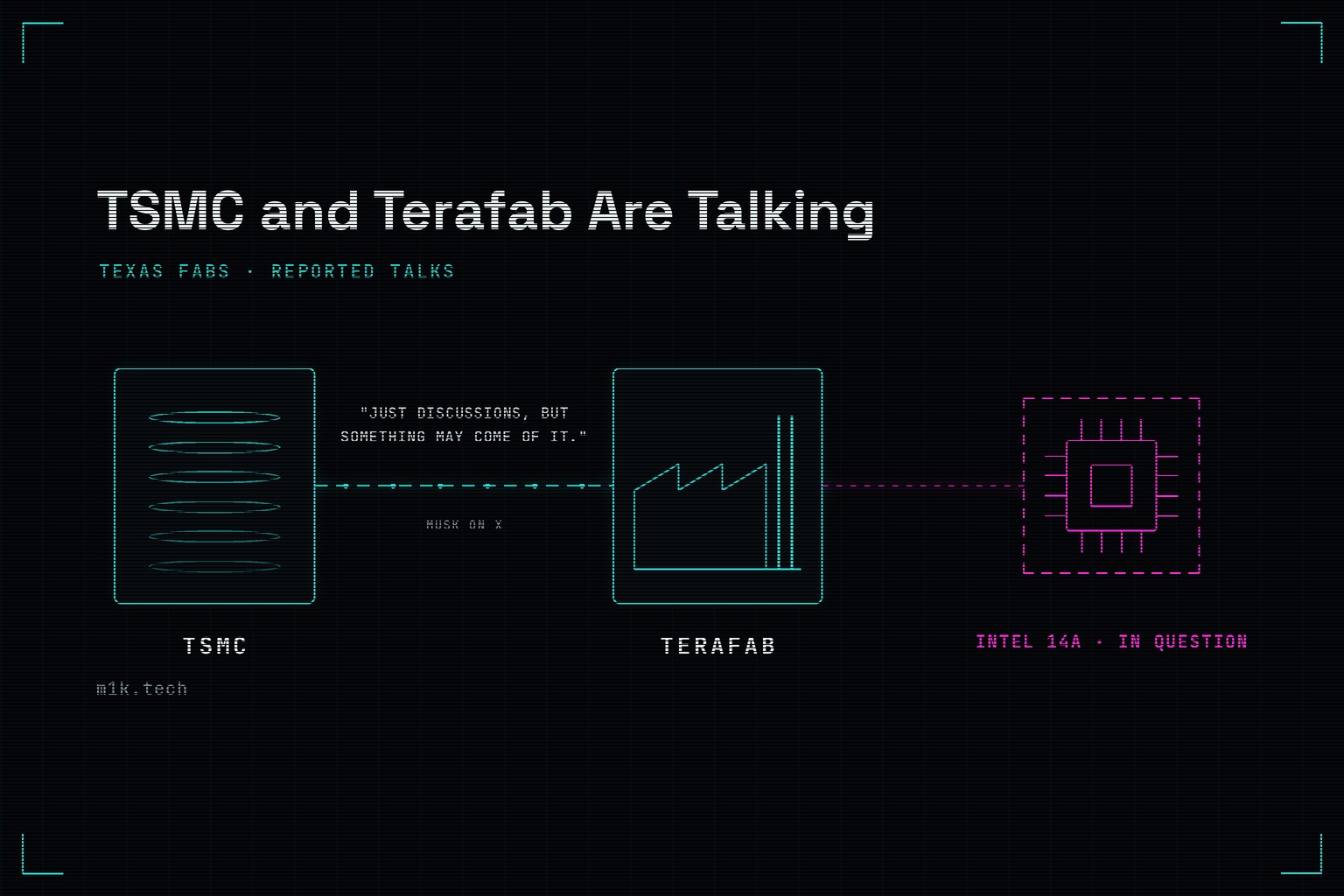
The TSMC Terafab talks are confirmed in the thinnest way possible. Tim Culpan’s Culpium newsletter reported on Friday that TSMC is exploring ways to help run the Texas factories Elon Musk’s chip venture is building, with Terafab possibly serving as the anchor customer for a new TSMC site in the state, and Musk replied on X early Saturday with a single line: “Just discussions, but something may come of it.” TSMC has said nothing. Most of Culpan’s piece sits behind a signup wall, so everything past that opening comes from follow-up coverage, mainly Tom’s Hardware, and Tom’s is explicit that the structures it describes are speculation.
Two shapes are circulating. In the first, TSMC owns and operates the plant while SpaceX or Terafab contributes capital, a guaranteed purchase volume, or both, resembling the JASM and ESMC joint ventures in Japan and Germany, where a local partner supplies money and demand and TSMC supplies process technology and operations. In the second, SpaceX holds the majority, and TSMC invests less while bringing operational expertise and its process. I find the second one more interesting, because TSMC has built its position on being the neutral foundry, and a minority operator inside a fab that exclusively serves Musk’s own companies would be something it has never been.
The awkward party is Intel. It is the only other named partner so far, supplying its 14A process to Terafab, and Tom’s points out that if TSMC arrives with its own node, 14A could drop out. I have been tracking that process since the week SpaceX’s own fab price tag moved again, and last week’s comparison of TSMC’s A14 pilot line against Intel’s 14A claims now reads differently: Intel was selling a node that a customer could weigh against TSMC’s, and the customer may be about to weigh it from the inside. That is also the context for the $20 billion stock offering Intel is using to fund its foundry bet, which assumed anchor customers would stay anchored. One more wrinkle from Tom’s, labeled as its own analysis: Intel holds a broad cross-patent license with TSMC and Terafab does not, so a fab built on an Intel-developed node could create a patent problem, giving Musk a practical reason to keep TSMC close even before any ownership stake.
I do not think Intel is out. Nothing published says so, and Tom’s itself allows for a Plan C, D, and E. Packaging is the other place TSMC could fit: Terafab might want chips made in Texas and packaged in Texas, and TSMC is a leading packaging supplier, though it is already pushing parts of its CoWoS work out to OSATs, so I would want to see which part of the packaging flow it would actually keep. What strikes me is how little evidence there is for how much attention it is getting. Until TSMC or Intel says something, this is one newsletter, one X post, and a lot of arithmetic.
Sources
- Culpium (Tim Culpan), Exclusive: TSMC Exploring Plans to Work With Elon Musk’s Terafab, October 2, 2026
- Tom’s Hardware, Elon Musk confirms discussions with TSMC about Terafab chipmaking collaboration, October 3, 2026
- TechPowerUp, TSMC Explores Collaboration with Elon Musk’s Terafab Project, October 3, 2026