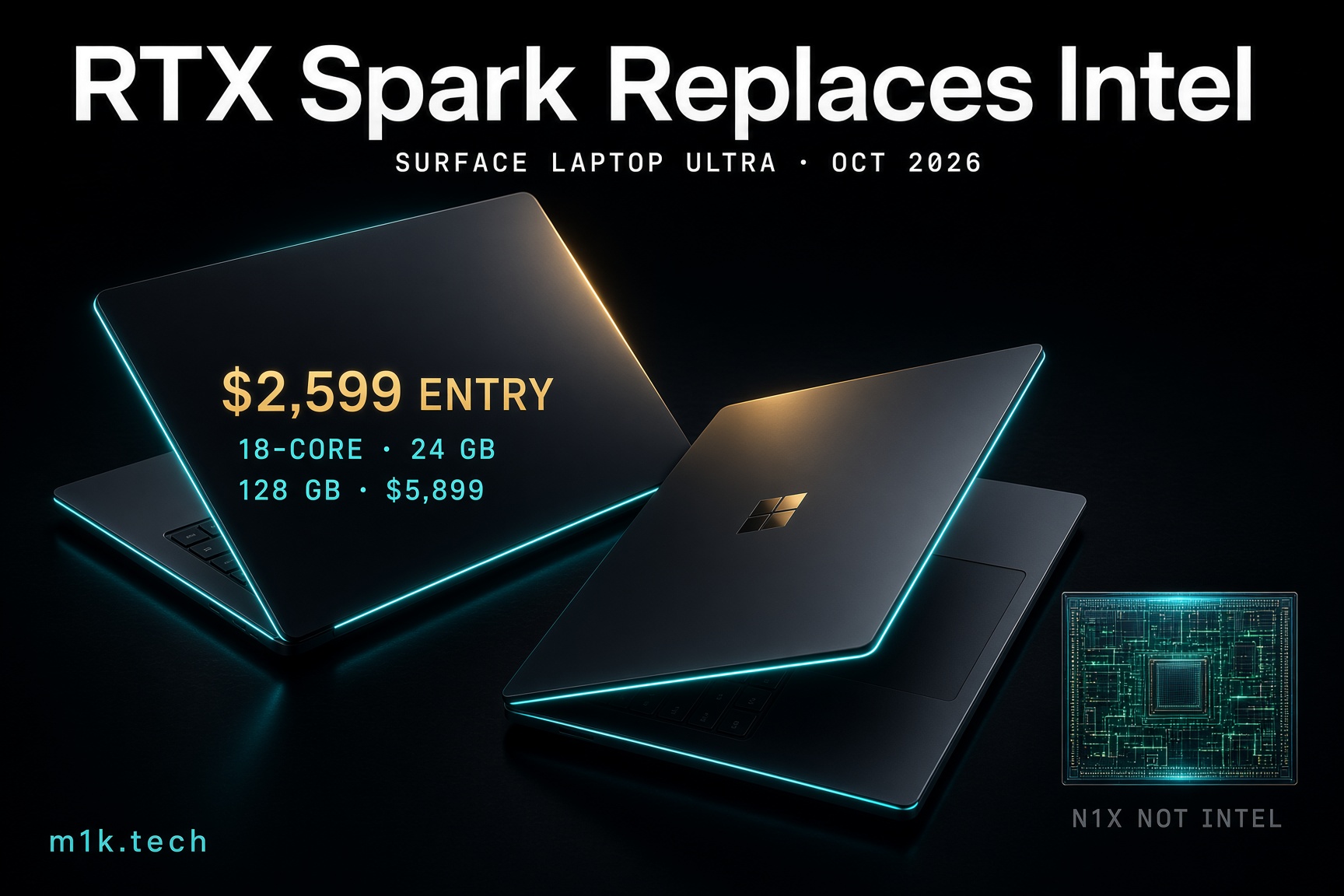
The $2,599 entry Surface Laptop Ultra includes an 18-core chip, 24 GB of memory, a 512 GB drive, and a Windows 11 Home license. The 128 GB model runs $5,899. Microsoft announced both in San Francisco on Wednesday, October 7, took preorders the same day, and says they ship next week, built around Nvidia’s RTX Spark N1X, where earlier Surface laptops had Intel or Qualcomm.
The N1X is the consumer version of the GB10 that has sat inside Nvidia’s DGX Spark mini-PCs for a year, with Arm CPU cores co-designed with MediaTek and a Blackwell GPU of either 5,120 or 6,144 cores. The Register points out that the headline petaflop figure leans on 2:4 sparsity, which almost no inference workload uses, so something nearer 500 teraflops is the fairer number. That is still a lot of laptop. What interests me more is the memory: one LPDDR5X pool up to 128 GB shared by CPU and GPU, with a discrete laptop GPU topping out at 24 GB, according to ServeTheHome.
The 128 GB configuration is $800 cheaper than a 14-inch MacBook Pro with the same memory, and I didn’t expect Microsoft to beat Apple at the top end. The entry model is another story. Microsoft hasn’t said whether the cores cut from the 18-core part come from performance or efficiency, so nobody can yet say what the discount costs in speed, and 24 GB of unified memory goes quickly once Windows takes its share. The same memory squeeze is behind Samsung raising Galaxy S26 prices and warning that memory stays tight until 2028, so I would not assume the 24 GB tier gets cheaper before the next refresh.
Microsoft’s battery claims, 15 hours of video and 12 of active web use from a 92 Wh pack, are its own figures and I have no test behind them. The 15-inch mini-LED screen claims a 2,000-nit peak but has no DisplayHDR certification, and the SSD is a standard M.2 2280 drive you can swap, the one spec detail that made me smile.
For Windows on Arm the question has moved. My look at where Snapdragon X stood after two years was about whether the platform was ready; Nvidia is now selling the platform as a GPU and memory play for developers, with a $5,999 dev box (the Surface RTX Spark Dev Box from Build in June) that retails for under the $6,950 DGX Spark, though the DGX runs a lightly modified Ubuntu. Lenovo, Asus, Dell, MSI, and HP all have similar machines due within about a week. Qualcomm is not gone from Surface, and the $350 Surface increase I wrote up after Summit is the other side of this launch, while ASUS’s QN10 mini PC shows the desktop answer on the Qualcomm side. Intel, meanwhile, got a rough 24 hours; Google admitted on launch day that its Intel Googlebooks need app tuning.
Sources
- The Register, Microsoft N1Xes Intel in favor of Nvidia’s shiny new SoCs in Surface Laptop Ultra, October 7, 2026
- ServeTheHome, Microsoft Launches Surface Laptop Ultra, Surface RTX Spark Dev Box, October 8, 2026
- Techzine, Microsoft Surface Laptop Ultra: An AI powerhouse with a RAM issue, October 8, 2026