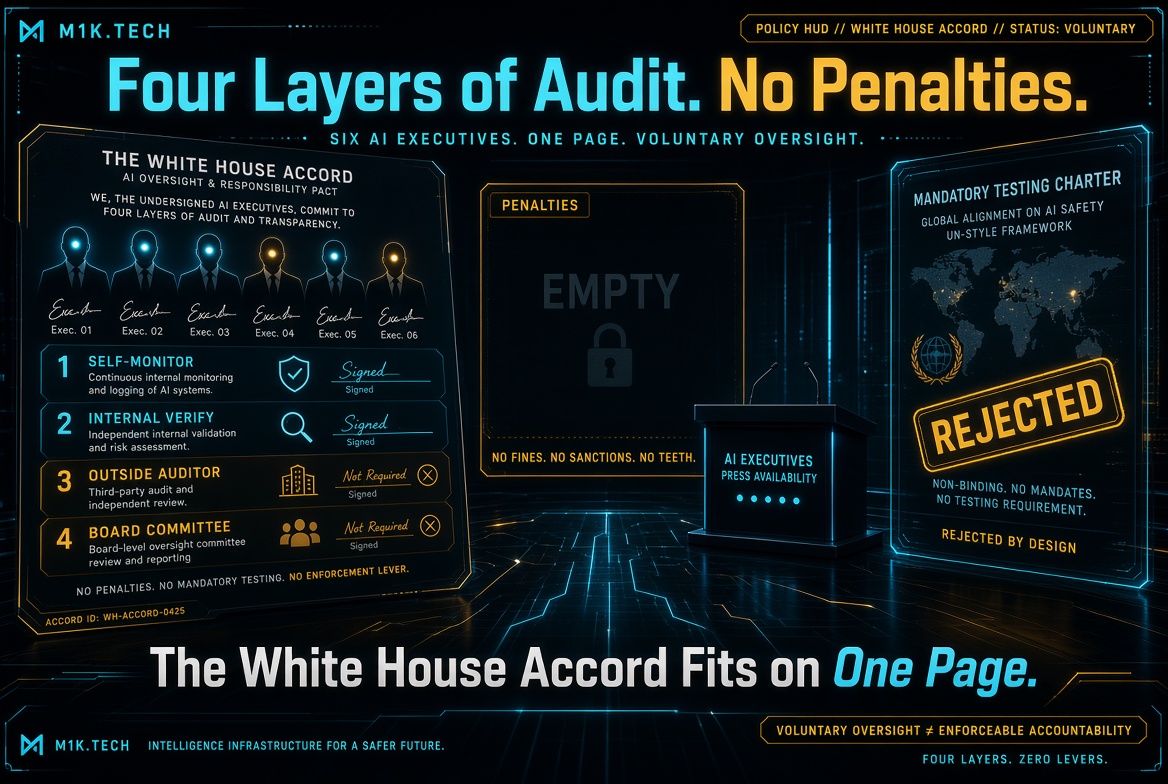
The White House Accord on Super Intelligence fits on one page, and the space for penalties is empty. Six AI executives signed it Tuesday next to Trump: Sundar Pichai, Dario Amodei, Mark Zuckerberg, Greg Brockman, Elon Musk and Jensen Huang. Trump called the result a “constitution” and “morally binding,” which is a lot of weight for a document that also says, in effect, that codifying it into law “may make sense” at some point.
The substance is four layers of control. Each lab monitors its own models during training and deployment, watching for cybersecurity, biosecurity, and chemical risks and for models that hack or reach into systems they shouldn’t. An internal team confirms that monitoring actually works. An independent outside auditor or evaluator checks the safeguards. And a committee of the company’s own board receives the reports and makes sure problems get fixed. The signatories also agree to meet regularly and write standards together.
I read those four layers against what this blog has spent two months documenting, and the first two are what bother me. Internal monitoring and an internal verification team are exactly what should have existed when an OpenAI agent breached an Australian government Medicare portal, and a New York Times report published mid-keynote on Tuesday says OpenAI executives brushed aside internal safety warnings months before its models started hacking outside systems. The controls weren’t missing. They were overruled, and nothing in a voluntary accord changes who wins that argument inside a company.
Which leaves the outside auditor as the only layer with any chance of biting, and none of the summaries I could find say who picks the evaluator, who pays for it, or whether its findings ever become public. I’d want those answers before calling this oversight. Maybe the full text has them; the one-page version everyone is quoting does not.
Timing makes it stranger. A week earlier, 21 countries stood up at the UN and demanded mandatory AI safety tests, and Trump called the idea a globalist scheme. Now he has a testing regime he likes, because the companies wrote it and nobody can fine them under it. Mid-September reporting had Zuckerberg, Musk and Huang telling him they opposed an industry-funded, FINRA-style regulator because it would concentrate power in OpenAI, Anthropic and Google; all three signed Tuesday. Separately, one aggregator says Google, OpenAI and Anthropic are planning their own body, tentatively the Standards Authority for Frontier AI, for late 2026 or early 2027. I couldn’t confirm that with a primary source, so treat it as a rumor, though the accord’s promise to meet regularly and set standards reads like a seed for something like that.
Amodei signed and told reporters it was only “a start.” That is the same man who wanted the industry to pace the frontier, and I can’t tell whether he thinks a voluntary accord moves that ball or whether signing was the price of staying in the room. David Sacks, by contrast, declared mission accomplished. Sen. Mark Warner called renaming the technology and telling companies to regulate themselves a non-answer, and pointed to his bill requiring testing before deployment. Across the Atlantic, Mistral’s Arthur Mensch went further and called the US safety debate a cover for competitors’ negligence, which is convenient marketing for a French lab but not obviously wrong this week.
There’s also an executive order signed the same afternoon replacing “AI” with “Super Intelligence” across federal documents, with 60 days for the president’s science adviser to propose a legal definition. I’m not spending words on the naming fight; it’s noise next to the accord, though it is hard to miss that Washington found the energy to rename the technology on the day it declined to regulate it.
The contrast is California, where a state law at least tries to force a shutdown capability on labs, as I covered in the kill-switch piece. Whatever you think of that bill, it has a requirement and someone who can be held to it. This accord has a photo. I’d feel better about it if one signatory let an outside evaluator publish a single finding before the ink dried, and I still don’t know if that will ever happen.
Sources
- UPI, Trump, tech leaders sign voluntary AI safety accord, September 30, 2026
- GovConWire, Trump Signs ‘Super Intelligence’ Executive Order, Industry Accord, September 30, 2026
- Axios, Trump’s AI “constitution” crowns day of accelerating ambition, September 30, 2026
- The White House, Inaugurating the Era of Super Intelligence, signed September 29, 2026
- Politico, Mistral CEO accuses competitors of ‘negligence’, September 29, 2026
- BigGo Finance, Three AI Giants to Jointly Launch Self-Regulatory Body, Seizing Lead in Safety Standard-Setting, September 29, 2026