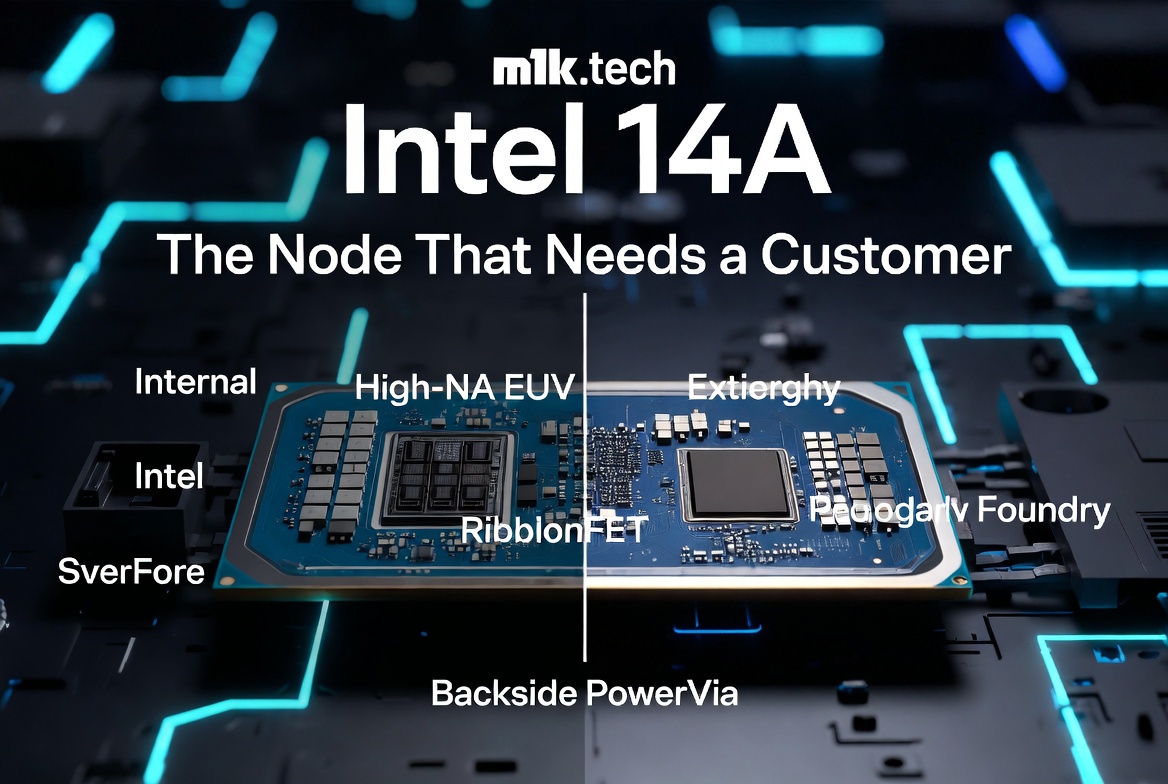
Intel 14A is the next node after 18A, it uses the High-NA EUV machines that cost a third of a billion dollars each, and Intel has said something out loud about it that no chipmaker says about a leading-edge node: that it might not build it. Not because the technology is impossible, but because 14A only makes financial sense if outside customers commit to it, and if they do not, Intel has signaled it may stop developing leading-edge process at all. 14A is the first node in Intel’s history whose existence depends on someone other than Intel wanting it.
The technology is the next escalation of the light itself. 14A uses High-NA EUV, a new generation of the extreme-ultraviolet machines with a wider aperture that prints even finer features, the most expensive tools ever pointed at a wafer. It builds on the RibbonFET and PowerVia that 18A brought to production, refining the gate-all-around transistor and backside power into a second generation. On paper 14A is where Intel’s bet compounds, where being early to backside power turns into a sustained lead, the node that finally puts Intel back in front the way 22nm once did. On paper.
The honest framing, the one Intel itself has started using, is that 14A is a business decision before it is an engineering one. Building a leading-edge node now costs more than Intel’s own products can justify alone; the volume is not there without external customers, and the foundry-grade work that started at Intel 3 has to turn into signed, high-volume commitments or the math does not close. Intel has effectively told the market that 14A needs anchor customers to exist, which is an extraordinary thing for the company that once treated foundry work as beneath it. The king is not just learning to serve. It is admitting it cannot survive at the leading edge without customers to serve.
None of this happens in a vacuum, and the vacuum is the problem. TSMC is not slowing down, it is extending its lead in the AI chips that are the whole game now, and a customer deciding where to build its most important silicon has every reason to stay with the foundry that has not missed in a decade. Intel’s pitch is real, a Western alternative, leading-edge features, government backing, but real is not the same as chosen. The customers Intel needs for 14A are the most conservative buyers in technology, spending billions on chips that cannot fail, and asking them to trust Intel’s newest node is asking them to bet against TSMC’s reliability. That is a hard sell even with better technology.
What 14A actually decides is whether Intel Foundry was a real strategy or a long, expensive detour. If the customers come, if 14A gets the commitments it needs and 18A proved Intel can execute, then the company that lost the lead in 2019 claws all the way back and becomes the second pillar the entire industry wanted, a leading-edge foundry that is not in Taiwan. If they do not come, Intel steps back from the leading edge, becomes a design company that buys its manufacturing like everyone else, and forty years of process leadership ends not with a failed transistor but with a customer who said no. The node is the test. The answer is other people’s.
Standing in early 2026, this is genuinely unresolved, and anyone who tells you they know how it ends is selling something. Perso, I want Intel to make it, a world with one leading-edge foundry is a worse and more fragile world than one with two or three, and the engineering in 18A earned more benefit of the doubt than Intel has had in years. But want is not the same as bet, and the pattern of this whole story is a company that kept being certain right up until it wasn’t. Intel owned the leading edge for forty years and treated serving others as beneath it. Now its survival at that edge depends entirely on convincing others to let it serve them. The metronome that never missed taught Intel it was the best. 14A is where it finds out if anyone still agrees.