NVIDIA’s Blackwell B300 is moving into production, and yields are stabilizing. That is not an interesting story. The interesting story is the bottleneck that sits between Nvidia and the demand it cannot fill fast enough: CoWoS, the advanced packaging technology manufactured by TSMC that connects the GPU die to HBM3e memory stacks on a single substrate.
What CoWoS actually is
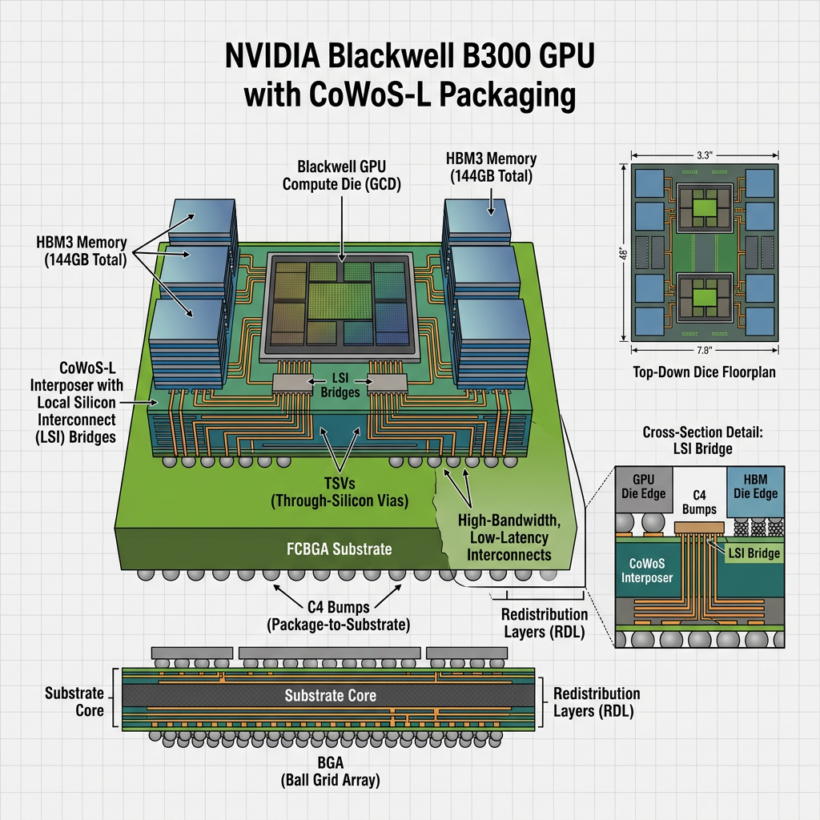
Chip-on-Wafer-on-Substrate is the packaging method that makes modern AI GPUs possible. TSMC manufactures the B300 die on its 4NP process, but the chip alone is not the product. The product is the package: GPU die plus six stacks of HBM3e memory, all mounted on a silicon interposer that provides the high-bandwidth connections between them. Without CoWoS, you have a GPU that cannot communicate with its memory fast enough to perform useful AI work.
TSMC is the only manufacturer capable of producing CoWoS at scale, and every major AI chip, from Nvidia’s Blackwell to AMD’s MI300X to Google’s TPUs, depends on it. The capacity is finite, and Nvidia consumes the majority of it. When Nvidia says it is supply-constrained, it is usually not talking about the GPU die. It is talking about CoWoS.
The 2026 production picture
Reports from the supply chain indicate that B300 yields have stabilized at commercially viable levels, which means the die itself is no longer the constraint. TSMC is expanding CoWoS capacity, but the ramp takes quarters, not weeks. The gap between what Nvidia can sell and what TSMC can package is the binding constraint for the entire Nvidia ecosystem, from data center GPUs to the RTX Spark consumer SoC.
SK Hynix, which supplies the HBM3e memory stacks that go onto every B300 package, posted record quarterly profits driven entirely by AI demand. The supply chain is healthy at the memory layer. The chokepoint is packaging, and it will remain the chokepoint through at least the second half of 2026.
Why this matters for the market
CoWoS scarcity creates a structural advantage for Nvidia: if TSMC’s packaging capacity is constrained and Nvidia books most of it, competitors like AMD and Cerebras face longer lead times even if their chips are ready. The xAI Colossus buildout, which consumed roughly $18 billion in GPU purchases, was limited not by budget but by how fast TSMC could package Nvidia’s chips. Every hyperscaler building AI infrastructure faces the same constraint.
For the data center boom in Chicago and the Midwest, CoWoS is the upstream bottleneck that determines how fast racks can be filled. You can build the building, run the power, and install the cooling. If the GPUs are not packaged yet, the racks sit empty.
The AI hardware story in 2026 is not about chip design. The designs are excellent. It is about packaging, power, and cooling, the physical infrastructure that turns silicon into deployed compute. CoWoS is the least glamorous and most important link in that chain.