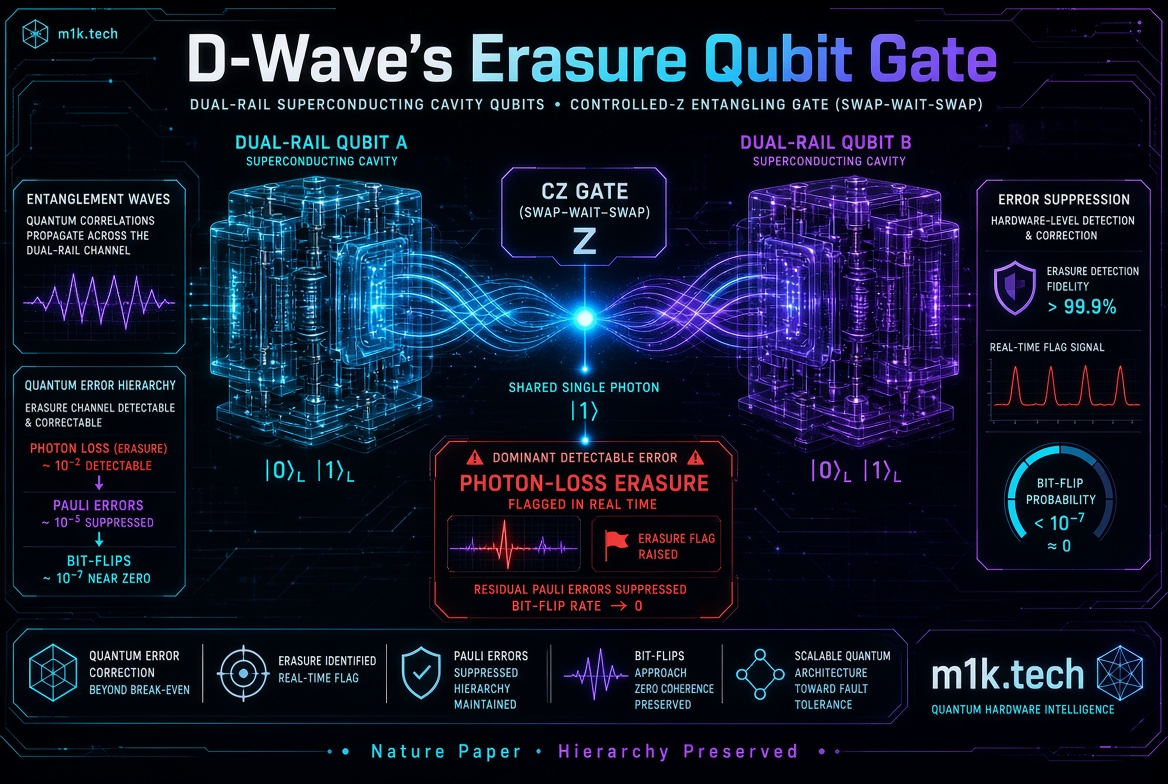
D-Wave’s erasure qubit paper landed in Nature this week with a good fidelity number: 99.9% on a two-qubit entangling gate, clocked at roughly 500 nanoseconds, built on a superconducting architecture the company calls dual-rail. That’s the headline every press release is running with. I don’t think that number matters most here.
What dual-rail erasure qubits actually buy you is a different error hierarchy. In most gate-model architectures, a qubit can fail in ways you don’t immediately know about, and catching those failures requires generic error-correction overhead, extra physical qubits stacked on top of the ones doing the actual computing, just to figure out that something went wrong and where. D-Wave’s approach is designed so the most common failure mode shows up as a flagged, known-location erasure the hardware detects natively, when it happens, rather than something inferred after the fact. Fewer unknowns per error means less overhead spent finding them, and that overhead is the part of quantum computing that’s actually been the bottleneck for years, not raw qubit count.
My first reaction was skepticism, because D-Wave’s whole identity for over a decade has been annealing, a computing model that never had to prove it could run universal gate-model algorithms, and the people building IBM’s, IonQ’s, and Quantinuum’s machines have spent that decade treating D-Wave’s advantage claims as a separate, lesser conversation happening somewhere else. A peer-reviewed Nature paper is a different bar than a press release, though, and the gate described in it is already integrated into D-Wave’s own systems, according to chief scientist Robert Schoelkopf, who isn’t a marketing hire. He’s one of the physicists who helped invent circuit quantum electrodynamics at Yale, which is the theoretical foundation most superconducting qubit hardware runs on today. When he says the architectural principles hold up, that carries more weight than the company’s usual press cycle.
D-Wave’s simulations, built on this gate, suggest the dual-rail architecture could cut the logical error rate by roughly a factor of ten for each added increment of error correction, a ratio the company calls Lambda. Its public roadmap targets a 100-logical-qubit system capable of more than a million operations, and it aims to get there by 2032. Every other lab racing toward useful quantum computing right now is really racing on a different axis than the one next to it. IBM is chasing bookings and logical-qubit count at once, Infleqtion just put 50 logical qubits into a Chicago facility on a neutral-atom architecture, and PsiQuantum is betting an entire South Chicago campus on photonics paying off years from now. D-Wave’s bet is narrower and, on paper, more honest about the actual constraint: it’s optimizing for how cheaply you can correct errors as you scale, not for how many qubits you can put on a chip this quarter.
None of this happens in a vacuum, either. Government money is chasing every one of these bets at once, whether it’s the billion dollars IBM has booked or France racing to keep its own quantum startups from getting bought out from under it before they prove which architecture wins. Nobody backing this field yet knows which physical qubit type ends up in the machine that actually does something nobody can do classically. That’s still true after this paper.
The number worth remembering from this whole announcement isn’t 99.9%. It’s 2032. That’s six years out, and quantum computing roadmaps have an unbroken habit of sliding to the right when the calendar actually arrives. I don’t know if dual-rail erasure qubits end up being the architecture that wins this, and I don’t think D-Wave fully knows either, not in a way that isn’t partly a bet on itself. What I do know is that the company spent a decade being the answer nobody in gate-model circles wanted to hear, and it just published in the same journal the field’s acknowledged leaders use to make their own claims. That alone is worth sitting with for a minute before the next press release resets the clock.
Sources
- D-Wave Quantum Inc., “D-Wave Demonstrates Major Hardware Breakthrough for Quantum Error Correction”, August 5, 2026
- Nature, “An entangling gate for dual-rail erasure qubits”, published online August 1, 2026